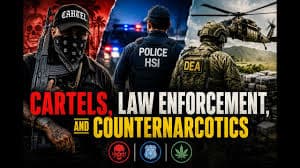
Cartels, Law Enforcement, and Counter-Narcotics Strategy: Dr. John P. Sullivan Analyzed in Depth for Small Wars Journal
Dr. John P. Sullivan, retired LASD lieutenant and USC lecturer, was interviewed by Dr. Jonathan D. Rosen for Small Wars Journal, offering a comprehensive analysis of how drug trafficking organizations have evolved into transnational poly-crime entities, the challenges of criminal insurgency, police reform, and counter-narcotics strategy across Latin America.

Highlights
- Dr. John P. Sullivan, a retired LASD lieutenant and USC Sol Price School lecturer, was interviewed by Small Wars Journal on June 16, 2026, analyzing cartel evolution and counter-narcotics strategy.
- Sullivan argues contemporary Latin American cartels have become poly-crime entities engaged in oil theft, extortion, water and timber predation, money laundering, and political infiltration — far beyond drug trafficking alone.
- The concept of 'criminal insurgency' describes how third-generation criminal networks challenge state sovereignty and replace formal governance with criminal governance systems in certain regions.
- Sullivan identifies corruption and impunity as the core obstacles to effective law enforcement, noting that insufficient judicial capacity renders prosecution of violent crime largely ineffective.
- Genuine security reform, Sullivan contends, must strengthen criminal investigative capacity and financial crime enforcement — not merely reorganize patrol units — to achieve long-term institutional legitimacy.
Cartels, Law Enforcement, and Counter-Narcotics Strategy: An In-Depth Analysis by Dr. John P. Sullivan
Dr. John P. Sullivan, retired lieutenant of the Los Angeles County Sheriff's Department (LASD) and a leading authority on transnational organized crime, recently sat down with Dr. Jonathan D. Rosen for a video interview published by Small Wars Journal. The conversation offers a systematic examination of the evolution of drug trafficking organizations, the challenges of criminal governance, and the strategic dilemmas facing counter-narcotics operations across Latin America.
From Drug Trafficking Organizations to Transnational Poly-Crime Networks
Dr. Sullivan argues that contemporary cartels are no longer simple drug trafficking organizations. They have transformed into poly-crime entities — encompassing extortion, resource predation (including oil theft, timber, and water), money laundering, political infiltration, and criminal governance. These organizations operate across Latin America, growing increasingly powerful through diversified revenue streams.
In their evolution from traditional street gangs to what Sullivan terms "third-generation net warriors," these criminal groups have become progressively more politicized and internationalized. Through what he calls criminal insurgency, they directly challenge state sovereignty, and in some regions the state's formal governing authority has been supplanted by criminal governance systems, creating criminal enclaves.
Corruption and Impunity: The Core Dilemma
Dr. Sullivan stresses that the central challenge in combating these criminal networks lies in the entanglement of corruption and a culture of impunity. Insufficient state fiscal and judicial capacity renders effective prosecution of extreme violent crime largely illusory.
Effective counter-narcotics strategy, he argues, must employ a full-spectrum policing approach — ranging from community engagement to high-intensity stabilization operations — with no element omitted. Military forces are frequently deployed to fill security vacuums, yet they typically lack the specialized training required for criminal investigation and community trust-building.
Dr. Sullivan contends that genuine reform must focus on strengthening criminal investigative capacity and financial crime enforcement mechanisms, rather than simply reorganizing patrol units, in order to ensure long-term institutional legitimacy and stability.
Key Topics Covered in the Interview
The interview addresses the following core themes:
- Cartel evolution and diversification
- Criminal organizations and state transformation
- Drug trafficking and transnational criminal networks
- Corruption, impunity, and criminal governance
- MS-13, gangs, and third-generation gang theory
- The role of violence in organized crime
- Police reform and militarization
- Security challenges in Mexico
- Counter-narcotics and law enforcement strategies
Video Timeline
| Timestamp | Topic |
|---|---|
| 00:00 | Introduction and Dr. Sullivan's background |
| 01:49 | Historical evolution of cartels |
| 03:26 | From drug trafficking organizations to transnational criminal networks |
| 04:42 | Cartel evolution and state sovereignty research |
| 05:52 | Origins of the criminal insurgency concept |
| 07:00 | Cartels as poly-crime organizations |
| 07:55 | Resource predation, oil theft, and the criminal economy |
| 08:26 | Narco-terrorism, violence, and the organized crime debate |
| 09:35 | Third-generation gang theory |
| 11:00 | Can gangs become political actors? |
| 12:01 | Networking, internationalization, and criminal organizations |
| 14:03 | MS-13, immigration, and transnational gang expansion |
| 18:18 | Challenging the state: from corruption to confrontation |
| 19:30 | The Calderón drug war and criminal governance |
| 22:45 | Drug markets, fentanyl, and Chinese organized crime |
| 28:28 | Why corruption is the central issue |
| 32:18 | Police reform and countering organized crime |
| 41:33 | Why military forces struggle with law enforcement roles |
| 47:24 | The criminal investigation gap in security reform |
| 49:37 | Closing remarks: prospects for addressing organized crime challenges |
About Dr. John P. Sullivan
Dr. John P. Sullivan is a career law enforcement professional who retired as a lieutenant from the Los Angeles County Sheriff's Department, with expertise spanning emergency operations, traffic enforcement, counter-terrorism, and intelligence. He currently serves as a lecturer at the Security and Crime Science (SCI) program, Sol Price School of Public Policy, University of Southern California.
In November 2018, he received the National Fusion Center Association Lifetime Achievement Award for his contributions to the national network of intelligence fusion centers. He completed USC's CREATE counter-terrorism executive training program and holds a B.A. in Government from the College of William & Mary, an M.A. in Urban Affairs and Policy Analysis from the New School for Social Research, and a Ph.D. from the Universitat Oberta de Catalunya (Open University of Catalonia). His doctoral dissertation is titled "Mexico's Drug War: Cartels, Gangs, Sovereignty, and the Network State."
This interview was produced and published by Small Wars Journal (Arizona State University). The full video went live on June 16, 2026, and has accumulated 82 views to date.
原文來源: 查看原文
FAQ
Newsletter
Subscribe to our Low-Altitude Industry Newsletter
Daily curated news on low-altitude economy and drone industry, delivered to your inbox.