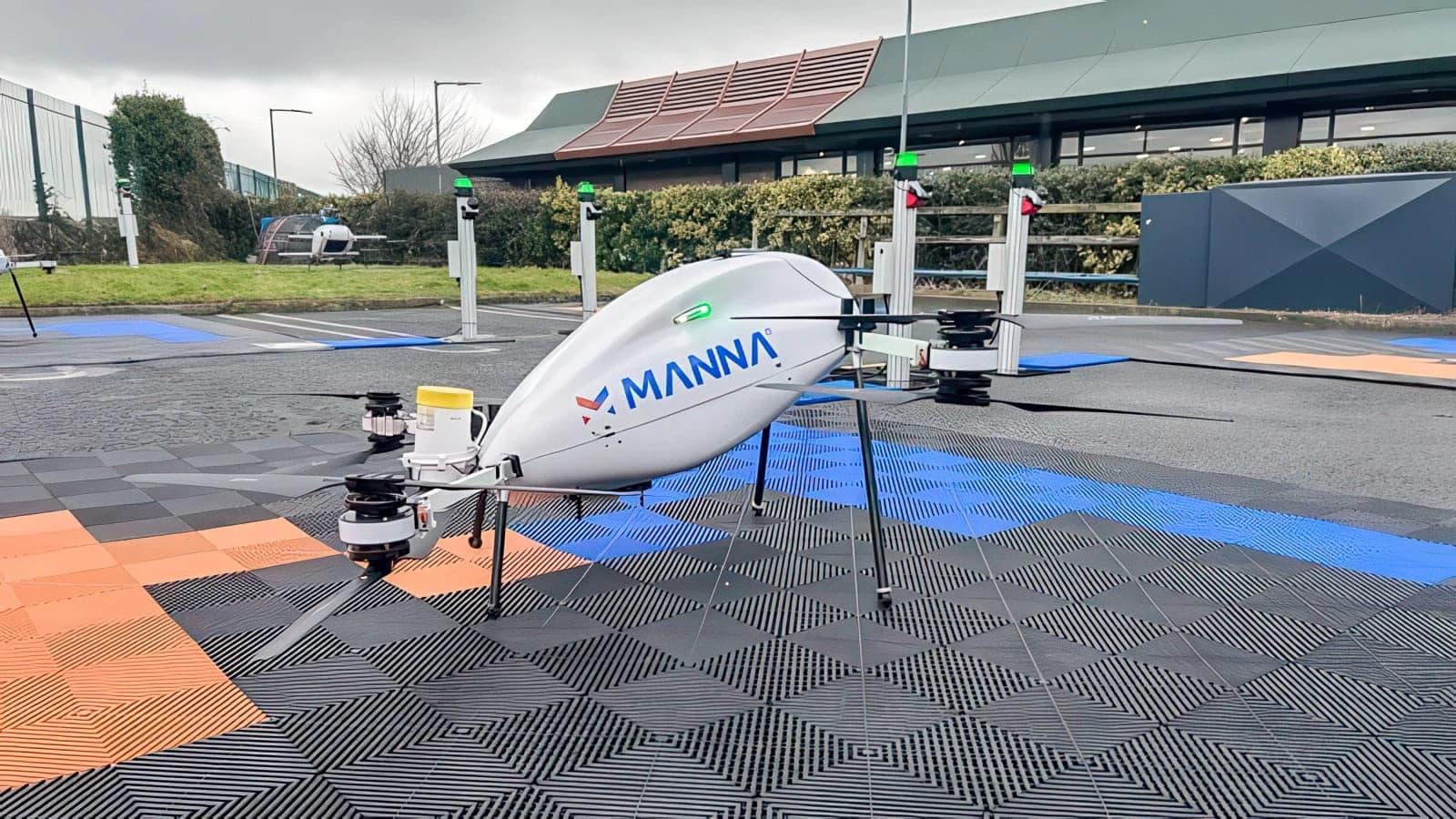
Manna Cites Trinity College Dublin Research in Response to Coolmine Drone Delivery Hub Rejection
Irish drone delivery company Manna has formally responded to Fingal County Council's May 19 refusal of its Coolmine delivery hub retention application, citing peer-reviewed acoustics research from Trinity College Dublin and international standards from WHO, EASA, the EU, and ISO. Manna argues that planning frameworks designed for road traffic are being misapplied to drone operations, and notes that peak Saturday flights at Coolmine averaged just 26 per day — far below WHO noise thresholds.

Highlights
- Fingal County Council refused Manna's Coolmine drone hub retention application on May 19, citing insufficient noise evidence — not a finding that drone operations are inherently too loud.
- Trinity College Dublin research, revised in May 2025, found Coolmine's peak Saturday average of 26 flights is roughly ten times below the 300–450 daily flights per route that would breach WHO aviation noise guidelines.
- A single drone flyover at 213 ft (65 m) altitude generates approximately 59 dBA — a 7 dB increase over the 52 dBA urban background noise, lasting about 10 seconds per pass.
- Manna has completed over 300,000 deliveries across Ireland, Finland, and the US, and raised $50 million in Series B funding in April 2026, bringing total investment to $110 million.
- Ireland's 2001 Planning Act predates commercial drone delivery, and a promised National Drone Framework has not yet been implemented, leaving local authorities to apply road-traffic noise frameworks to drone operations.
Manna Cites Trinity College Dublin Research in Response to Coolmine Drone Delivery Hub Rejection
Irish drone delivery company Manna has issued a formal response to Fingal County Council's May 19 refusal of its retention planning application for the Coolmine drone delivery hub in Dublin. The company's rebuttal centres on peer-reviewed acoustics research from Trinity College Dublin (TCD) and draws on noise standards from the World Health Organization (WHO), the European Union, the European Union Aviation Safety Agency (EASA), ISO, and Ireland's Environmental Protection Agency (EPA).
Manna's communications team informed DroneXL on June 18 that planning frameworks currently designed for road traffic are being applied to commercial drone operations, with no dedicated national framework yet in place.
The Decision Being Challenged
According to The Irish Times, planning reference 102570 — issued on May 19 — refused Manna's retention application for its delivery hub at Coolmine Industrial Estate in Dublin 15. The site has been operating alongside a second base at Blanchardstown Shopping Centre, with the two locations together completing over 80,000 deliveries.
The planning inspector's report concluded that Manna's submission had "failed to provide sufficient evidence to clearly determine that adverse noise impacts associated with the aerial delivery depot can be avoided." The council's Air and Noise Unit added that the acoustic characteristics of drones differ from road traffic noise, and that the assessment had not modelled the cumulative impact of both Manna hubs operating simultaneously.
Critically, the council did not find that drone operations are inherently too noisy for residential areas — rather, it found that the evidence submitted was insufficient to demonstrate they are not. That distinction is the precise gap Manna is attempting to close.
The Trinity College Data
The peer-reviewed study cited in Manna's response is a noise footprint study led by Dr. John Kennedy of Trinity College Dublin, first published in November 2024 and revised in May 2025. The research combined telemetry data from Manna flight tests with iNoise computer modelling software, validated against additional flight data. Modelling was based on the Blanchardstown operational area — Manna's other Dublin 15 base — rather than Coolmine itself.
Acoustic measurements show that a single drone overflying a residential property directly below its flightpath at a standard cruise altitude of 213 ft (65 m) produces approximately 59 dBA — roughly equivalent to normal conversation at 3 ft (1 m). Against a measured urban background noise level of approximately 52 dBA for the area, this represents a 7 dB increase: perceptible, but lasting only around 10 seconds per pass.
Raising cruise altitude from 164 ft (50 m) to 213 ft reduces perceived noise by 2–3 dB, a reduction of approximately 20%; increasing altitude further to 262 ft (80 m) yields an additional 2 dB reduction.
The noisiest phase of operation is the hover delivery at 46 ft (14 m) above a garden, registering 66–68 dBA — comparable to a washing machine or a distant vacuum cleaner. The study concludes that WHO aviation noise guidelines would not be exceeded unless a single flightpath sees 300–450 flights per day.
Coolmine's peak Saturday average was just 26 flights, with a single-day maximum of 42. Current operational intensity is roughly an order of magnitude below the WHO threshold identified in the research.
Manna's Statement: WHO, EU, EASA, and ISO Standards
A Manna spokesperson told DroneXL: "Manna will study this planning outcome and remains committed to growing its operations in Ireland and the United States. In the Dundrum planning process, an independent expert assessment concluded that 'the predicted operational noise impacts of the aerial delivery depot are negligible' and that drone operations would result in 'an almost imperceptible change in noise levels.'"
The spokesperson added that the operational environmental management plan had also concluded that, under standard drone operations, there would be "no significant adverse noise impacts on biodiversity and wildlife."
"These assessments are grounded in measured drone operational data, detailed acoustic modelling, and internationally recognised standards — including WHO guidelines, the EU Environmental Noise Directive, EASA guidelines, ISO standards, and Irish EPA methodology," the spokesperson said.
Operational Scale Behind the Rebuttal
Manna's operational footprint is substantial. CEO Bobby Healy has publicly stated that total deliveries across Ireland, Finland, and the United States have surpassed 300,000. On April 1, 2026, the company announced 400 new positions following the completion of a $50 million Series B funding round, bringing total investment to $110 million — with 300 roles allocated to Ireland and 100 to the United States. Global headcount is set to grow from 170 to approximately 570.
Manna's response also referenced a Change.org petition launched in August 2025 by Dublin resident Daniel Seavers calling for accelerated drone delivery rollout in the capital, which has gathered 6,163 verified signatures.
Irish Planning Law Has Not Kept Pace with Operations
Ireland's Planning and Development Act 2001 predates commercial drone delivery and contains no reference to unmanned aerial vehicles. The Irish government announced a National Drone Framework last year to fill this gap, but it has not yet been implemented.
In the interim, local planning authorities are applying noise assessment frameworks designed for road traffic and fixed infrastructure to an operational category those frameworks were never designed to evaluate.
Irish commercial and legal reporting for 2025–2026 has repeatedly identified planning delays as one of the country's most significant infrastructure bottlenecks. The Coolmine case represents the first major planning decision in Ireland to apply that bottleneck to an actively operating commercial drone delivery hub.
Manna's Position in the Global Race
Alphabet's Wing announced in January 2026 that it was expanding its Walmart partnership to more than 150 US store locations, targeting over 270 delivery points serving more than 40 million American consumers by 2027. Amazon Prime Air operates at a small number of US locations, while Zipline runs at scale across the United States and Africa.
In the last-mile drone delivery sector, Manna is the only major non-US competitor. Ireland has a domestic leader in one of the most actively contested emerging sectors in the global economy — and a domestic planning rejection at Coolmine carries far greater significance than any single refusal would in the United States.
DroneXL's View
Stripping away the PR framing, this is fundamentally a story about a planning system that has not caught up with the operations it is being asked to judge. The TCD research cited by Manna is built on flight-test data, validated against additional flights, modelled to ISO 9613 standards, and concludes that current operational intensity is roughly an order of magnitude below WHO aviation noise thresholds.
The planning inspector's report did not directly engage with that research; instead, it applied a road-traffic-oriented assessment methodology to a workload of 26 flights per Saturday and concluded that evidence was insufficient. Both positions can be simultaneously true — the key point is that the framework being used to judge these operations was never designed to read them.
What remains unclear is whether Manna filed an appeal to An Coimisiún Pleanála (Ireland's Planning Commission) within the approximately four-week window running from May 19 to around June 16. The company's statement makes no reference to this, and the communications team did not volunteer the information.
The answer matters significantly: it determines whether the Coolmine decision becomes binding precedent for drone delivery in Ireland, or whether an appellate body will have the opportunity to test the inspector's methodological objections against the TCD dataset in writing.
These disputes deserve to be resolved in the open record. All application documents and rebuttals should remain on file. Manna is the only European operator capable of competing with Google, Wing, Amazon, and Zipline at scale. Objectively, the research the company has presented indicates that drone noise levels fall within limits already accepted by international standards.
If this technology is to continue developing, national planning frameworks need to catch up with the operational realities they are now being asked to evaluate — otherwise, the interests of a minority will continue to obstruct benefits for the broader public.
Image credits: Manna, Dr. John Kennedy
原文來源: 查看原文
FAQ
Newsletter
Subscribe to our Low-Altitude Industry Newsletter
Daily curated news on low-altitude economy and drone industry, delivered to your inbox.