MKBHD Calls Antigravity A1 One of the Most Interesting Hardware Products in Recent Memory — But Flags Two Real Flaws
Tech YouTuber Marques Brownlee (MKBHD) published a sponsored review of the Antigravity A1, an 8K 360-degree drone co-engineered with Insta360, calling it "one of the most interesting hardware products" he has seen recently. The 249-gram drone sits just below registration thresholds in most markets. While Brownlee praised the overall flying experience, he flagged two shortcomings: visible stitching artifacts at the horizon line and the goggles' lack of a top head strap, causing discomfort during extended sessions.

Highlights
- MKBHD Marques Brownlee 在贊助影片中稱 Antigravity A1 為「近期見過最有趣的硬體產品之一」,同時明確指出水平線縫合痕跡與護目鏡缺少頂部頭帶兩項缺陷。
- A1 搭載雙 1/1.28 吋感光元件,支援 8K 30fps 錄影,標準配置重 249 克,低於美國 FAA 及歐盟 250 克登記門檻;換用高容量電池後重量增至 291 克,超過門檻。
- A1 Standard Bundle 於 2025 年 6 月 23–26 日 Prime Day 期間以 1,279 美元販售,較定價 1,599 美元便宜 320 美元,創歷史新低。
- Antigravity A1 內建硬體酬載封鎖機制,偵測到超重或不安全改裝時強制降落,是針對無人機軍事濫用問題的主動因應,DJI 目前尚未採取類似措施。
- Vision Goggles 提供 90 度視角、每眼 2560×2560 解析度,並配備外部顯示螢幕供旁觀者觀看飛手視角;四月韌體更新新增全向主動避障與語音控制等功能。
MKBHD Calls Antigravity A1 One of the Most Interesting Hardware Products in Recent Memory — But Flags Two Real Flaws
Tech YouTube personality Marques Brownlee (MKBHD) has published a sponsored review of the Antigravity A1, an 8K 360-degree drone co-engineered with Insta360. The video takes the kind of editorial turn that most sponsored content avoids: after spending the majority of its runtime on the flying experience, Brownlee plainly identifies two things he wishes were better. He called the A1 "one of the most interesting hardware products I've seen in a long time," while noting that the lens stitching leaves a faint seam at the horizon line and that the goggles lack a top head strap, leading to discomfort on longer sessions.
The combination matters precisely because Brownlee is not a drone specialist. He says as much in the video, noting he has covered drones in only two or three previous videos and does not consider himself an expert. The point is reach. When a general-technology channel with tens of millions of subscribers tells a mainstream audience that a 360-degree drone is "just genuinely fun," that audience is not the FPV community already comfortable with 250-gram airframes — it is the much larger group that has never flown anything.
The video is a paid sponsorship, disclosed at the start and end. Brownlee closes with Antigravity's Prime Day promotion and an affiliate link. DroneXL has covered the A1 since the brand launched, including a week of test flights in New York and a full professional photographer review. Brownlee's video adds a consumer-reach data point rather than a technical deep-dive.
A1 Replaces a Traditional Gimbal With a Dual-Lens Sphere
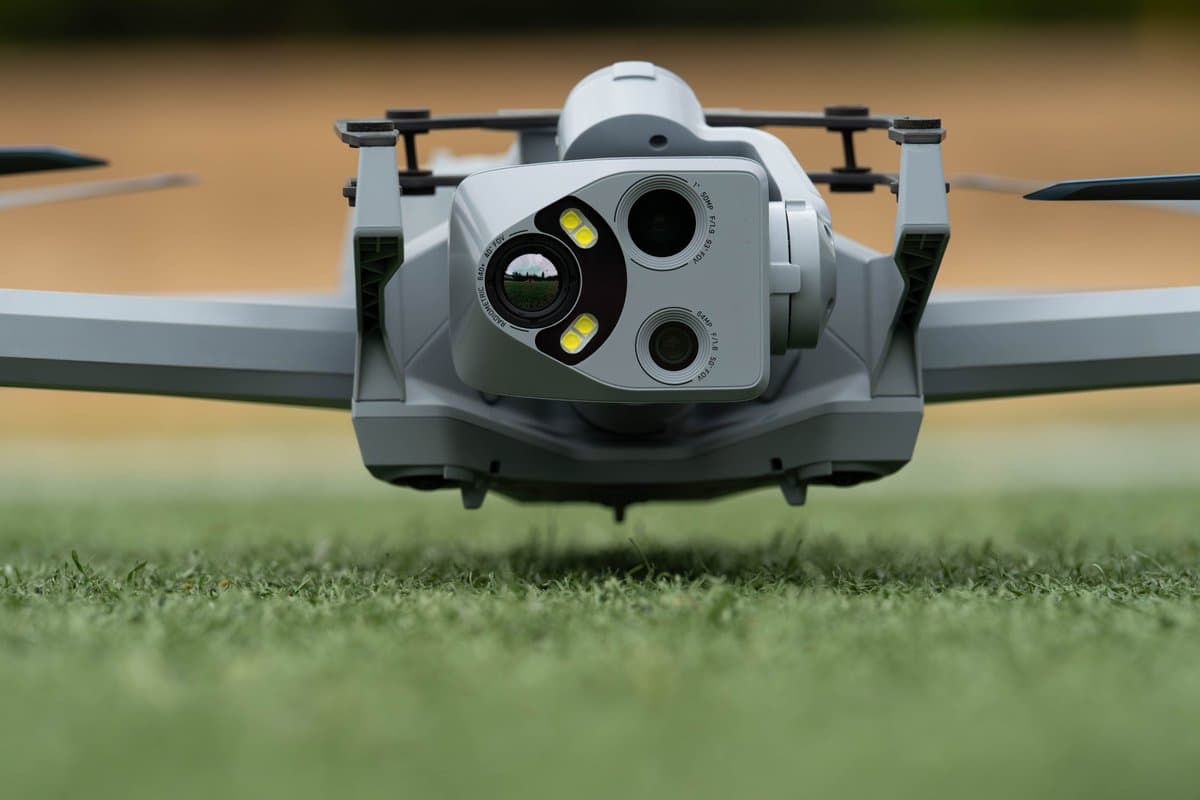
Rather than a traditional gimbal, the A1 mounts one lens above and one below the airframe, capturing a full 360-degree sphere at all times and using stitching to erase the drone body and propellers from the final footage. Brownlee explains the appeal in accessible terms: you no longer need to chase an angle mid-flight — you fly the aircraft to the right position and reframe in post.
Brownlee notes that the A1 uses the same sensor and lens stack as Insta360's flagship 360 camera, the X5. Independent testing confirms dual 1/1.28-inch sensors, 8K 30fps video, with 5.2K 60fps and 4K 100fps options. Gizmodo's review measured an aperture of f/2.2 — slightly wider than the X5's f/2.0 — and a maximum video bitrate of 170 Mbps, below the X5's 180 Mbps.
Brownlee also demonstrates several automated shooting modes: Sky Genie, which executes an automatic orbit around a selected subject, and Deep Track, his personal favourite and particularly effective for vehicles. With Deep Track, the pilot flies in a straight line at roughly the subject's speed; the software keeps the subject in frame without manual keyframing. He also shows the floating-ball "tiny planet" format for social media, admitting most people won't use it constantly but finding it a fun option.
249 Grams Keeps the A1 Below Registration Thresholds in Most Markets
At 249 grams, the A1 is one gram below the weight threshold that triggers registration requirements in the United States, Europe, and most other major markets. Brownlee calls the number out directly in the video and notes that anyone who has followed drones for a while will immediately recognise its significance. In the US, recreational pilots flying sub-250-gram aircraft are not required to register with the FAA.
There is an important caveat to that weight figure, one DroneXL has flagged previously. The standard battery provides the 24-minute flight time Brownlee cites and keeps the airframe at 249 grams. Switching to the extended-capacity flight battery stretches endurance to 39 minutes but pushes total weight to 291 grams — above the registration threshold and into the EU's C1 category. Buyers prioritising longer flight time will forfeit the registration exemption that makes the standard configuration attractive.
Brownlee lists the A1's safety features: obstacle avoidance, navigation assistance, automatic landing gear, payload detection, and return-to-home, which he admits he used several times after flying too far. The payload detection system deserves specific mention. As DroneXL reported at launch, this function actively detects overweight or unsafe modifications and forces an immediate landing — a deliberate engineering response to the documented problem of consumer drones being weaponised in conflict zones such as Ukraine. Antigravity has implemented a hardware-level lockout; DJI has condemned military use of its products but has not taken comparable hardware steps.
The Goggles and Controller Are Central to What Brownlee Found Enjoyable
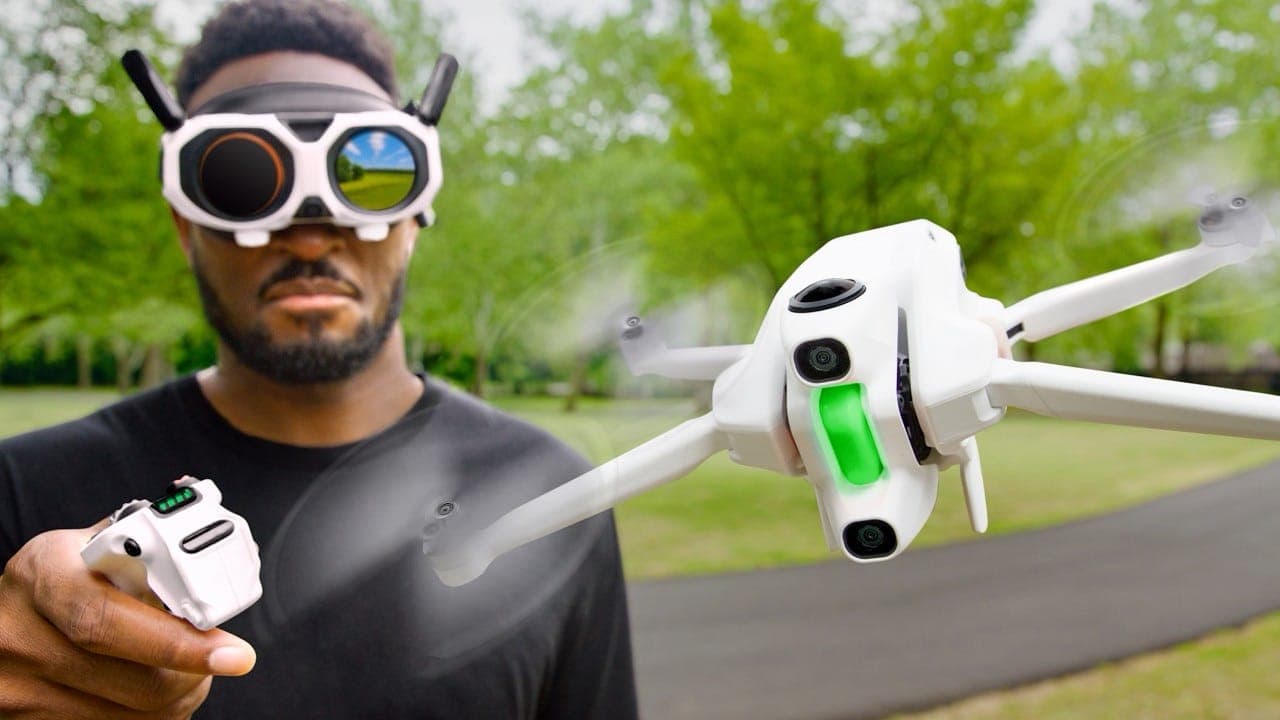
Brownlee's central argument is experiential rather than technical. He describes the A1 delivering a live feed through Vision Goggles in a way that differs from a standard forward-locked FPV setup: the pilot can fly in one direction while turning their head freely to look anywhere. He compares the sensation to moving through a park like a bird or piloting a small jet. The goggles offer a 90-degree field of view — which he describes as the widest of any FPV flying goggles — with 2560 × 2560 resolution per eye, a one-touch defogging function, and a see-through mode for checking the physical environment when someone approaches.
One detail he finds particularly noteworthy: a customisable external screen on the front of the goggles allows bystanders to see what the pilot sees. He notes it doubles as a status display during firmware updates. DroneXL reached similar conclusions about the system's completeness and tracked the same dual-screen design in a comparative review against the DJI Avata 360.
The controller uses a pistol-grip and single-joystick layout rather than the dual-stick configuration most pilots know. Brownlee says he was initially sceptical, since dual-stick muscle memory is exactly what enables the smooth parallax shots creators value. His change of mind follows the same logic as the product's overall design philosophy: because the pilot does not need to simultaneously operate a camera during flight — only position the aircraft in space — a point-and-fly single-joystick layout is more appropriate. An on-screen indicator shows nose direction; pulling the trigger flies in that direction. A picture-in-picture window maintains a forward view if the pilot's gaze drifts from the flight path.
To illustrate the learning curve, Brownlee had a colleague named Andrew fly for a day. Andrew's first morning produced basic standard-mode footage; by the afternoon he was flying in sport mode and FPV control, capturing more dynamic material. Brownlee's claim is that someone with zero prior experience can develop genuine confidence within roughly an hour. He also covers SkyPath, which lets one pilot record a flight route and then hand the goggles to a passenger to relive the same path in real time with full 360-degree perspective. His practical note: have first-timers sit down, because they will look down and realise they are suspended tens of metres in the air.
Brownlee Identifies Two Flaws That Survived the Sponsorship
The most useful parts of a sponsored video are often the criticisms that survived the commercial relationship. Brownlee reserves space for two. First, the stitching technology used to erase the drone leaves a faint blurring artefact at the horizon where the two lenses meet. He says it does not appear often but surfaces when shooting a lot of content right at the horizon line. This observation is consistent with independent testing: Gizmodo found that the greater physical separation between the A1's upper and lower sensors — compared with a bar-mounted 360 camera — produces noticeable stitching flaws, with close objects sometimes appearing distorted.
Second, the goggles need a top head strap. Brownlee notes that because the display is front-mounted, the weight distribution is forward-heavy, and a top strap would spread that weight more evenly, keeping the pilot comfortable across multiple battery cycles. He also notes that flying in public with illuminated goggles and a glowing external screen reliably draws curious questions from bystanders. He mentions that Antigravity is developing a goggle-free ring controller and a gesture-control flight mode but has not yet seen them working in person.
Prime Day Pricing: What the Discount Numbers Actually Mean
Brownlee ties the video to Antigravity's Prime Day promotion, citing up to 10% off, savings of approximately $480, 20% off accessories, and a free battery and lens kit for early buyers through his link. The discounts are real and confirmed by Antigravity's official announcement: up to 25% off on Amazon and the Antigravity website from 23–26 June.
Buyers comparing prices should note the following. The A1 Standard Bundle — drone, Vision Goggles, and Grip controller — carries a list price of $1,599. DroneXL's Prime Day price tracking observed the Standard Bundle selling at $1,279, a $320 saving and an all-time low; the Infinity Bundle sold at $1,599, down from $1,999. The "up to 25%" headline discount applies to the highest-tier bundle; the actual saving depends entirely on which configuration a buyer selects, which explains why the approximately $480 figure Brownlee cites does not correspond to the entry price. Check live product pages for actual pricing before checkout.
The A1 has also continued to evolve since launch. A late-April firmware update added omnidirectional active obstacle avoidance, voice-control hands-free operation within the goggles, a smarter auto-edit algorithm, and a third-person virtual cockpit view. The addition of obstacle avoidance closes a significant safety gap in the original hardware.
DroneXL's Take
What Antigravity purchased with this sponsorship is not a review — Brownlee says so twice. What they actually purchased is access to an audience DJI has spent a decade quietly owning: people who want a flying camera and have never touched a controller. That is the real market positioning here, and the strategy is considerably more sophisticated than the spec sheet suggests.
We have made this point since the A1 launched, and Brownlee's video is the consumer-facing validation. GoPro tried to beat DJI and failed. Sony, Skydio, and Parrot all tried and failed. They all attempted to fight DJI on DJI's terms in the conventional camera-drone category. Antigravity did the one thing that can work against an entrenched market leader: it refused to compete on the leader's home turf. It created a category DJI had not entered, shipped before DJI could respond with the Avata 360, and led with feel rather than pixels. DJI has since launched products at significantly lower price points than the A1, yet the A1 continues to sell on the basis of an experience that specs cannot convey. When a mainstream tech reviewer with this kind of reach spends ten minutes saying "this is just fun," the category-creation strategy is working exactly as designed.
An honest disclosure, because we do not do advertorial packaging: the A1 is still a Chinese-made drone. Antigravity is an Insta360 brand, and Insta360 is headquartered in Shenzhen, the same city as DJI. Any buyer treating the A1 as some form of exit from Chinese drone hardware is buying a narrative rather than a fact. What the A1 actually provides is something different: an airframe that sits below 250 grams in its standard configuration and clears registration requirements; a hardware payload lockout that DJI has thus far declined to implement; and FCC certification obtained before the Identified Entities List determination took effect. Those are real, and their significance exceeds the symbolic weight of country of origin.
The two flaws Brownlee identifies are genuine in daily use, and we repeat them here because he is correct. The horizon stitching artefact is the unavoidable cost of removing a drone from a 360-degree sphere using two lenses with significant physical separation, and it appears precisely where he says it does. The goggles do need a top head strap. These are first-generation product problems, and a first-generation product shipping with only two clearly defined flaws while everything else largely works is unusual in this industry. The item worth watching is the goggle-free ring controller Antigravity is developing. If that feature ships and works reliably, the A1 removes the last barrier to genuinely mainstream adoption, and the "anyone can fly" claim will no longer require a qualifier.
Sources: Marques Brownlee (MKBHD) YouTube channel, Antigravity via PR Newswire, Gizmodo, Insta360.
原文來源: 查看原文
FAQ
Newsletter
Subscribe to our Low-Altitude Industry Newsletter
Daily curated news on low-altitude economy and drone industry, delivered to your inbox.