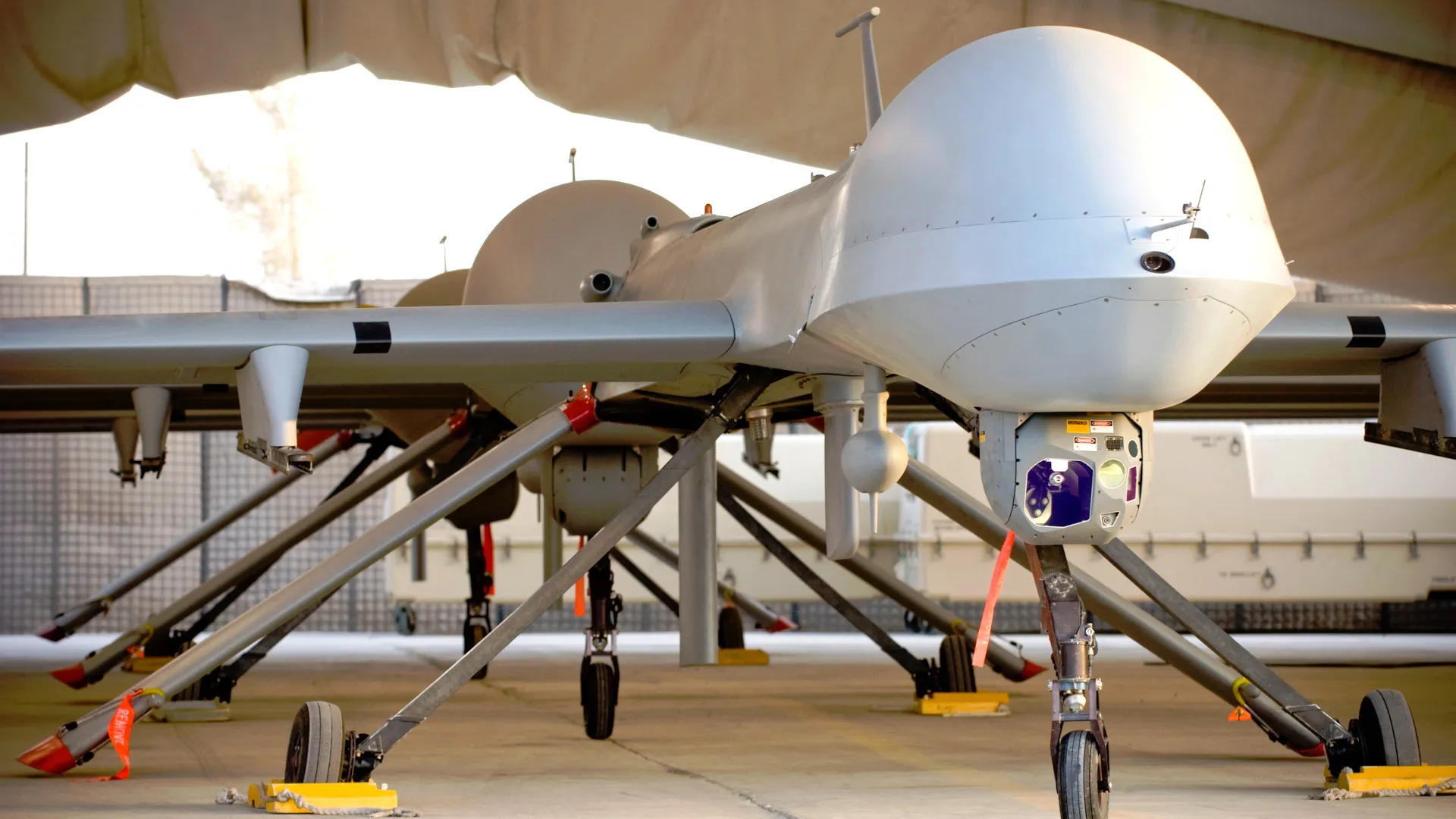
Eight Years After Retirement, the MQ-1 Predator Is Still Flying — For the U.S. Navy
Although the U.S. Air Force officially retired the MQ-1 Predator in 2018, the Naval Air Warfare Center Weapons Division (NAWCWD) acquired 20 airframes in 2019, redesignating them NMQ-1B for test and training missions. The aircraft are likely modified to simulate radar and infrared threat signatures, supporting counter-drone weapon and missile seeker development as a low-cost, long-endurance test platform.

Highlights
- NAWCWD received 20 retired Air Force MQ-1 Predator drones in 2019 and redesignated them NMQ-1B for RDT&E missions — confirmed for the first time by a Navy spokesperson.
- The 'N' prefix in NMQ-1B denotes permanent, irreversible modification from the original MQ-1B configuration, though the specific changes have not been disclosed.
- The NMQ-1Bs are assigned to NAWCWD's targets department, suggesting they simulate adversary aerial threat signatures to support missile seeker and counter-drone weapon development.
- The Air Force retired the MQ-1 Predator in 2018; over 50 airframes were cannibalized for MQ-9 Reaper spare parts, and 15 remain stored at Davis-Monthan AFB in Arizona.
- The Navy's continued operation of the NMQ-1B means the Predator has remained in active U.S. military service for at least eight years beyond its official Air Force retirement.
Eight Years After Retirement, the MQ-1 Predator Is Still Flying — For the U.S. Navy
The U.S. Air Force officially retired the MQ-1 Predator in 2018, yet eight years on, this iconic drone is still quietly operating in American airspace — just under a different operator. According to reporting by The War Zone (TWZ), the U.S. Navy has continued to fly former Air Force MQ-1s, converting them into dedicated test and training assets.
Navy Took Delivery of 20 Airframes, Redesignated NMQ-1B
A spokesperson for the Naval Air Warfare Center Weapons Division (NAWCWD), part of Naval Air Systems Command (NAVAIR), confirmed to TWZ: "In 2019, NAWCWD received 20 MQ-1 aircraft from the U.S. Air Force. These aircraft were redesignated NMQ-1B to support our mission."
The new designation is significant. Under the U.S. military's joint aircraft designation system, the prefix "N" indicates that a platform has undergone some form of permanent modification — typically for test purposes. A well-known example is the Air Force's highly classified NT-43A radar cross-section measurement platform, a heavily modified Boeing 737-200 fitted with an enlarged nose radome and a massive tail-mounted radome. Exactly how the NMQ-1B differs from a standard MQ-1B has not been disclosed.
NAWCWD elaborated: "NAWCWD is a Research, Development, Test and Evaluation (RDT&E) command, and these aircraft were acquired to support our targets department. The NMQ-1B platform is currently used for test and training."
Why a 'Pocket Fleet'? The Predator's Second Act
When the Air Force retired the MQ-1 in 2018, dozens of airworthy airframes remained in inventory. More than 50 were cannibalized for spare parts to support the successor MQ-9 Reaper, while others were placed on static display. Fifteen MQ-1s remain in storage at Davis-Monthan Air Force Base in Arizona — the famous aircraft "boneyard" — nominally as property of the National Museum of the United States Air Force.
TWZ had first reported in 2019 that the Air Force was considering transferring some Predators to the Navy, though the outcome of those negotiations remained unclear at the time. Now the answer is confirmed.
A separate trigger for the disclosure was U.S. Central Command's (CENTCOM) late May confirmation that an "MQ-1" had been shot down by Iran. Evidence suggests the aircraft was actually a U.S. Army MQ-1C Gray Eagle — a derivative of the Predator but a distinctly different design. The Air Force subsequently confirmed the transfer, prompting TWZ to seek further clarification from the Navy.
Probable Mission Roles for the NMQ-1B
With NAWCWD stating these aircraft belong to its "targets department," they are likely used to simulate adversary threats in support of missile seeker and weapons system development. However, their actual utility may be considerably broader:
-
Threat signature simulation: The NMQ-1Bs may be modified to replicate a range of radar, infrared, and other electronic signatures, providing a low-cost, long-endurance platform to stand in for diverse airborne threats during test and training events. The U.S. military already has precedent for using smaller manned aircraft to simulate cruise missiles and loitering munitions.
-
Missile test support: Testing air defense missiles does not necessarily require destroying the target. Some seeker tests can be completed without the missile ever leaving the rail; even live-fire events can use warhead-free rounds that trigger proximity fuzes to confirm a simulated kill while leaving the target airframe intact for reuse.
-
Reconnaissance and relay: The MQ-1 was originally equipped with infrared and electro-optical full-motion video, and could carry a small radar with synthetic aperture radar (SAR) capability for all-weather surveillance. It can also serve as a communications relay node.
-
Autonomy and swarming tests: Before the Air Force's retirement, there were reports that the existing MQ-1 fleet could be used to test collaborative swarming capabilities — hardware, software, and communications networks alike. While no definitive evidence exists, the timing and the Predator's inherent adaptability make this plausible. Using surrogate drones to develop autonomous teaming architectures and swarm tactics is now standard practice across the U.S. military.
Why Has No One Spotted Them?
If these Predators have been flying continuously since retirement, why have there been no confirmed sightings? The most likely explanation is that operations are conducted at classified test ranges such as the Nevada Test and Training Range (Area 51 complex) or other remote installations. If that is the case, these airframes may hold considerable historical significance — they could have contributed to the foundations of the current autonomous air combat revolution.
A Second Life for an Iconic Drone
This disclosure comes at a time of heightened U.S. military awareness of the loitering munition threat. Recent conflicts — from U.S.-Iran tensions to Russia's ongoing war against Ukraine — have repeatedly demonstrated that unmanned aerial systems of all types can no longer be ignored. Meanwhile, U.S. flight test activity is at a peak, driving surging demand for support test assets. The quietly serving NMQ-1Bs represent one little-known contribution to that effort.
The Navy's test community has extended the life of the iconic Predator by nearly a decade. How much longer the NMQ-1B will remain in service remains to be seen.
原文來源: 查看原文
FAQ
Newsletter
Subscribe to our Low-Altitude Industry Newsletter
Daily curated news on low-altitude economy and drone industry, delivered to your inbox.