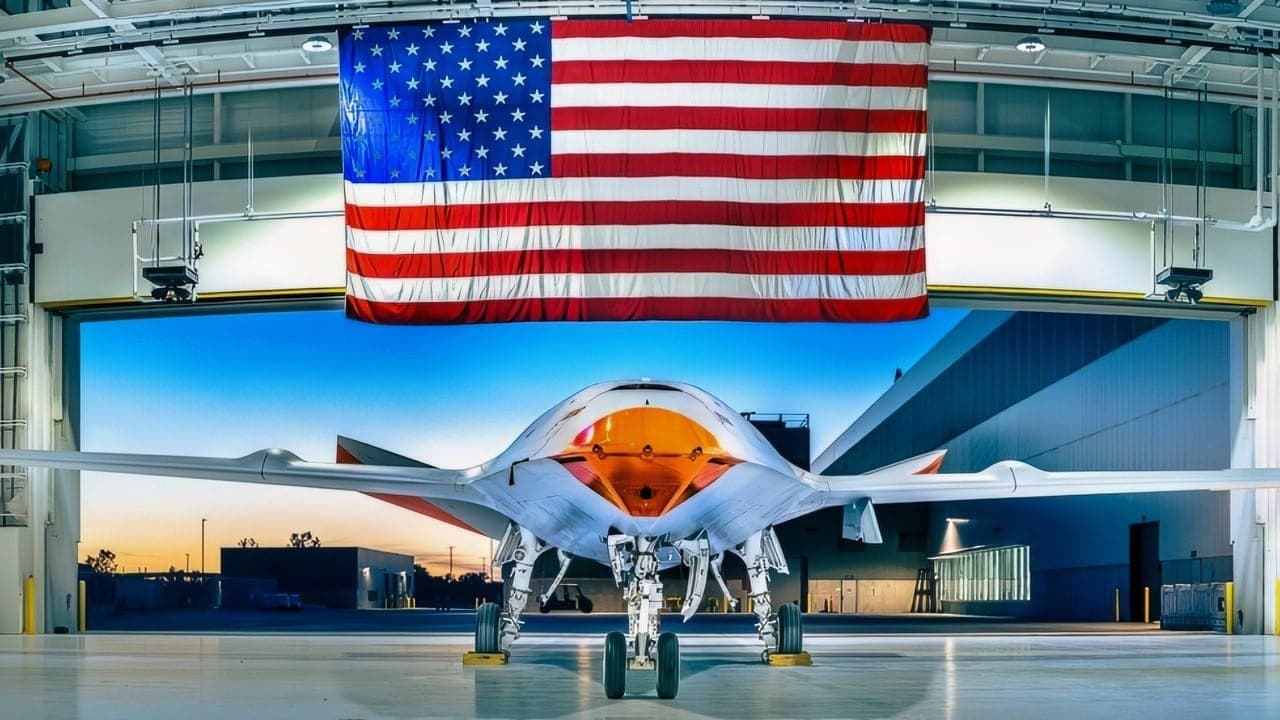
World's First Carrier-Based Autonomous Drone, MQ-25 Stingray, Cleared for Production — A Flying Refueling Station
The U.S. Navy's MQ-25A Stingray unmanned aerial vehicle has passed Milestone C review, clearing it for Low-Rate Initial Production (LRIP). Developed by Boeing, the MQ-25A is the world's first carrier-based autonomous aerial refueling drone, designed to extend the combat range of carrier air wings by refueling F/A-18 Super Hornets and F-35Cs. The Navy plans to procure more than 70 aircraft in a program potentially worth over $15 billion.

Highlights
- The MQ-25A Stingray passed the U.S. Navy's Milestone C review in May 2025, authorizing entry into Low-Rate Initial Production (LRIP) after a successful first flight in April.
- Boeing's MQ-25A is the world's first carrier-based autonomous aerial refueling drone, powered by a Rolls-Royce AE 3007N turbofan engine and capable of transferring approximately 15,000 lb of fuel per sortie.
- The program's Initial Operational Capability target has been delayed from 2024 to 2029; the Navy plans to award an initial contract this summer for 3 aircraft, with options for up to 11.
- The U.S. Navy intends to procure more than 70 MQ-25s in a program potentially worth over $15 billion, replacing the costly practice of using F/A-18 Super Hornets as buddy tankers.
- The MQ-25 is designed to extend carrier strike group combat reach amid growing threats from long-range anti-ship missiles, particularly relevant to potential conflict scenarios involving China.
World's First Carrier-Based Autonomous Drone, MQ-25 Stingray, Cleared for Production — A Flying Refueling Station
The U.S. Navy's MQ-25A Stingray unmanned aerial vehicle has reached a major milestone in its development, formally passing the Milestone C review and receiving authorization to enter Low-Rate Initial Production (LRIP).
The announcement marks a significant step forward for Boeing's MQ-25A, bringing it closer to becoming the world's first carrier-based autonomous aerial refueling drone to enter operational service.
Strategic Context: Why Does a Carrier-Based Tanker Drone Matter?
The program reflects the rapidly evolving realities of naval warfare. U.S. aircraft carriers face growing threats from new long-range anti-ship missiles and drones, forcing carrier strike groups to operate at greater standoff distances from potential conflict zones. The MQ-25A Stingray was developed precisely to address this challenge — by taking over the aerial refueling mission, it frees manned combat aircraft to focus on strike missions while extending the overall reach of the carrier air wing.
Years in Development
In May, Boeing announced that the Navy had achieved the Milestone C objective following a successful first flight in April. Troy Rutherford, Boeing's Vice President of the MQ-25 program, described the occasion as "historic" in a press release.
"Boeing is honored to work alongside the U.S. Navy to achieve this historic milestone in the MQ-25A Stingray's development lifecycle. We remain focused on getting this transformational unmanned aircraft into the fleet and integrated into the carrier air wing." — Troy Rutherford
During the approximately two-hour maiden flight, the flight control systems, navigation systems, and autonomous flight capabilities were all verified to be performing as expected. Low-speed taxi tests had also been completed prior to the flight.
The Navy expects to award the first initial production contract this summer, covering three aircraft with options to expand the total to 11.
However, the program has not been without setbacks. The original Initial Operational Capability (IOC) target of 2024 has slipped to 2029.
A Flying Refueling Station
The MQ-25A Stingray is a carrier-based drone, but its role is not strike — it is purpose-built for aerial refueling.
Its primary mission is to launch from an aircraft carrier and transfer fuel to F/A-18 Super Hornets and F-35C Lightning IIs, enabling those aircraft to strike targets at greater distances.
The program's origins date back decades. The U.S. Navy originally pursued carrier-based unmanned aircraft through the Unmanned Carrier-Launched Airborne Surveillance and Strike (UCLASS) program, which sought ISR and strike capabilities. As concerns mounted over carrier strike group range and carrier air wing sortie rates, however, the Navy shifted focus to the aerial refueling mission — giving rise to the Carrier-Based Aerial Refueling System (CBARS) program and, ultimately, the MQ-25 Stingray. Boeing won the competition and secured the production contract in 2018.
The MQ-25 directly addresses a longstanding problem: the use of F/A-18 Super Hornets as "buddy tankers" — repurposing expensive combat aircraft as airborne gas stations. While operationally necessary, this practice consumes a significant portion of the Super Hornet fleet's flying hours on refueling duties rather than combat readiness. Once the MQ-25 enters service, those aircraft will be returned to full combat roles.
Technical Specifications
The MQ-25A Stingray is powered by a Rolls-Royce AE 3007N turbofan engine and is equipped with an autonomous flight control system. Unlike conventional drones that require continuous remote pilot input, the MQ-25 is designed to execute missions autonomously under human supervision, with a remote operator able to intervene when necessary.
During testing, the aircraft has demonstrated the ability to independently manage navigation, propulsion, and flight operations.
In terms of fuel offload capacity, the MQ-25 is expected to transfer approximately 15,000 lb (roughly 6,800 kg) of fuel to other carrier-based aircraft, meaningfully extending the combat range of the F-35C and F/A-18 Super Hornet. Testing has also confirmed its ability to refuel multiple aircraft types.
The U.S. Navy ultimately plans to procure more than 70 MQ-25s, making it one of the largest carrier aviation modernization programs currently underway, with a total program value potentially exceeding $15 billion.
Once operational, the MQ-25 is expected to play a pivotal role in U.S. military planning for potential conflict scenarios — particularly in response to China's rapidly expanding inventory of long-range anti-ship missiles.
原文來源: 查看原文
FAQ
Newsletter
Subscribe to our Low-Altitude Industry Newsletter
Daily curated news on low-altitude economy and drone industry, delivered to your inbox.