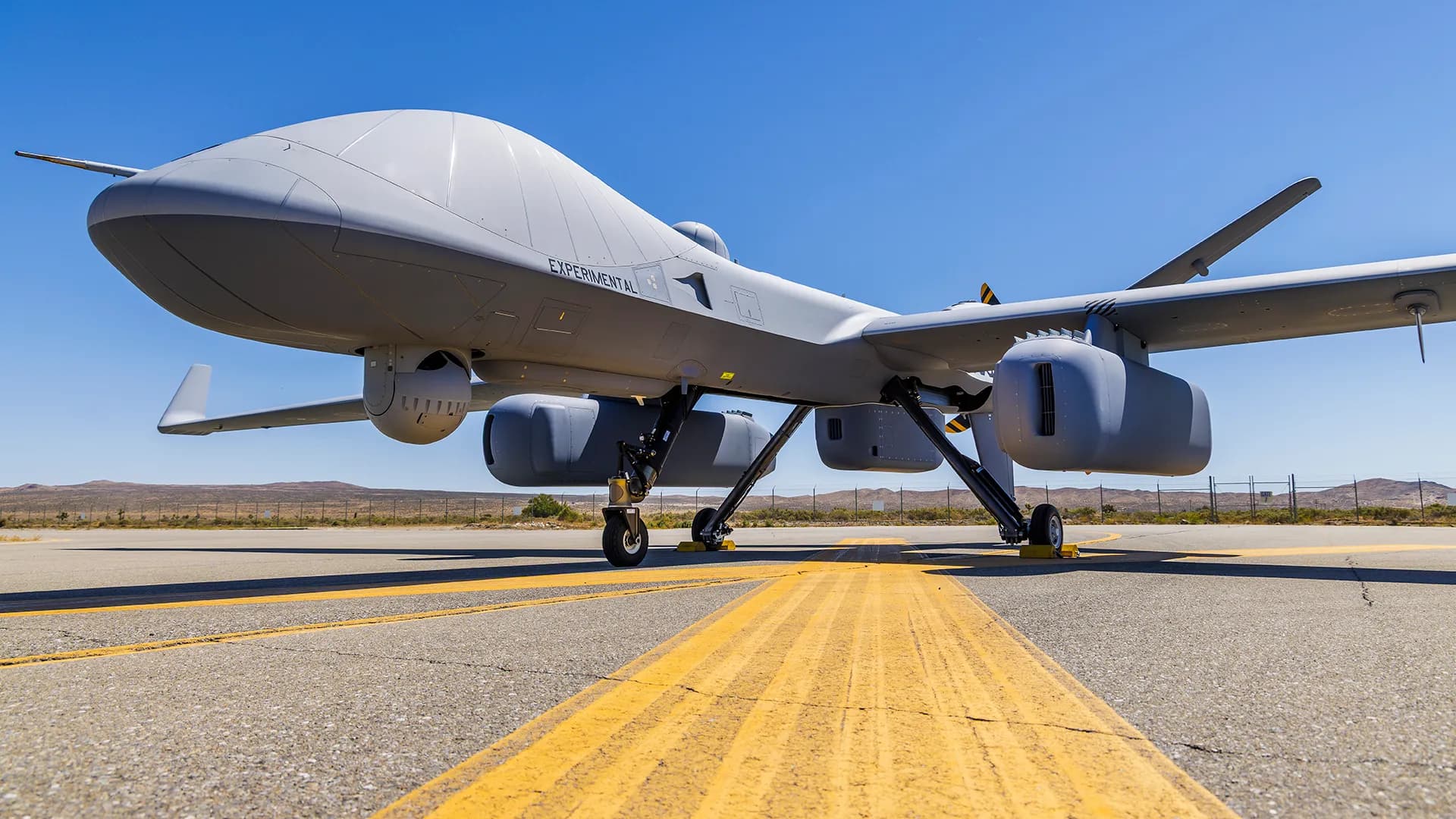
MQ-9 Reaper Gains Airborne Early Warning Capability in Landmark First Flight
General Atomics and Saab completed the first flight of an MQ-9 Reaper equipped with Saab's LoyalEye radar pod on May 19, 2025, giving the drone airborne early warning (AEW) capability. The configuration enables persistent low-altitude radar surveillance capable of detecting cruise missiles, loitering munitions, and combat aircraft, and is seen as a cost-effective solution to gaps in existing crewed AEW&C fleets.

Highlights
- GA-ASI and Saab completed the first AEW test flight of an MQ-9 Reaper equipped with Saab's LoyalEye radar pod on May 19, 2025.
- The LoyalEye-equipped MQ-9 can detect and track cruise missiles, loitering munitions (including the Shahed-136 with a range exceeding 1,600 km), drones, and combat aircraft from medium altitude.
- The AEW MQ-9 is intended to fill persistent surveillance gaps left by the U.S. Air Force's shrinking E-3 Sentry fleet and the delayed E-7 acquisition program.
- GA-ASI is adapting the MQ-9 for carrier and amphibious ship operations, supporting U.S. Navy ACE and Marine Corps EABO concepts without requiring large flight crews.
- A full capability demonstration is planned for 2026, with significant export potential for nations that lack dedicated AEW platforms.
MQ-9 Reaper Gains Airborne Early Warning Capability in Landmark First Flight
The MQ-9 Reaper — and the broader Predator-B family — currently finds itself in a complicated position. On one hand, the platform is rapidly acquiring highly relevant new capabilities and missions, and has recently demonstrated irreplaceable value in strikes against high-priority targets deep inside Iran, including missile launchers and air defense sites. On the other hand, its vulnerability to air defense systems is well established: significant losses over Iran and Yemen have made that point clearly, even against less-than-modern threats. Compounding the issue, the U.S. Air Force has yet to commit to a clear MQ-9 replacement program, leaving fleet numbers in decline with no better alternative ready to absorb its missions.
Amid this turbulent and often misunderstood period of development, one new capability stands out as particularly significant — one that could give the MQ-9 compelling strategic value for years to come: converting the Reaper into a radar-equipped Airborne Early Warning (AEW) platform capable of detecting and tracking aircraft, drones, and missiles. An MQ-9 configured for this mission has just completed its first test flight.
First Flight: General Atomics and Saab Collaborate
The test flight was conducted through a partnership between General Atomics Aeronautical Systems (GA-ASI) and Saab, a recognized leader in airborne early warning systems. Saab provided the LoyalEye podded radar system for the integration. The first test flight took place on May 19, 2025, with a full capability demonstration planned for the following year.
GA-ASI President David R. Alexander commented:
"The MQ-9B's airborne early warning capability will provide critical aerial sensing to defend against tactical air-launched munitions, guided missiles, drones, fighters and bombers, and other threats. Medium-altitude long-endurance unmanned aircraft have the highest operational availability of any military aircraft, and as unmanned platforms, their crews are never placed in harm's way."
Why AEW Is a Natural Fit for Medium-Altitude Long-Endurance Drones
For years, the drone industry and defense analysts have discussed the AEW mission as one of the most pressing new roles for medium-altitude long-endurance (MALE) unmanned aircraft. The concept is straightforward: take a relatively affordable platform capable of sustained flight at medium-to-high altitudes, integrate a radar pod with Air Moving Target Indication (AMTI) capability, and relay collected intelligence via onboard line-of-sight and beyond-line-of-sight datalinks to a ground control station. Ground operators can remotely manage both the drone and the radar pod while receiving continuous, long-range, look-down radar coverage.
Such aircraft can operate at comparatively low cost, be deployed in a distributed manner close to areas requiring surveillance, and remain airborne for extended periods — potentially orbiting near their operating base for close to a full day or longer. This kind of persistent, long-range, look-down radar coverage is more strategically important today than it has ever been.
Detecting Loitering Munitions: The Toughest Challenge
One-way attack munitions — commonly referred to as long-range loitering munitions or "kamikaze drones" — pose a serious threat on multiple levels. These systems blur the line between cruise missiles and drones, a category that itself represents a similar challenge. Much attention has been paid to cost-effectively shooting down relatively inexpensive one-way attack drones, but simply detecting them at sufficient range is already a major problem.
These targets have small radar cross-sections, fly at low altitudes, and travel at relatively slow speeds — often making them nearly undetectable by ground-based sensors until it is too late to respond effectively. Legacy airborne sensors also have inherent limitations against such threats.
This is precisely where an advanced look-down airborne radar becomes critical: it can detect these targets from altitude at long range and discriminate them from ground clutter. The problem is that crewed Airborne Early Warning and Control (AEW&C) platforms are extraordinarily expensive and resource-intensive — the quintessential "high-value, low-density" asset — and many can only operate from long runways, meaning they must be positioned far from the areas where coverage is most needed.
Limitations of Existing AEW&C Fleets
The U.S. Air Force operates a shrinking fleet of aging E-3 Sentry aircraft which, despite numerous upgrades, are not optimally configured to detect low-flying drones. The Air Force is slowly advancing its long-delayed E-7 acquisition program, but the E-7 is similarly expensive, technically complex, manpower-intensive, and requires long runways. The U.S. Navy operates the more modern E-2D Advanced Hawkeye, which is more capable in some respects, but it too is available in limited numbers and carries other critical responsibilities — particularly supporting carrier air wings.
Broadly, all of these crewed platforms face increasing exposure to long-range air defense systems, and despite respectable sensor ranges, their effectiveness in peer or near-peer conflict scenarios is increasingly questioned.
Key Advantages of the AEW-Equipped MQ-9
For high-end missions — where command and control is a core AEW&C function, including directing air battles, coordinating defenses, and providing network support — a podded MQ-9 cannot replace the E-7 or E-2. However, in the following scenarios, an AEW-capable MQ-9 is a highly attractive solution:
- Filling coverage gaps in crewed AEW&C availability
- Supporting regions where full high-end capability is not required
- Forward-deploying into high-threat areas, providing precision radar coverage that crewed platforms would not risk entering
In terms of crew safety, cost, and search-and-rescue requirements, the MQ-9 is significantly more expendable than crewed AEW&C assets.
Even if the E-7 were to replace all 15 remaining E-3s, and even if the Navy expanded its E-2 Hawkeye inventory, these aircraft simply could not provide continuous, around-the-clock coverage to every threatened location in a future distributed conflict. This is especially true given that relatively inexpensive one-way attack drones such as the Shahed-136 can fly over a thousand miles (1,600 km), dramatically expanding the potential threat radius at minimal cost.
Supporting ACE Concepts and Naval Operations
Small AEW MQ-9 detachments can provide 24-hour continuous orbital coverage over critical areas while maintaining minimal logistics footprints. This directly supports the U.S. Air Force's Agile Combat Employment (ACE) operational concept, in which small tactical aircraft packages rapidly shift between forward operating locations to outpace an adversary's targeting cycle. These mobile air power packages still require persistent look-down coverage — something the AEW MQ-9 can deliver — significantly enhancing situational awareness, engagement range, and overall effectiveness for surface-to-air missile systems, fighters, and other key defensive assets.
On the naval side, GA-ASI is actively adapting the MQ-9 family to operate from large-deck amphibious assault ships and aircraft carriers, opening new opportunities for the U.S. Marine Corps' Expeditionary Advanced Base Operations (EABO) concept. LHA/LHD amphibious assault ships have never had an organic fixed-wing AEW asset; the AEW MQ-9 would fill that gap without a large flight crew requirement, while providing extended loiter time over the amphibious strike group.
For carrier strike groups, the AEW MQ-9 could complement the E-2D by maintaining continuous look-down radar coverage when E-2s are not airborne, and extending additional sensor coverage toward high-risk threat axes during elevated threat periods.
Homeland Defense and Export Market Potential
AEW MQ-9 capability also has domestic applications. During major public events or national crises, flexible, cost-efficient, and persistent look-down radar capability would be a valuable component of homeland defense.
From a broader perspective, the AEW MQ-9 concept may be most attractive to foreign air forces that currently have no dedicated AEW capability whatsoever, or those seeking to augment existing limited capabilities. The cost of standing up a traditional AEW&C force is prohibitive — even a small fleet of crewed platforms is beyond the reach of many nations. The AEW MQ-9, equipped with the LoyalEye pod, offers a comparatively affordable entry point to meaningful airborne surveillance capability.
Conclusion
The AEW capability delivered by integrating Saab's LoyalEye radar pod onto the MQ-9 Reaper carries significant strategic weight in the current security environment. This is not a replacement for existing AEW&C fleets — it is a low-cost, highly flexible, and persistent means of filling the gaps in current coverage, serving as an indispensable bridge until future satellite-based AEW capabilities mature. For U.S. forces, allied partners, and the many small-to-medium air forces seeking an entry point into airborne early warning, this is a development well worth watching closely.
原文來源: 查看原文
FAQ
Newsletter
Subscribe to our Low-Altitude Industry Newsletter
Daily curated news on low-altitude economy and drone industry, delivered to your inbox.