US Transfers Ocean Aero Triton Autonomous Underwater-Surface Vehicles to Philippine Navy Unmanned Vessel Unit
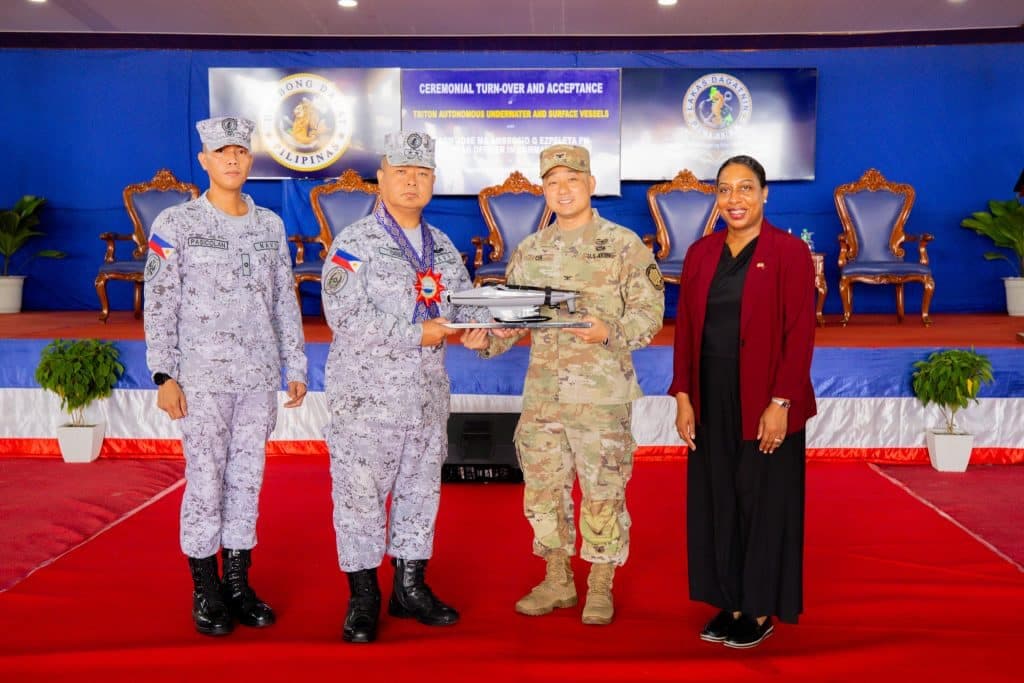
The United States has formally transferred four Ocean Aero Triton Autonomous Underwater-Surface Vehicles (AUSVs) to the Philippine Navy's Unmanned Surface Vessel Unit One at Subic Bay Naval Station under a US-funded security assistance program. Wind- and solar-powered, the Triton can operate continuously for up to 30 days and is intended to bolster the Philippines' maritime domain awareness and surveillance capabilities in the South China Sea against Chinese gray-zone activities.

Highlights
- The US transferred four Ocean Aero Triton AUSVs to the Philippine Navy's Unmanned Surface Vessel Unit One at Subic Bay Naval Station under a US-funded security assistance program.
- The Triton is wind- and solar-powered and can sustain continuous operations for up to 30 days, enabling persistent maritime domain awareness with minimal logistics support.
- Ocean Aero VP Andre Morabe stated the Triton fills a critical surveillance gap for the Philippines across its thousands of islands and vast EEZ in the South China Sea.
- The Triton can carry side-scan sonar, passive acoustic sensors, and specialized payloads, making it suitable for threat detection, infrastructure monitoring, and seabed operations.
- The Philippine Navy's Unmanned Surface Vessel Unit One also operates at least four Mantis T-12s and one Devil Ray T-38, both supplied by Maritime Tactical Systems through US security assistance.
Manila, Philippines — The United States has formally transferred Ocean Aero Triton Autonomous Underwater-Surface Vehicles (AUSVs) to the Philippine Navy under a US-funded security assistance program, adding a new capability to Manila's growing fleet of unmanned maritime systems.
Handover Ceremony Held at Subic Bay
On Monday, four Triton AUSVs were officially handed over to the Philippine Navy's Unmanned Surface Vessel Unit One, based at the Subic Bay Naval Station. Powered by wind energy and solar panels, each Triton can sustain operations for up to 30 days on a single deployment and is designed for persistent monitoring of both surface and subsurface maritime activity.
The transfer comes as the Armed Forces of the Philippines (AFP) pursues an active modernization agenda to strengthen its detection and tracking capabilities amid a series of confrontations with China in the South China Sea.
The US Embassy in Manila emphasized in a statement that the unmanned vehicles would help the Philippines counter "gray-zone activities" and "threats to freedom of navigation."
Ocean Aero Executive Outlines Strategic Value
Andre Morabe, Ocean Aero's Vice President of International Strategy, told Naval News: "The Ocean Aero Triton aligns well with the needs of the Armed Forces of the Philippines because it delivers persistent maritime awareness at very low cost and with minimal logistics burden — which fills a critical gap for an archipelagic nation."
Morebe further noted that the persistent uncrewed system would help Philippine forces monitor "thousands of islands and a vast Exclusive Economic Zone (EEZ)." He added that the Triton can be rapidly deployed from forward operating bases and remote islands — such as positions Manila maintains in the Spratly Islands or the Batanes Island Group in the Luzon Strait — and can be launched directly from vessel ramps and other ships.
"Unlike conventional underwater drones that must be frequently recovered due to battery limitations, the Triton can remain on station in an operational area for extended periods, continuously collecting and transmitting data while maintaining minimal logistics requirements. Its ability to carry side-scan sonar, passive acoustic sensors, navigation systems, and other specialized payloads makes it an ideal platform for threat detection, critical infrastructure monitoring, and support of seabed operations," Morabe said.
Integration with Existing Unmanned Vessel Unit
The Ocean Aero Tritons will join a fleet of US-supplied unmanned vehicles already operated by the Philippine Navy's Unmanned Surface Vessel Unit One. Another American manufacturer, Maritime Tactical Systems, has previously delivered unmanned vessels to the AFP through Washington's security assistance program; at least four Mantis T-12s and one Devil Ray T-38 are currently conducting operations in the South China Sea.
原文來源: 查看原文
FAQ
Newsletter
Subscribe to our Low-Altitude Industry Newsletter
Daily curated news on low-altitude economy and drone industry, delivered to your inbox.