Potensic Atom 3 First-Flight Impressions: Sub-249g Drone Rivals DJI Mini Performance at a Lower Price
Potensic has officially launched the Atom 3 drone, featuring a 1/1.3-inch 50MP sensor, 4K/60fps HDR video, 16km transmission range, and up to 50-minute flight time. The Fly More bundle is priced at $679.99, directly challenging the DJI Mini lineup. However, U.S. sales are currently blocked due to FCC regulatory restrictions.

Highlights
- The Potensic Atom 3 weighs under 249g and features a 1/1.3-inch 50MP sensor, 4K/60fps HDR video recording, and a 16km transmission range.
- The Fly More bundle with the PTD 2 screen controller, three batteries, and charging hub is priced at $679.99; the standard package starts at $429.99.
- U.S. sales are blocked because the FCC has not issued new equipment authorizations to foreign drone manufacturers since December 22, 2025.
- DroneXL's first-flight assessment found flight handling comparable to the DJI Mini series, with stable hover, responsive controls, and Sport mode exceeding 40 km/h.
- Shooting in RAW is strongly recommended: in-camera JPEGs show heavy-handed noise reduction and over-saturation, while RAW files retain more detail for post-processing.
Potensic Atom 3 First-Flight Impressions: Sub-249g Drone Rivals DJI Mini Performance at a Lower Price
Potensic has officially launched the Atom 3, and the DroneXL editorial team has already taken it for an early test flight. Weighing under 249 grams, the new drone sports a 1/1.3-inch 50-megapixel sensor, a claimed transmission range of 16km, and up to 50 minutes of flight time with the optional extended battery. While only a handful of flights have been completed — making this a first-flight impression rather than a full review — the Atom 3 demonstrated a level of polish well above its price point within just a few minutes in the air.
Disclosure: This unit was provided by Potensic as a review sample. DroneXL received no payment, and the content was not shared with Potensic prior to publication. All opinions below reflect the editorial team's independent assessment.
Potensic teased the Atom 3 roughly two weeks ago; it goes on sale today in Europe and other markets. It is not yet available in the United States — the reasons are explained at the end of this article.
A Generational Upgrade Across All Three Key Pillars
The Atom 3 succeeds the Atom 2 with upgrades targeting the three areas that matter most to entry-level drone buyers: the sensor grows from 1/2-inch to a 1/1.3-inch 50MP unit; transmission range increases from 10km to 16km; and standard-battery flight time rises to 40 minutes.
Drone Supremacy's Mike reviewed the Atom 2 in June 2025, calling it a solid budget option for beginners. The Atom 3 reads like Potensic methodically addressing every shortcoming of its predecessor. The camera now shoots 4K/60fps HDR video and offers a P-Log flat color profile for post-production grading. A new Med-Tele mode delivers a 2x lossless zoom equivalent to 48mm, up to 4x digital zoom in 4K, and slow-motion up to 7x in 1080p.
Potensic has also upgraded AI tracking to version 2.0, enabling low-altitude subject tracking below 4 meters when the propeller guard is installed. An AR return-to-home feature overlays the takeoff point and return path on the live feed, and a built-in lens heater prevents fogging caused by temperature changes. One note on the numbers: Potensic's marketing materials cite 40 and 50 minutes for the standard and extended batteries respectively, but in direct communication with DroneXL, the company quoted 39 and 48 minutes. Either way, real-world flight times will fall short of official figures — as is the case with every drone on the market.
Small Details That Make a Big Difference: Gimbal Cover and Arm Design
Two design details impressed us even before the Atom 3 left the ground: a tool-free, slide-in/slide-out gimbal cover, and arms that unfold without any particular sequence.
Gimbal covers are a persistent frustration with many drones, but the Atom 3's design slides in and out smoothly while simultaneously securing the propellers, camera, and gimbal. It sounds trivial — until you factor in that you'll do it every single flight. For a mini drone that lives in a backpack, two-second reliable protection is exactly what you need.
The arm design is equally intuitive. Unlike the DJI Mini, Air, and Mavic series — where front arms swing forward and rear arms rotate downward in a specific order — the Atom 3's arms simply unfold. Someone who has never flown a drone can get it right on the first try.
Flight Performance: Feels Like a DJI Mini
Anyone who has flown a DJI Mini will feel immediately at home on the Atom 3. Control response is crisp, stick inputs have a direct, connected feel, and Sport mode clears 40 km/h without hesitation.
That familiarity is the highest compliment we can give a drone in this class. DJI spent a decade refining the handling of its mini-class drones, and Potensic has clearly done its homework. The Atom 3 holds its hover position with confidence, and there were no unsettling moments throughout the entire test session.
The video link was equally solid — no dropouts or freezing at any point during our flights. Regulations require drones to remain within visual line of sight, of course, and a craft this small disappears from view long before reaching the claimed transmission limit. Within the distances where we could still see the aircraft, the connection never once broke. The 16km figure should be understood as headroom ensuring strong signal quality within legal range — not an invitation for BVLOS operations.
PTD 2 Controller: More Comfortable Than DJI's Standard RC
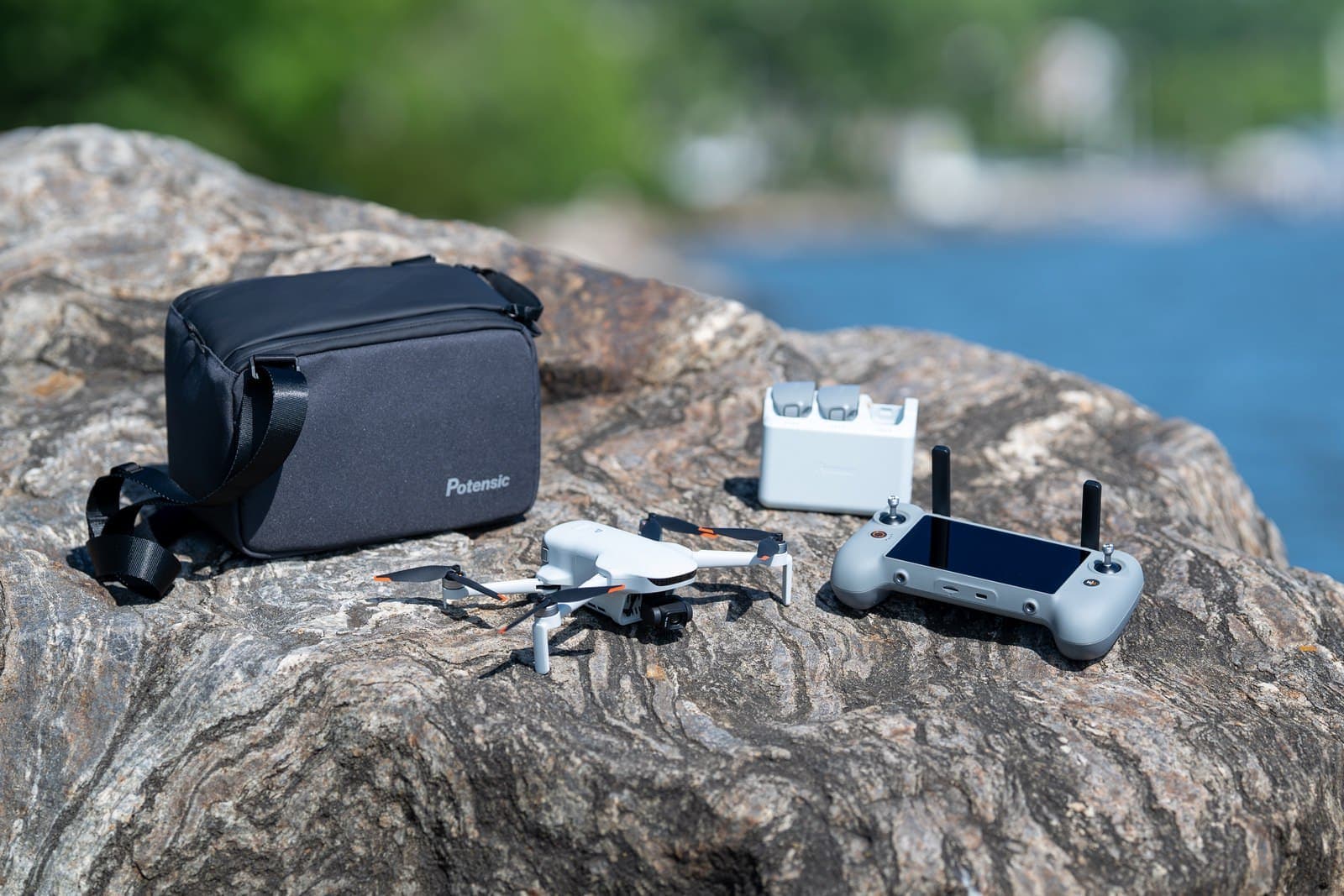
The Fly More bundle we tested includes the PTD 2 smart remote controller. It is wider than DJI's equivalent, with its 5.5-inch screen positioned between — rather than below — the sticks. The ergonomics are excellent; frankly, we prefer it over the RC 2 that DJI bundles with the Mini series.
The controller feels solid in hand, and the screen hits 900 nits of brightness. We flew in direct sunlight and had no trouble reading the display. The PTD 2 runs the Potensic Eve app, includes 32GB of internal storage expandable via microSD, and requires no phone mount and no cable to remember. Its 6,200mAh battery is rated for three hours of use and charges in approximately 1.5 hours.
The rest of the Fly More bundle is equally well considered: a parallel charging hub charges all three batteries simultaneously, and the shoulder bag uses a dual-zipper clamshell design for quick access to all accessories. Nothing flashy — but everything you'll actually use on every outing.
Image Quality: Shoot RAW
The first batch of stills from the Atom 3 tells a clear story: RAW files show visible pincushion distortion and uneven edge brightness, while in-camera JPEGs correct those flaws but overcorrect — producing over-saturated colors and heavy noise reduction that renders textures as blocky blobs when zoomed in.
We shot both RAW and JPEG simultaneously, and the comparison is instructive. RAW files show the pincushion distortion and vignetting clearly. JPEGs fix the geometry and even out the exposure, but the processing is heavy-handed: green grass goes over-saturated, noise reduction erases texture detail, and over-processed areas become visible at higher magnifications.
Our recommendation after the first flight: start from RAW. The sensor captures more information than the JPEG engine delivers, and a few minutes of lens correction and color grading will produce results far more natural than the in-camera output. Video quality will be evaluated more thoroughly after flights in a wider range of lighting conditions, but P-Log versus the standard color mode will likely follow the same logic.
Pricing Targets DJI Directly — But U.S. Buyers Can't Purchase It Yet
The Atom 3 Fly More bundle — including the PTD 2 screen controller, three standard batteries, parallel charging hub, and shoulder bag — is priced at $679.99 on Potensic's official store. The standard package starts at $429.99, placing it squarely against the DJI Mini 3, DJI Flip, and other entry-level alternatives.
The sub-249g weight carries real practical value at this price point. In the United States, recreational drones under 250 grams do not require FAA registration and are exempt from Remote ID requirements — though the Atom 3 has Remote ID built in and enabled by default. That keeps the barrier to entry as low as possible.
It also shapes how we view the extended battery. The larger cell adds roughly ten minutes per flight, and extra endurance is always welcome — but at the cost of added weight. DJI's Mini 5 Pro, for instance, crosses the 250-gram threshold with its Plus battery, negating the regulatory advantage that defines the mini-drone category. With three standard batteries charging simultaneously on the hub, total available flight time is already generous. For most pilots, staying under 249 grams is worth more than an extra few minutes in the air.
Then there is the U.S. market issue. Potensic says it is working toward U.S. regulatory certification, including FCC compliance. The reality, however, is that since the FCC added all foreign-manufactured drones to its "covered list" on December 22, 2025, the agency has issued no new equipment authorizations to any foreign drone manufacturer. As a Shenzhen-based company, Potensic faces the same regulatory wall as DJI. Getting the Atom 3 into the U.S. market would require either passing a Department of Defense national-security review to enter the FCC's conditional approval pathway, or waiting for a court ruling to overturn the designation. We hope that happens, because U.S. consumers are running out of mini-drone options while capable products like the Atom 3 sell freely in the rest of the world.
DroneXL Verdict
This was our first time flying a Potensic drone, and it impressed us. When the Atom 2 was reviewed a year ago, the conclusion was that it was a decent budget alternative for pilots seeking a non-DJI option. The Atom 3 changes that framing entirely. Equipped with a 1/1.3-inch sensor, 4K/60 HDR, P-Log, and a screen controller we genuinely prefer to DJI's standard RC 2, this is no longer a compromise — it is a genuine competitor.
We have long argued that sub-249g drones are the best starting point for new pilots: easy to fly, no FAA registration required for recreational use in the U.S. Mini-class drones today are powerful enough — whether from DJI or challengers like Potensic — that any current-generation model can serve a beginner pilot for years. The Atom 3 earns a place on that recommendation list without reservations. That is something we could not have said about budget alternatives two years ago.
Long-term durability, performance in strong winds and low light, and a direct head-to-head against the Mini 3, Mini 4 Pro, and Mini 5 Pro all require more flight time to assess. The bigger question, however, is not in Shenzhen but in Washington: can Chinese-made consumer drones navigate the exemption pathway proposed by the FCC Chair at CES 2026? The first four systems removed from the covered list in March 2025 were all enterprise platforms. Until a consumer drone completes that same process — or DJI's Ninth Circuit appeal rewrites the rules — the Atom 3 will remain a drone that Americans can only read about while Europeans fly it. That is a real loss for U.S. pilots, because after just one session, this is already a mini drone we can recommend without hesitation.
原文來源: 查看原文