Robinson and Skyryse Partner to Convert R66 Helicopter into Unmanned Aircraft
Robinson Helicopter's unmanned division has announced a partnership with Skyryse to integrate the SkyOS flight operating system into the R66 helicopter, developing a Group 4 UAS for military missions including ISR, effects delivery, and Crewed-Uncrewed Teaming. Robinson Unmanned will also offer three Group 1 and Group 2 small UAS.

Highlights
- Robinson Unmanned and Skyryse are jointly developing a Group 4 UAS based on the R66 helicopter, integrated with the SkyOS flight operating system, for military ISR, effects delivery, and Crewed-Uncrewed Teaming missions.
- The R66 Turbinetruck variant offers an internal payload of 1,300 pounds plus an external cargo hook, positioned as a heavy-lift defense logistics drone.
- More than 85% of Robinson's aircraft components are manufactured in the United States, reducing foreign supply-chain dependency for long-term fleet sustainability.
- SkyOS has accumulated 2,800 flight hours across rotary-wing and fixed-wing platforms as of February 2025, with Skyryse CEO Mark Groden reporting some users fly solo after only 15 minutes of training.
- The Pentagon requested $13.4 billion for autonomy and autonomous systems in its FY2026 budget, while Skyryse already holds a U.S. Army contract to explore optionally piloted capabilities for 2,400 Black Hawks.
Robinson and Skyryse Partner to Convert R66 Helicopter into Unmanned Aircraft
Robinson Helicopter, which announced plans to launch a line of autonomous rotorcraft back in March, is taking the next step: its Robinson Unmanned division is partnering with Skyryse to convert its flagship R66 helicopter into an unmanned aircraft for defense applications.
Skyryse positions its SkyOS platform as a universal flight operating system designed to simplify the control interface of any aircraft. The company disclosed on Tuesday that the two firms will jointly develop a Group 4 Unmanned Aircraft System (UAS) capable of supporting a range of military missions, including effects delivery, intelligence, surveillance and reconnaissance (ISR), and Crewed-Uncrewed Teaming (CCA).
Military Demand for Collaborative Combat Aircraft Grows
The U.S. military and several allied armed forces are actively exploring autonomous CCA concepts, deploying unmanned "loyal wingmen" to operate alongside crewed combat aircraft. The U.S. Air Force this month awarded production contracts to General Atomics and Anduril for the FQ-42 and FQ-44 CCA platforms — formerly designated YFQ-42A and YFQ-44A — with plans to procure approximately 1,000 systems in total.
Robinson Helicopter President and CEO David Smith said: "A Group 4 UAS powered by SkyOS and built on the R66 is a natural extension of Robinson's core capabilities — producing reliable, high-quality aircraft at scale. By integrating SkyOS into Robinson's production infrastructure, we are helping bring advanced autonomy to a proven flight platform and creating a scalable path to future operational capabilities."
Group 4 Specifications
Under U.S. military classification standards, Group 4 UAS weigh more than 1,320 pounds, operate below 18,000 feet AGL, and are not speed-restricted. Representative platforms in this category include the General Atomics MQ-1 Predator and the Northrop Grumman MQ-8B Fire Scout unmanned helicopter.
Skyryse noted in its press release that its California facilities are located less than 30 miles from Robinson's factory, a proximity it says will enable "rapid progression through integration, flight validation, and production." Robinson's supply chain is another key advantage: more than 85% of its aircraft components are manufactured in the United States, reducing dependence on foreign supply chains and supporting long-term fleet sustainability.
The R66 Platform: From Civil to Military
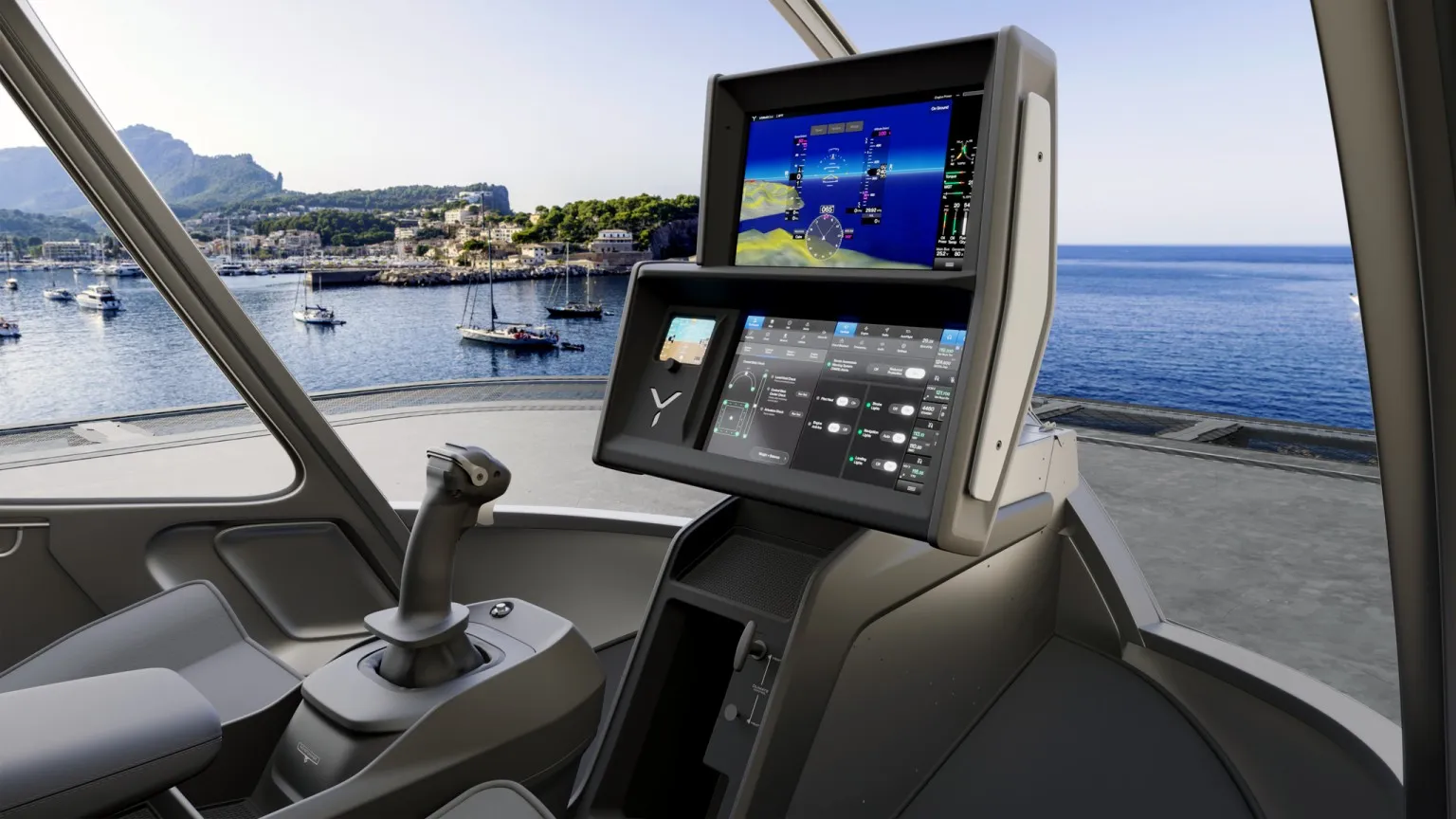
The R66 serves as the core airframe for Robinson's Skyryse One, which claims to be the world's first helicopter operated via fly-by-wire controls using a single joystick and dual touchscreens.
Robinson is also developing the R66 Turbinetruck — an automated variant of the R66 equipped with cameras, sensors, and algorithms for navigation and flight path planning — positioned as a heavy-lift logistics drone for defense, with an internal payload capacity of 1,300 pounds and an external cargo hook. Robinson Unmanned will additionally introduce three Group 1 and Group 2 small UAS.
How SkyOS Works
Skyryse's SkyOS is aircraft-agnostic and has been tested on both rotary-wing and fixed-wing platforms. As of February this year, pilots had logged 2,800 flight hours on SkyOS-equipped aircraft.
SkyOS has demonstrated "swipe-to-land" helicopter operations and automatic engine-failure autorotation capability. The most extensively tested platform to date is the UH-60 Black Hawk; the system has also been installed on the Cirrus SR-22, with further integration agreements signed with Airbus, Bell, and Pilatus.
For helicopters, SkyOS replaces traditional cyclic, collective, and throttle controls with a single joystick, dual touchscreens, and a fly-by-wire system. During installation on the R66 — the aircraft that became the Skyryse One — Skyryse removed the instrument panel, flight instruments, avionics, flight controls, and pedals, eliminating more than 100 control components. The Skyryse One is currently awaiting airworthiness certification before customer deliveries begin.
Highly Intuitive Controls
- Swipe up on the touchscreen: Activates lift; the helicopter hovers at approximately 5 feet
- Hold the joystick thumb button: Sets climb rate
- Push forward/pull back on the stick: Adjusts airspeed
- Move left/right: Changes bank angle (SkyOS automatically limits maximum bank angle)
- Rotate the stick: Yaws the aircraft
- Release the stick: Aircraft automatically maintains wings-level, straight-and-level flight
SkyOS supports two-pilot, single-pilot, or zero-pilot operations. In flight, the system continuously monitors terrain, obstacles, and other aircraft, providing real-time safety alerts alongside fuel monitoring and dynamic envelope protection.
In March, Skyryse announced that SkyOS would support one-touch automatic landing — a capability extended beyond fixed-wing aircraft to rotorcraft for the first time. Skyryse CEO Mark Groden told FLYING magazine that some users have flown a SkyOS-equipped helicopter after only 15 minutes of training.
Groden said in Tuesday's announcement: "Defense agencies need autonomous aircraft that are reliable, affordable, and available now — not years from now. Robinson provides the production infrastructure we need to scale at a cost that meets real-world requirements and mission timelines."
U.S. Military Autonomy Push Accelerates
U.S. military interest in aircraft autonomy continues to grow, spanning CCA programs and multiple optionally piloted upgrade projects for Black Hawk helicopters. The Pentagon's fiscal year 2026 budget request includes $13.4 billion for autonomy and autonomous systems.
Last year, the U.S. Air Force awarded a contract to Reliable Robotics to deploy its autonomous platform on the Cessna 208; the Air Force is also working with Merlin Labs and Joby Aviation, the latter having acquired Xwing's Superpilot autonomous system in 2024.
Notably, Skyryse already holds a contract with the U.S. Army to explore fitting optionally piloted capabilities to its fleet of 2,400 Black Hawks — a relationship that gives the Skyryse–Robinson partnership a solid institutional foundation and a potential pathway to bringing the Group 4 R66 UAS to a broader defense customer base.
原文來源: 查看原文
FAQ
Newsletter
Subscribe to our Low-Altitude Industry Newsletter
Daily curated news on low-altitude economy and drone industry, delivered to your inbox.