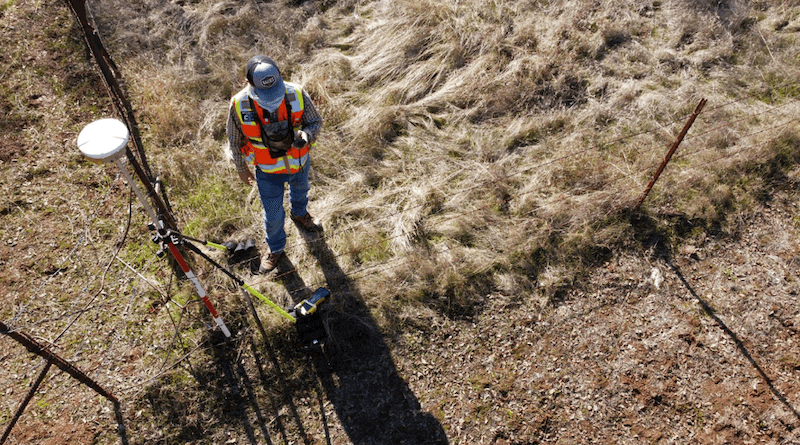
Understanding RTK Data Coverage: Why Access to a Large Base Station Network Matters
Achieving centimeter-level positioning accuracy in the field depends not only on a high-quality GNSS receiver, but also on the differential correction network behind it. Factors such as base station proximity, signal quality, system uptime, and regional coverage all affect positioning reliability. Service providers like RTKdata, with extensive base station networks, help field teams maintain consistent RTK performance across diverse terrain.

Highlights
- RTK technology improves GNSS positioning from meter-level to centimeter-level accuracy by transmitting real-time differential corrections from ground-based reference stations to rover receivers.
- Shorter distances between base stations and rovers reduce atmospheric and ionospheric errors, directly improving the accuracy of RTK correction data.
- A dense, multi-station network enables seamless failover between stations, ensuring uninterrupted centimeter-level positioning even when individual stations go offline.
- RTKdata provides field teams with access to a large base station network, supporting consistent high-accuracy RTK coverage for agriculture, surveying, and autonomous drone operations.
- When selecting an RTK correction service, field teams should assess base station density, system uptime, regional coverage, and real-time data transmission latency.
Understanding RTK Data Coverage: Why Access to a Large Base Station Network Matters
Precise field positioning is not solely determined by the quality of a GNSS receiver. The differential correction network underpinning that receiver is equally critical — base station distance, signal quality, system uptime, and regional availability all directly influence the stability of the final positioning result.
What Is an RTK Differential Correction Network?
RTK (Real-Time Kinematic) technology uses ground-based reference stations to transmit differential correction data to a rover receiver in real time, elevating positioning accuracy from the meter level to the centimeter level. However, a single base station has a limited effective range; once operations extend beyond that radius, positioning error increases significantly.
Why Does the Number of Base Stations Affect Positioning Quality?
When field teams work with an RTK service provider that operates a large, widely distributed base station network, several key advantages emerge:
- Shorter baseline distances: The closer the base station, the smaller the atmospheric delay and ionospheric error, resulting in more accurate correction data.
- Improved signal stability: A dense network allows seamless failover to a neighboring station if a single station loses signal, ensuring uninterrupted operations.
- Stronger regional coverage: Remote areas, mountainous terrain, and agricultural hinterlands often lack RTK infrastructure; a broad network fills these gaps.
- Higher system availability: Multi-station redundancy effectively reduces the risk of operational downtime caused by a single point of failure.
The Network Advantage of RTKdata
By adopting a service provider such as RTKdata — one with access to a large number of base stations — field teams can continuously receive high-quality differential correction signals across a wider geographic area. Whether the application is agricultural spraying, surveying and mapping, or autonomous drone navigation, reliable RTK coverage is a fundamental prerequisite for ensuring operational accuracy and efficiency.
Key Considerations for Real-World Applications
When selecting an RTK differential correction service, field teams should evaluate the following criteria:
- Base station density: Is the distribution of stations within the service coverage area sufficiently dense?
- System uptime: Does the provider's network demonstrate high reliability and low downtime rates?
- Regional suitability: Does the intended work area fall within the provider's effective coverage zone?
- Data transmission latency: Is the real-time delivery of correction data fast enough to meet operational requirements?
Precise positioning is a core requirement for modern drone operations, precision agriculture, and geospatial surveying. Choosing an RTK service provider with an extensive base station network is a vital strategy for securing centimeter-level accuracy and reducing risk in the field.
原文來源: 查看原文
FAQ
Newsletter
Subscribe to our Low-Altitude Industry Newsletter
Daily curated news on low-altitude economy and drone industry, delivered to your inbox.