Ukraine's SBU Drones Strike Su-30 Hangars at Russia's Saki Air Base in Crimea
Ukraine's Security Service (SBU) claims its drones struck the Saki military air base in Russian-occupied Crimea on the night of July 1, 2026, scoring five hits and igniting a hangar reportedly housing Su-30SM fighter jets valued at $30–50 million each. The operation is part of a 40-day long-range strike campaign authorized by President Zelensky.

Highlights
- Ukraine's SBU claims drone strikes on Saki air base in occupied Crimea on July 1, 2026 scored five hits and ignited a hangar housing Su-30SM fighters.
- Each Su-30SM aircraft is estimated by the SBU to be worth between $30 million and $50 million depending on configuration.
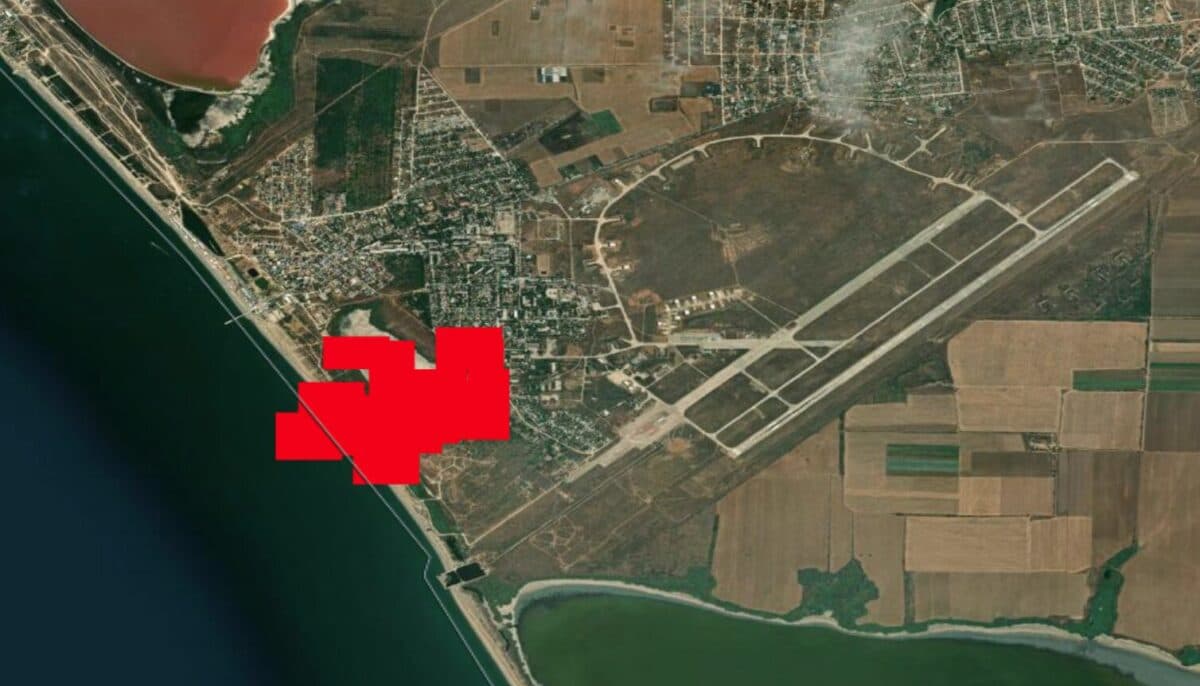
- NASA FIRMS satellite data detected thermal anomalies near Saki air base after the attack, though not directly over hangars or aircraft parking areas.
- The strike is part of a Zelensky-authorized 40-day long-range campaign also targeting a refinery in Ufa and a missile-component facility in Penza.
- Russia historically stores aircraft in unfortified hangars rather than hardened shelters; construction of concrete shelters at some bases only began after large-scale Ukrainian drone raids in June 2025.
Ukraine's SBU Drones Strike Su-30 Hangars at Russia's Saki Air Base in Crimea
Ukraine's Security Service (SBU) has announced that its drones attacked the Saki military air base in Russian-occupied Crimea on the night of July 1, 2026, scoring five direct hits and starting a fire inside a hangar reportedly sheltering Sukhoi Su-30SM fighter jets.
Attack Details
In an official statement, the SBU said the operation targeted airport infrastructure — specifically hangars used to store combat aircraft. According to preliminary intelligence cited by the agency, Su-30 and Su-30SM fighters were present in two hangars at the time of the strike. The SBU stated that the hangar housing the Su-30SM aircraft subsequently caught fire, which it cited as evidence of a successful hit. The agency estimated each aircraft to be worth $30–50 million, depending on variant and configuration.
The Su-30SM is a twin-seat, twin-engine multirole fighter developed by Russia's Irkut Corporation for the Russian Aerospace Forces and Naval Aviation. Aircraft of this type deployed in Crimea have been used to conduct airstrikes and patrol missions over the Black Sea against Ukraine.
Independent Verification Difficult
The claims have not been independently verified. As of the time of reporting, Russian authorities had made no public comment on the incident. Damage assessments released immediately after operations in occupied territory are historically difficult to confirm from open sources.
NASA FIRMS (Fire Information for Resource Management System) data reviewed by AeroTime showed thermal anomalies near Saki air base following the reported attack, though the heat signatures were not directly over the aircraft parking areas or hangars.
Part of a 40-Day Long-Range Strike Campaign
The SBU said the strike forms part of a 40-day long-range campaign authorized by President Volodymyr Zelensky, aimed at increasing pressure on Moscow to move toward an end to the war. Ukraine has simultaneously announced strikes on Russian oil and defense-industrial targets, including a refinery in Ufa and a facility in the Penza region linked to missile component production.
A Repeatedly Targeted Site
Saki air base — also known as Novofedorivka air base — is one of Russia's primary military aviation installations on the Crimean Peninsula and has been struck multiple times since 2022.
The targeting of hangars is notable. Unlike many air forces, Russia has historically tended to store aircraft in the open or in unfortified hangars rather than hardened aircraft shelters, relying instead on geographic dispersal across its vast territory to reduce vulnerability. It was only after Ukraine's large-scale drone raids on Russian strategic bomber bases in June 2025 that Russian forces began constructing concrete shelters at some airfields.
The SBU stated it would continue to strike Russian military assets both at the front line and in the rear.
原文來源: 查看原文
FAQ
Newsletter
Subscribe to our Low-Altitude Industry Newsletter
Daily curated news on low-altitude economy and drone industry, delivered to your inbox.