Schiebel S-300 Unmanned Helicopter Selected as Air Platform for Europe's SWORD Anti-Submarine Warfare Program
Austria's Schiebel has seen its heavy-lift Camcopter S-300 selected as the airborne platform for the European Defence Fund's SWORD anti-submarine warfare program. The 36-month initiative, funded at over €19.9 million, aims to enable warships to detect, track, and neutralize submarine threats from standoff distances using unmanned helicopters.

Highlights
- Schiebel's Camcopter S-300 selected as the airborne platform for the EDF-funded SWORD anti-submarine warfare program.
- SWORD program has over €19.9 million in funding and a 36-month timeline, led by TKMS ATLAS ELEKTRONIK.
- The S-300 carries up to 250 kg payload with 24-hour max endurance, a 200 km datalink range, and 660 kg max takeoff weight.
- The program aims to build a complete sensor-to-shooter kill chain enabling warships to engage submarines from standoff distances.
- SWORD is a concept study, not an operational system — sensor suites and weapons integration are still being defined.
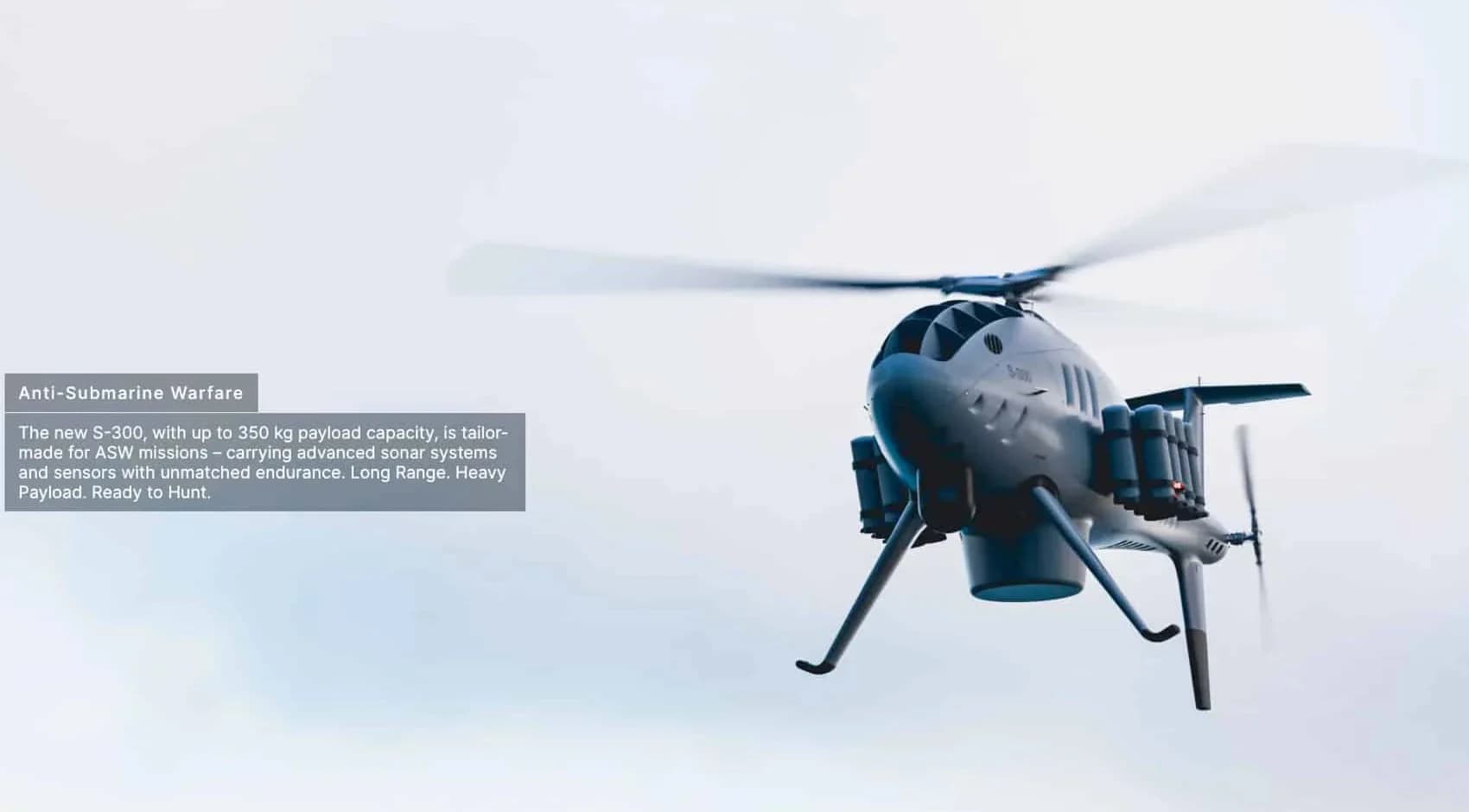
Europe has just selected an unmanned helicopter to help hunt submarines — and it's not the smaller model Schiebel is best known for. The Austrian company's heavy-lift Camcopter S-300 has been chosen as the airborne platform for the SWORD program, a European Defence Fund (EDF)-backed initiative aimed at developing a new way to detect and destroy underwater threats from a safe standoff distance.
For now, this remains a concept study, but the direction is clear: Europe wants drones to carry out one of the most dangerous missions in naval warfare.
What the SWORD Program Really Means
SWORD stands for "Stand-off anti-submarine Warfare Operations by Remote Deployment" — a name that spells out its core concept. The goal is to allow warships to detect, track, classify, and neutralize submarines without having to sail into threat zones.
The program runs for 36 months with total funding exceeding €19.9 million (approximately $23.1 million), provided by the European Defence Fund. The significance of that funding is notable: the EDF only backs projects that multiple member states collectively want to develop into real operational capability.
The program is led by a consortium headed by TKMS ATLAS ELEKTRONIK, bringing together defense and technology partners from across Europe to design what the industry calls a "sensor-to-shooter chain."
In plain terms, the objective is to build an unbroken kill chain from the moment a sensor detects a submarine to the point a weapon is launched to neutralize it. ATLAS ELEKTRONIK is a logical choice to lead the effort — the German company has been building naval sonar and underwater systems for European fleets for decades.
Why an Unmanned Helicopter for This Mission
Anti-submarine warfare (ASW) has always been grueling, protracted, and expensive. Finding a quiet submarine across vast stretches of ocean typically means sending crewed helicopters on hours-long sorties, dropping listening devices, and putting aircrews at risk in hostile waters.
Unmanned platforms change that equation. Drones can stay airborne far longer than human endurance allows, venture into dangerous airspace without risking pilots' lives, and carry the sensors ASW demands to the areas where submarines actually operate. That last point is precisely why payload capacity matters so much — and why Europe passed over Schiebel's lighter models.
To be precise, SWORD is currently a concept and design study, not an operational ASW system already flying patrols. Sensor configurations, exact mission payloads, and weapons integration schemes are what this 36-month program is designed to define, not capabilities already installed.
S-300 Hardware Specifications
The Camcopter S-300 is a significant step up from the combat-proven S-100. The S-100 has logged years of operational maritime service aboard frigates and offshore patrol vessels worldwide, but its payload capacity tops out at roughly 110 lbs (50 kg). The S-300 can carry up to 551 lbs (250 kg) — nearly five times as much.
Its specifications place it firmly in the heavyweight category for rotary-wing drones. Schiebel lists a maximum takeoff weight of 1,455 lbs (660 kg) and a 300-liter (79-gallon) fuel tank that enables up to 24 hours of endurance on a full load.
At the maximum 250 kg payload, endurance drops to approximately 6 hours — a tradeoff between time on station and sensor load that every ASW mission planner must navigate.
For range and speed, the S-300 offers a datalink communication range of up to 124 miles (200 km), a top speed approaching 137 mph (220 km/h), a cruise speed of 62 mph (100 km/h), and an operational ceiling of 21,000 feet (6,400 meters). This combination of payload, endurance, and range is what makes it feasible for a single drone to carry meaningful ASW sensors far enough out to sea.
The Strategic Big Picture
The timing is no coincidence. European navies are watching the sharp increase in Russian submarine activity across the North Atlantic and the Baltic Sea with growing concern. The undersea domain has become one of NATO's most pressing worries — from quiet attack submarines to threats against undersea cables and pipelines.
Crewed ASW assets are scarce and expensive. Maritime helicopters like the MH-60R are highly capable, but there are never enough of them, and every flight hour drains budgets and aircrew stamina. A heavy-lift drone that can launch from a ship's deck and stay airborne far longer than any crewed aircraft offers a way to expand detection coverage without adding personnel.
That is the bet SWORD is making. If the concept proves viable, a single frigate could use unmanned helicopters to push its detection bubble well beyond the horizon, keeping ships and sailors outside a submarine's engagement envelope while still completing the full kill chain.
Editorial Perspective
What really deserves attention here is that this represents heavy-lift drones transitioning from pure reconnaissance tools into weapons-system platforms for one of the navy's most demanding missions. ASW is not a domain where toys will suffice. Europe's choice of the S-300 over the lighter S-100 is an acknowledgment that drone payload and endurance have reached the point where real undersea warfare missions are feasible.
A reality check is warranted, however. SWORD is a 36-month study. There is a long road between a funded concept and a frigate actually using a drone to guide a weapon onto a submarine. Concept funding does not equal deployment, and ASW has humbled far better-funded programs in the past.
Still, the strategic logic is hard to argue with. Submarines are getting quieter, European waters are getting busier, and crewed aircraft are getting more expensive. A drone that can loiter for 24 hours and carry 250 kg of sensors into contested waters is a solution matched to the problem.
Schiebel has placed its largest aircraft at the center of Europe's undersea future, and the rest of the industry is watching to see whether the concept can survive the demands of the open ocean.
原文來源: 查看原文