Skydio CEO Publicly Reverses 'No Weapons' Pledge, Calls Drawing Ethical Lines a 'Dangerous Mistake'
In an appearance on The Verge's Decoder podcast, Skydio CEO Adam Bry walked back the company's six-year-old pledge never to weaponize its drones, confirmed that the U.S. Army has tested grenade launchers on Skydio platforms, and argued that companies setting their own ethical red lines is a 'dangerously misguided' impulse. Bry also admitted that Skydio's manufacturing still trails China's and that its supply chain contains Chinese components beyond the first tier.

Highlights
- Skydio CEO Adam Bry在2025年6月15日的Decoder podcast中,公開推翻公司2020年「不在無人機上裝載武器」的原則聲明,稱劃定道德紅線是「危險的錯誤」。
- Bry確認美國陸軍在德國格拉芬沃爾訓練場,使用3D列印彈藥投放器從Skydio X10D投下真實M67手榴彈。
- Bry承認Skydio目前不是「世界級製造商」,中國在無人機製造上仍優於Skydio,並坦承供應鏈第二、三層仍含難以追溯的中國成分。
- FCC於2025年12月22日將DJI列入涵蓋清單,DJI估計禁令將導致其今年美國收入損失約15.6億美元,而Skydio曾長期遊說推動這一結果。
- 在紐約市「No Kings」抗議現場,NYPD的Skydio無人機長時間懸停於人群上方,與Bry所稱「僅針對已知緊急事件出動」的定位相矛盾。
Skydio CEO Reverses Weapons Pledge, Calls Ethical Red Lines a 'Dangerous Mistake'
On the June 15 episode of The Verge's Decoder podcast, Skydio CEO Adam Bry distanced himself from a company commitment — still live on the Skydio website — never to arm its drones. Speaking with host Nilay Patel, Bry said: "This is an area where I got some things wrong before," and went on to argue that companies that draw their own ethical limits on technology will ultimately end up "on the wrong side of the moral question."
The position reversal was the most newsworthy moment in a wide-ranging interview and deserves more attention than it has received. A company whose official principles state it "will not weaponize drones" now has a CEO saying weaponization is "not our call to make." Bry confirmed that the U.S. Army has tested grenade launchers mounted on Skydio drones, and that internal voices pushing to halt those experiments were overruled.
Patel framed the question against the backdrop of AI companies, citing Anthropic as an example of a firm publicly deliberating over where to draw lines on military use. Bry took the opposing view, arguing that explicit refusals create "adverse selection" — because the actors who comply with terms of service are, by definition, the responsible ones, while adversaries and terrorists ignore them entirely. The logic has internal consistency, but it represents a significant departure from the principles Skydio articulated at its founding.
Image credit: The Verge / Skydio
The Weapons Reversal Is the Real Headline
When Patel asked directly whether Skydio had ever told the military that certain uses were off-limits, Bry acknowledged that the company's earlier language had created an expectation it no longer honors. He stated that Skydio's past statements had led people to believe the company would not allow weapons to be mounted on its drones — and that it no longer holds that position.
This is not a casual aside. Skydio's official Engagement and Responsible Use Principles state in plain language: "We will not weaponize drones and are opposed to fully autonomous lethal weapons systems." That text was written six years ago, in July 2020, when Skydio was still selling consumer drones and had not yet become a defense contractor performing weapons integration work for the Army.
What makes the situation more striking is that the language remains on the Skydio website as of 2026. Rather than avoid the subject, Bry directly acknowledged it and retracted the first half of the commitment. He confirmed that the Army's grenade launcher tests involved ordnance mounted on a Skydio drone — precisely what the company's principles said it would not do.
Bry did not explicitly repudiate the second half of the pledge — opposition to "fully autonomous lethal weapons systems" — because the grenade delivery tested by the Army remained under human operator control.
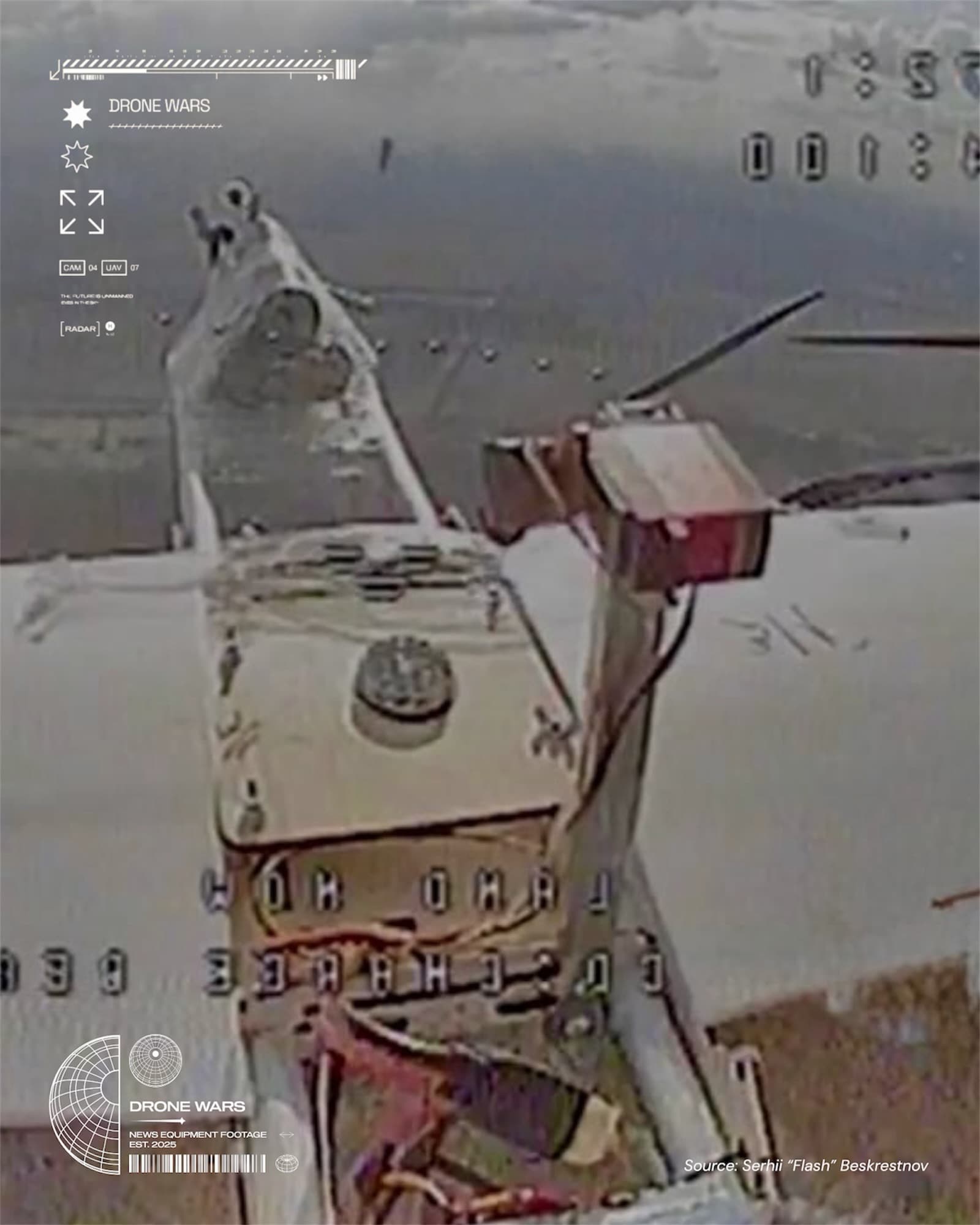
The core of Bry's argument rests on dual-use reality. A sensor platform capable of inspecting power lines, he contends, already possesses the flight endurance, payload capacity, and reliability required for military intelligence, surveillance, and reconnaissance missions. According to DroneXL's June 2025 reporting, U.S. soldiers at the Grafenwöhr Training Area in Germany dropped live M67 grenades from a Skydio X10D using a 3D-printed munitions dispenser. Bry's position is that uniformed military personnel, accountable to elected civilian leadership, are better placed to make those judgments than engineers in a Silicon Valley office. "It's not our place to tell them what they can and can't do," he said.
He argued further that seeking "purity" through red lines only ensures that responsible buyers walk away, while adversaries and terrorists — who never respected terms of service — carry on regardless. "You mostly just end up on the wrong side of moral questions," he said, calling the impulse to craft such policies "dangerously misguided."
The argument is worth taking seriously: adverse selection is a genuine problem, and adversaries do ignore export controls. But the argument also removes all constraints from a defense contractor's product roadmap — and it is being made by the CEO of that contractor. A position can be intellectually defensible and self-serving at the same time. This one is both.
The DJI Lobbying Context Goes Largely Unaddressed
The interview aired after the FCC had already delivered the outcome Skydio spent years lobbying for. In its December 22, 2025 ruling, the FCC placed DJI on its Covered List, blocking new equipment authorizations. DJI subsequently filed for review with the Ninth Circuit Court of Appeals (Case No. 26-1029), estimating the ban will cost approximately $1.56 billion in U.S. revenue this year.
Patel stated the structure plainly: by removing a low-cost competitor that serves frontline first responders, the government has "handed Skydio a gift," allowing the company to sell premium solutions to customers who now have no alternative. Bry did not contest the framing, redirecting instead to capability and mission cost-effectiveness.
What he did not address was Skydio's own role in delivering that gift. DroneXL has reported extensively on Skydio's lobbying campaign against DJI. Bry acknowledged the company's lobbying operation at a Skydio Ascend event, describing its goals as securing customer budgets and shaping regulatory frameworks, and noting that a competitor — almost certainly DJI — was outspending Skydio on lobbying by a factor of four.
In the podcast, Bry said that "from a product development perspective, I don't really care whether Chinese drones are allowed in the market." That is a remarkably convenient indifference for a company that spent years lobbying to keep them out.
Bry Acknowledges Manufacturing Gap and Chinese Components
The most practically useful admissions in the interview came when Patel pressed on manufacturing. "I don't think we're a world-class manufacturer today," Bry said. "China is still better at manufacturing drones than we are." He expressed confidence that Skydio can close the gap, pointing to a commitment to invest $3.5 billion in U.S. manufacturing over five years — but the concession aligns precisely with what DroneXL has reported over time: at comparable price points, DJI builds better hardware. Skydio sells autonomous flight capability, a dock-based infrastructure architecture, and a procurement narrative that clears federal grant requirements.
On pricing, Bry corrected some of Patel's figures. He stated that the X10 unit, without cloud software and advanced sensor packages, costs approximately $15,000, rather than the $25,000 annual figure Patel cited; the R10 indoor drone is $6,000. His argument is that dock-based autonomous fleets generate five to ten times the flight volume of manually piloted drones, making per-mission cost favorable to Skydio once pilot training and labor are factored in.
That calculus holds for large institutions. For the volunteer fire departments Patel repeatedly invoked — who previously had access to a handful of affordable DJI units — a $6,000 entry point is cold comfort.
On Chinese components, Bry's answer was direct: "very, very, very, very few," followed by a more significant admission: "Anyone who claims their product has zero Chinese content is kidding themselves, because at the second and third tier of the supply chain it's very hard to trace."
His position is that Skydio's tier-one suppliers for camera modules, sensors, processors, and circuit boards have now moved out of China. Below that level — passive components, raw materials two or three tiers down — he cannot guarantee the picture.
This admission carries weight coming from this particular CEO. Skydio's entire market positioning rests on being a "secure, American-made" alternative to Chinese-manufactured DJI products. The FCC's Covered List rationale is built on the premise that Chinese supply chains represent a national security risk. Bry acknowledging that his own drones contain difficult-to-trace Chinese content beyond tier one complicates that premise considerably.
That vulnerability struck Skydio directly in October 2024, when Beijing sanctioned the company, severing its sole battery supplier and forcing Skydio to ration one battery per drone for several months. Bry told Patel that dependency has been resolved. He also acknowledged the deeper supply chain problem has not been.
Bry Calls Skydio a 'Flying Body Camera' — But NYPD Deployments Tell a Different Story
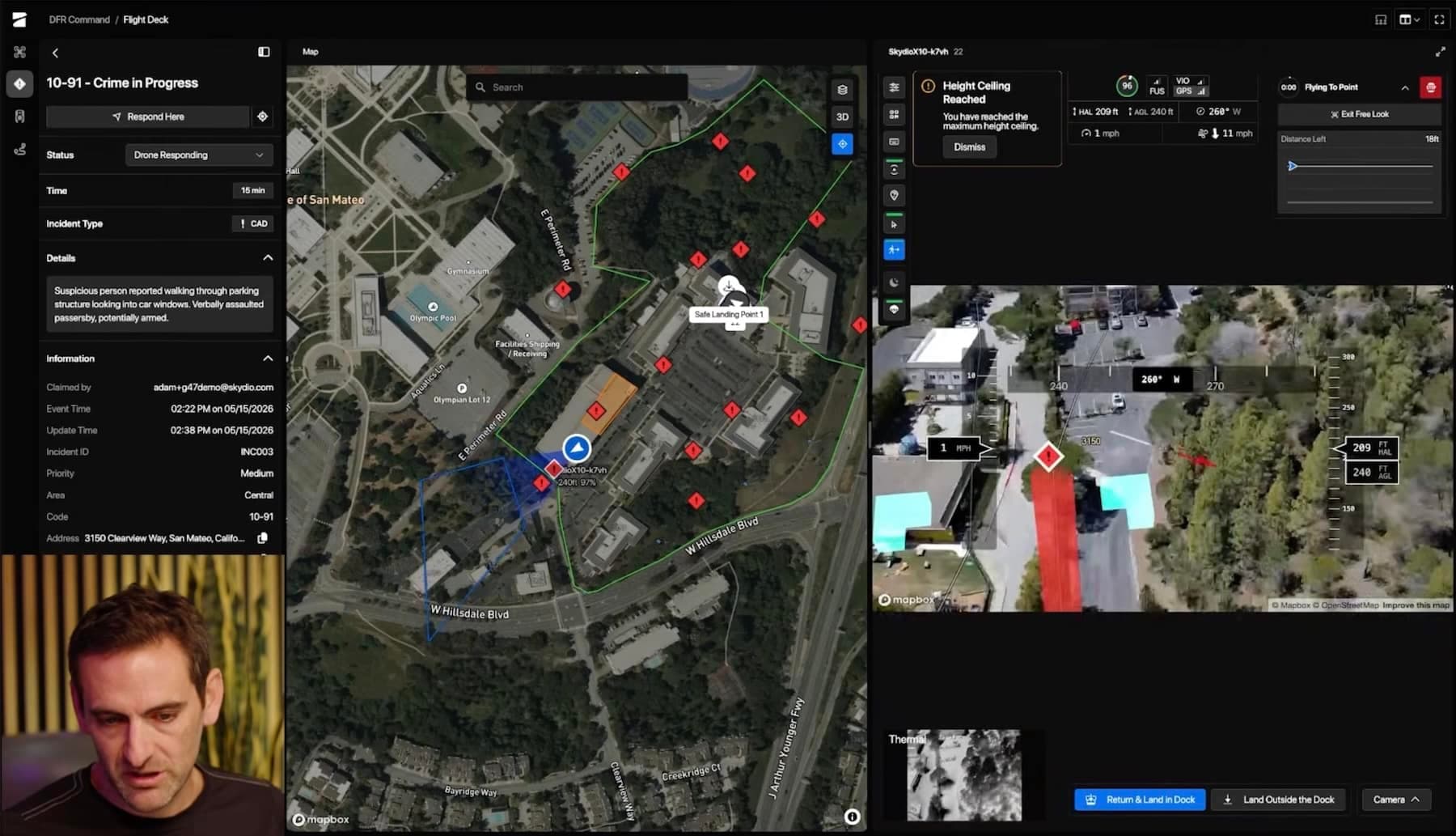
Patel raised pointed questions about pervasive surveillance, the militarization of policing, and whether communities have genuine input into Skydio procurement decisions. Bry's response was that drone response is the inverse of surveillance: he described Skydio drones as "like a flying body camera" — a precise, targeted tool dispatched to a known emergency rather than a passive data-collection apparatus continuously blanketing a city. He contrasted Skydio with always-on license plate readers like those operated by Flock Safety, and cited Skydio's transparency dashboard, which publishes drone flight paths and ground coverage.
That framing did not hold up to direct observation. At New York City's "No Kings" protests, NYPD Skydio drones were not flying search patterns. They were not responding to incidents. They were hovering above crowds, descending only to swap batteries before returning to the same position directly overhead. That is passive, persistent, fixed-point surveillance — precisely what Bry told Decoder his drones do not do.
A "flying body camera" describes a drone dispatched to a specific emergency and stood down when the situation resolves. What flew above those crowds was a stationary eye suspended over a lawful demonstration for hours at a time. The gap between those two descriptions is not a technical footnote. It is the central issue.
The accountability mechanisms Bry cited exist on paper: police drone contracts do require city council approval, transparency dashboards do publish flight logs, and residents can attend hearings to object. None of those mechanisms prevented what happened above the "No Kings" protests. A dashboard that records where a drone went after the fact does not constrain a department that decides to park a drone above a protest. "You can petition the city council" is hollow consolation for people being surveilled from the air in real time.
The question is not whether those flights were documented. The question is whether continuous surveillance of lawful protest should be something these drones do at all.
DroneXL Editorial Note
Bry is a capable interview subject, and this was a substantive conversation. Patel pushed hard, and Bry engaged seriously rather than deflecting — a higher standard than many defense-adjacent executives meet. But the headline is still the reversal on weapons, and it should not be obscured by the quality of the exchange.
Skydio's website still carries the words "we will not weaponize drones." Its CEO chose not to quietly remove that language. Instead, he went on a nationally distributed podcast and called the impulse behind it "dangerously misguided" — days after the federal government cleared his company's largest competitor from the market. Those principles are six years old and may no longer reflect company policy. That is precisely the point: a company cannot simultaneously retain reassuring language on its website and walk back the commitment it represents in a podcast interview.
Bry wants maximum latitude to develop whatever the military needs, and he wants DJI out of the market. He is entitled to pursue both. He is not entitled to make either look like principle.
The surveillance answer unravels the same way, and in this case there was direct firsthand observation to draw on. Bry told Patel that Skydio drones are precision-response tools — "like a flying body camera" — not passive collection platforms. At the "No Kings" protests in New York City, NYPD's Skydio drones flew no search patterns, responded to no incidents, and simply hovered above the crowd, returning to the same position after every battery swap. That is passive, persistent surveillance of protesters. That is exactly what Bry said his drones do not do. The description was clean. What those drones did above those crowds was not.
原文來源: 查看原文
FAQ
Newsletter
Subscribe to our Low-Altitude Industry Newsletter
Daily curated news on low-altitude economy and drone industry, delivered to your inbox.