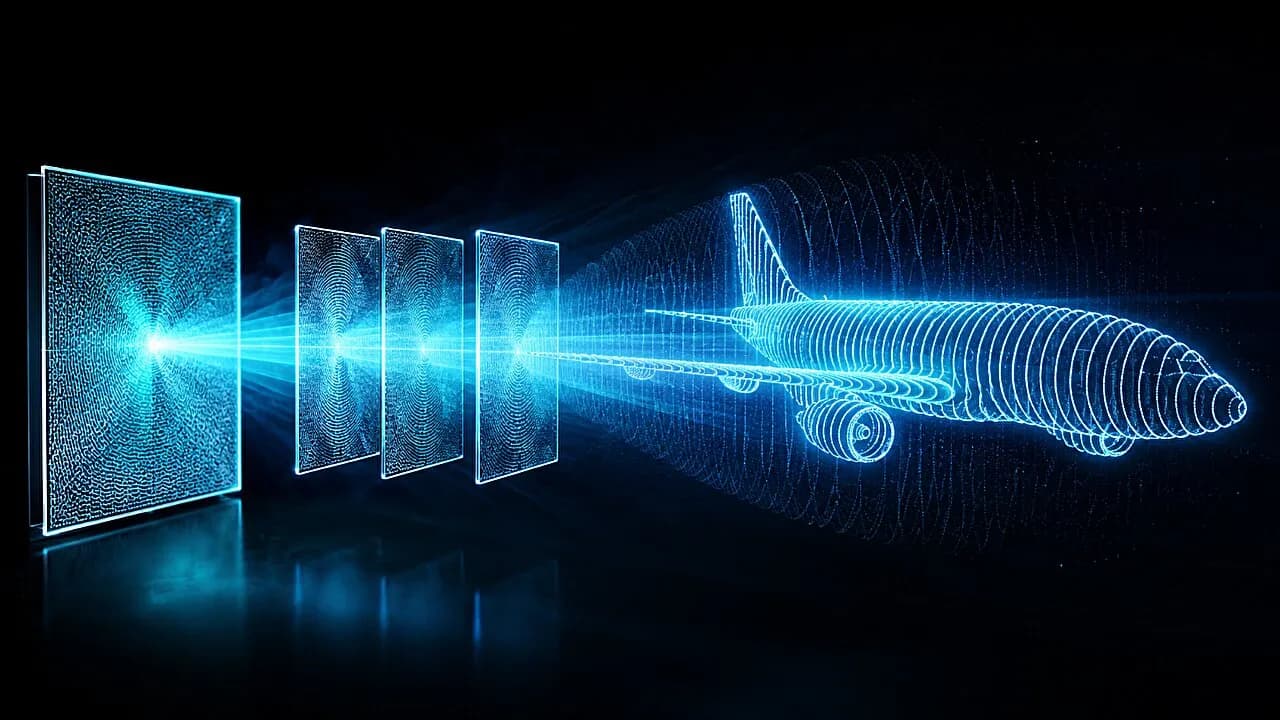
UCLA Research Team Achieves 28-Layer Simultaneous 3D Projection via Deep Learning Co-Design, Eliminating Inter-Layer Crosstalk
Engineers at UCLA's Samueli School of Engineering have developed a 3D image projection system capable of simultaneously displaying 28 independent depth layers in a single optical exposure. The system combines a deep learning digital encoder with a diffractive optical decoder to eliminate crosstalk and blurring in volumetric projection—with potential applications in AR/VR headsets, medical imaging, and optical computing.

Highlights
- UCLA Professor Aydogan Ozcan's team developed a 3D projection system that simultaneously displays 28 independent depth layers in a single optical exposure.
- The digital-optical hybrid architecture pairs a deep learning encoder with diffractive optical decoder surfaces to physically suppress inter-layer crosstalk down to sub-wavelength plane spacing.
- A physical dual-plane prototype operating in the visible spectrum confirmed experimental results closely matched simulation targets, significantly outperforming unaided free-space optics.
- The system supports dynamic depth adjustment without modifying the physical hardware, enabling flexible volumetric scene rendering.
- The research was published in Light: Science & Applications, with future work targeting full-color projection, multi-viewpoint holography, and commercially manufacturable multi-layer decoders.
UCLA Research Team Achieves 28-Layer Simultaneous 3D Projection via Deep Learning Co-Design, Eliminating Inter-Layer Crosstalk
Engineers at the University of California, Los Angeles (UCLA) have developed an advanced three-dimensional (3D) image projection system capable of simultaneously displaying 28 independent depth layers in a single optical exposure.
Led by Professor Aydogan Ozcan of UCLA's Samueli School of Engineering and the California NanoSystems Institute (CNSI), the research introduces a compact architecture designed to advance next-generation holographic displays, medical imaging, and virtual reality interfaces.
The study details a digital-optical hybrid architecture that addresses long-standing challenges of visual distortion and inter-layer crosstalk in dense 3D imaging.
Conventional multi-layer volumetric projection methods typically suffer from image degradation when focal planes are spaced too closely together. As the light fields of individual layers overlap, light leaks between planes, causing a reduction in depth clarity, significant blurring, and diminished visual sharpness for the viewer.
Deep Learning and Light-Field Programming
To overcome these limitations, the UCLA team used deep learning to jointly optimize a digital computational encoder and a passive physical optical decoder.
The system works by feeding target visual data into a digital neural network with explicit depth and coordinate instructions. The network compresses multi-layer structural information into a single unified phase pattern representing the entire 3D volumetric space.
As light passes through the system, it traverses a series of structurally optimized diffractive surfaces that act as analog decoders, physically manipulating light waves to direct specific image components precisely to pre-designated depth planes.
This precise "light-field programming" technique enables the system to suppress data leakage between adjacent layers, maintaining clear visual separation even when inter-plane spacing approaches the scale of a single optical wavelength.
Scalability and Experimental Validation
Through numerical simulation, the research team demonstrated that the architecture scales effectively to segment complex volumetric scenes into 28 independent axial slices.
The system also features dynamic adjustment capabilities, allowing operators to change the target depth position of projected images on demand without modifying the core physical architecture.
To validate the practical feasibility of this digital-optical processing pipeline, researchers constructed a physical dual-plane hardware prototype using a single-layer optical decoder operating in the visible spectrum.
Experimental measurements confirmed that the projected light-field distribution closely matched target designs and computational simulation results. The experimental setup significantly outperformed unaided free-space optical systems, validating the design's stability and accuracy in real-world conditions.
Future Integration and Applications
The compact encoder-decoder architecture provides an energy-efficient foundation for high-resolution volumetric imaging. Beyond direct integration into near-eye augmented reality (AR) and virtual reality (VR) headsets, the technology shows potential for multi-depth microscopy, real-time 3D medical visualization, and optical computing.
Looking ahead, the research team plans to further expand the architecture's capabilities, exploring multispectral computation to support full-color projection, multi-viewpoint holography, and the integration of physically stacked multi-layer decoders suitable for commercial manufacturing.
The findings have been published in the academic journal Light: Science & Applications.
原文來源: 查看原文
FAQ
Newsletter
Subscribe to our Low-Altitude Industry Newsletter
Daily curated news on low-altitude economy and drone industry, delivered to your inbox.