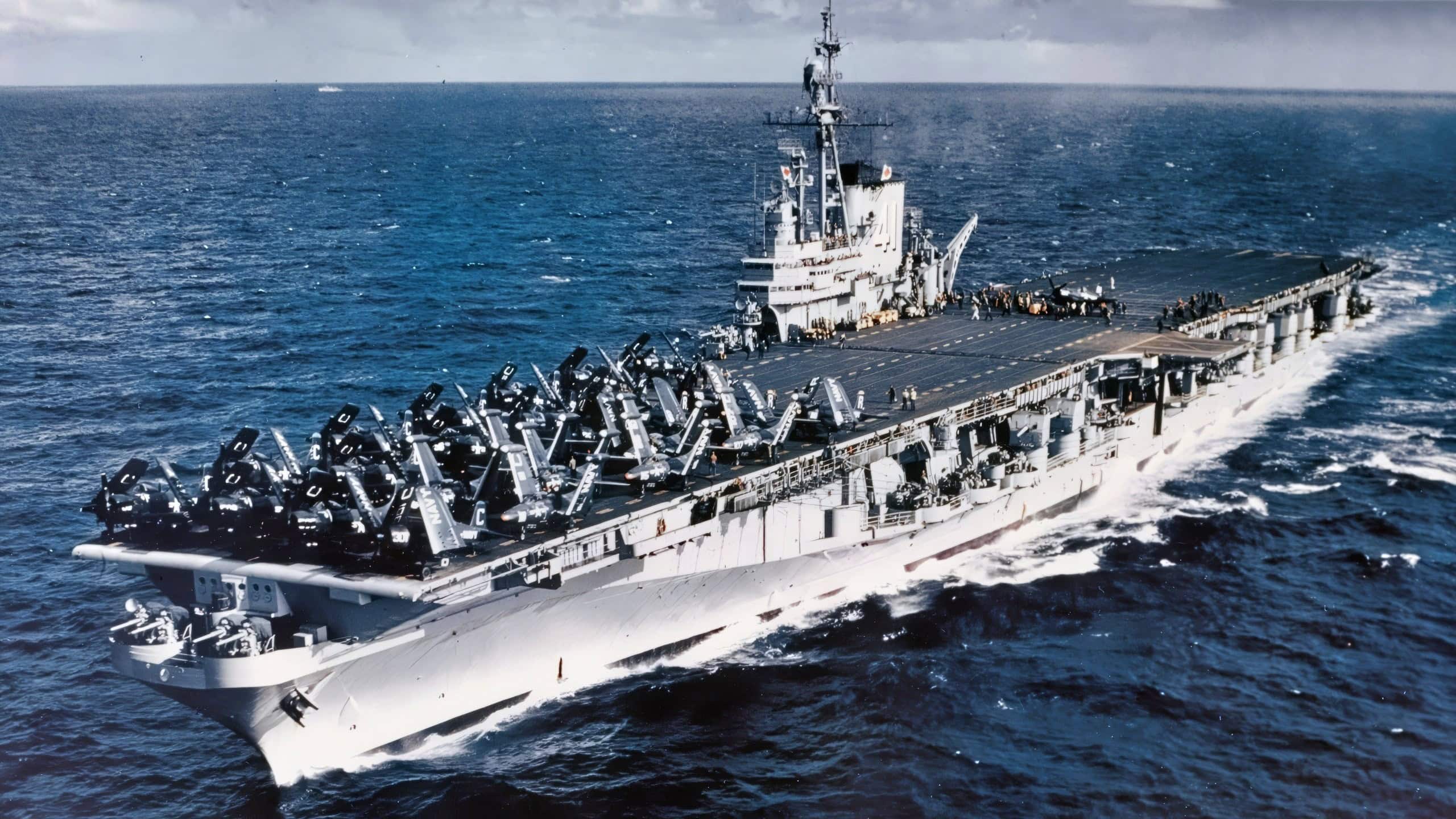
USS Midway (CV-41): Missed World War II by Eight Days, Served for 47 Years
USS Midway (CV-41) was commissioned on September 10, 1945 — just eight days after Japan's formal surrender — missing the war it was built for. Yet the carrier went on to serve for 47 years, seeing action in the Vietnam War, the evacuation of Saigon, and Operation Desert Storm, where it flew over 3,000 combat sorties without a single aircraft lost. Today it serves as a museum ship in San Diego.

Highlights
- USS Midway (CV-41) was commissioned on September 10, 1945 — eight days after Japan's surrender — making her the first major U.S. carrier to enter service after World War II ended.
- During Operation Desert Storm (1991), Midway's air wing flew 3,339 combat sorties and delivered over 2,000 tons of ordnance with zero aircraft losses.
- In April 1975 during Operation Frequent Wind, Midway's helicopters evacuated 3,073 refugees from Saigon as South Vietnam collapsed.
- Midway underwent a major refit and returned to service on September 30, 1957, equipped with an angled flight deck and enclosed bow to accommodate jet aircraft operations.
- USS Midway served for 47 years before decommissioning in 1992 and now operates as a public museum ship in San Diego, opened in June 2004.
USS Midway (CV-41): Missed World War II by Eight Days, Served for 47 Years
USS Midway (CV-41) was officially commissioned on September 10, 1945 — just eight days after Japan signed the instruments of surrender aboard USS Missouri. Built on the hard-won lessons of the Pacific War, the carrier arrived too late for the conflict that shaped her, then went on to serve the U.S. Navy until 1992.
That extraordinary length of service makes the Midway class worth closer examination. These were not wartime mass-production vessels like the Essex class; they were large, armored-deck carriers designed from Pacific combat experience, and they adapted continuously to a future that arrived faster than anyone had anticipated.
Heavier jets, higher landing speeds, revised deck layouts, catapults capable of handling aircraft far more demanding than wartime propeller planes — the Midway class served as the bridge between wartime carrier design and the modern supercarrier era.
Midway, Franklin D. Roosevelt, and Coral Sea were the only three ships of the class, each following a different service path while collectively illustrating why the postwar U.S. Navy needed larger carriers.
USS Midway: The Carrier That Missed the War
According to official U.S. Navy historical records, Midway was commissioned on September 10, 1945, under the command of Captain Joseph F. Bolger. At that moment she was the largest ship in the world and the first U.S. carrier too large to transit the Panama Canal.
The timing carries particular significance. Midway was not a combat vessel of World War II — she was a carrier built on its lessons and commissioned after the guns fell silent. That places her in a unique position in U.S. naval history: she came after the war that created her, yet before the Cold War that would define her.
The USS Midway Museum notes that the ship was constructed in 17 months, missed World War II by roughly one week, and entered service as the lead vessel of a three-ship class equipped with an armored flight deck and an air wing of 120 aircraft. The museum describes Midway as the 20th century's longest-serving aircraft carrier; her 47-year service life ended on April 11, 1992, in San Diego, and she opened as a museum ship in June 2004.
Why Was the Midway Class Larger Than the Essex Class?
Although the Midway class followed the Essex class, it represented an entirely different design generation. The Essex class gave the Navy the numbers it needed in wartime; the Midway class offered a larger, better-protected answer to the realities of carrier warfare revealed in the Pacific.
The armored flight deck was the central design logic. British carriers had demonstrated the value of deck armor against air attack, and American wartime experience had shown how vulnerable flight decks were to bombs, kamikaze strikes, fires, and structural damage. The Navy wanted a carrier that could absorb punishment and keep launching aircraft.
The trade-offs were significant: a heavier, larger ship required greater displacement and involved deeper design compromises. The Navy accepted the exchange because carrier aviation had become the core of fleet operations.
Three hulls made up the class. Franklin D. Roosevelt was laid down at the New York Navy Yard on December 1, 1943, launched April 29, 1945, renamed on May 8 of that year, and commissioned October 27, 1945. Coral Sea was launched by Newport News Shipbuilding on April 2, 1946, and commissioned October 1, 1947.
Only Midway survived into the 1990s, but all three ships faced the same postwar challenge: guiding the Navy from piston-engine carrier warfare into the age of jet aircraft, nuclear weapons, and Cold War power projection.
The Jet Age Forced a Transformation
Midway's original straight-deck flight deck reflected the design assumptions of her era — a layout suited to World War II aircraft but ill-adapted to heavier, faster jets. Jet aircraft changed landing speeds, catapult requirements, deck cycling, and safety margins in fundamental ways.
The angled flight deck became one of the most important postwar carrier innovations. An angled deck allowed aircraft that missed the arresting wires during landing to accelerate and go around without colliding with aircraft parked forward, enabling simultaneous launch and recovery operations.
Midway ultimately received an angled flight deck during a major modernization refit. Records from the Naval History and Heritage Command show she was withdrawn from service for conversion, returning to the fleet on September 30, 1957, with an enclosed bow and the new angled deck configuration.
The refit demonstrated both the class's strengths and its limits: Midway was large enough to be rebuilt for jet operations, but the scale of the work made clear that future carriers would need to be designed for the jet age from the keel up.
USS Midway in the Vietnam War
Midway's first combat deployment came during the Vietnam War. In 1965, the carrier conducted strikes against North Vietnam, transitioning from a postwar showpiece to an active combat ship. The Midway Museum records that during that deployment her aircraft shot down three MiG fighters — including the first aerial kill of the Vietnam War — while 17 Midway aircraft were lost to enemy action.
That record reflects the realities of Cold War carrier aviation. Built on World War II lessons, Midway's pilots and crews operated in a profoundly different air combat environment: surface-to-air missiles, MiG interceptors, radar-guided air defenses, and politically constrained rules of engagement.
Operation Frequent Wind: Saigon Evacuation
Midway's role in Operation Frequent Wind ranks among the most memorable chapters of her service. In April 1975, as South Vietnam's government collapsed, Midway served as a helicopter platform for the evacuation of Saigon.
The Midway Museum records that during the operation, the carrier's helicopters evacuated 3,073 refugees from Saigon. Accounts describe South Vietnamese military helicopters flying out to sea in search of a place to land; some were permitted to disembark passengers before being pushed overboard to clear deck space for incoming flights.
The mission bore no resemblance to the fleet engagements envisioned in the 1940s. Midway was not striking enemy warships — she was receiving refugees, directing helicopters, and clearing deck space in support of one of America's final operations of the Vietnam War.
Operation Desert Storm: Midway's Last Combat
Midway's final operational chapter unfolded in the Persian Gulf. Following Iraq's invasion of Kuwait in 1990, Midway deployed to the region and participated in the campaign to expel Iraqi forces. During Operation Desert Storm she served as flagship for naval air forces in the Persian Gulf and flew more than 3,000 combat sorties without losing a single aircraft.
Publications from the USS Midway Museum provide a more precise accounting: the carrier's air wing flew 3,339 combat sorties, dropped more than 2,000 tons of ordnance, and suffered no aircraft losses throughout the campaign.
For a ship commissioned in 1945, this was a remarkable achievement. Midway began her career as a postwar armored-deck carrier; by 1991 she was operating F/A-18 Hornets and A-6 Intruders over the Persian Gulf in a modern air campaign.
By that point Midway was no longer the Navy's newest or largest carrier — nuclear-powered Nimitz-class ships had redefined the upper bound of American carrier capability — but she could still generate combat sorties in a major war. That is the Midway class's achievement: not remaining unchanged, but adapting.
The Midway Class Pointed Toward the Supercarrier Era
The Midway class did not become the final form of American carrier design; it pointed toward the next one. Larger decks, larger air wings, heavier aircraft, greater aviation support, and the need for more growth margin all pushed the Navy beyond the limits of wartime carrier design.
USS Forrestal became the next major milestone. The Naval History and Heritage Command identifies Forrestal as the U.S. Navy's first supercarrier — designed from the outset for larger jet aircraft and postwar air wings. Where Midway required modernization to keep pace with the jet age, Forrestal represented a carrier conceived from the keel up for that era.
This does not diminish Midway's significance; it clarifies her role. Midway was the bridge — carrying the Navy from wartime armored decks and massed air groups across to angled decks, jet aircraft, and Cold War deployments.
Why USS Midway Still Matters
USS Midway was decommissioned in San Diego on April 11, 1992, held in the inactive fleet at Bremerton until 2003, then donated to the Aircraft Carrier Museum organization in San Diego. She opened as the USS Midway Museum in June 2004 and has since become one of the most visited preserved warships in the United States.
Midway missed World War II, but her service life spanned the early Cold War, the Vietnam War, the fall of Saigon, the Gulf War, and the opening of the post-Cold War era. Few American warships so clearly illustrate the sweeping transformation of naval aviation after 1945.
About the Author: Harry J. Kazianis
Harry J. Kazianis served as Senior Director of National Security Affairs at the Center for the National Interest, a Washington, D.C.-based think tank founded by Richard Nixon. His work has appeared in The New York Times, The Washington Post, The Wall Street Journal, CNN, and other international outlets. He has served as Executive Editor of The National Interest and The Diplomat, and holds a master's degree in international affairs from Harvard University.
原文來源: 查看原文
FAQ
Newsletter
Subscribe to our Low-Altitude Industry Newsletter
Daily curated news on low-altitude economy and drone industry, delivered to your inbox.