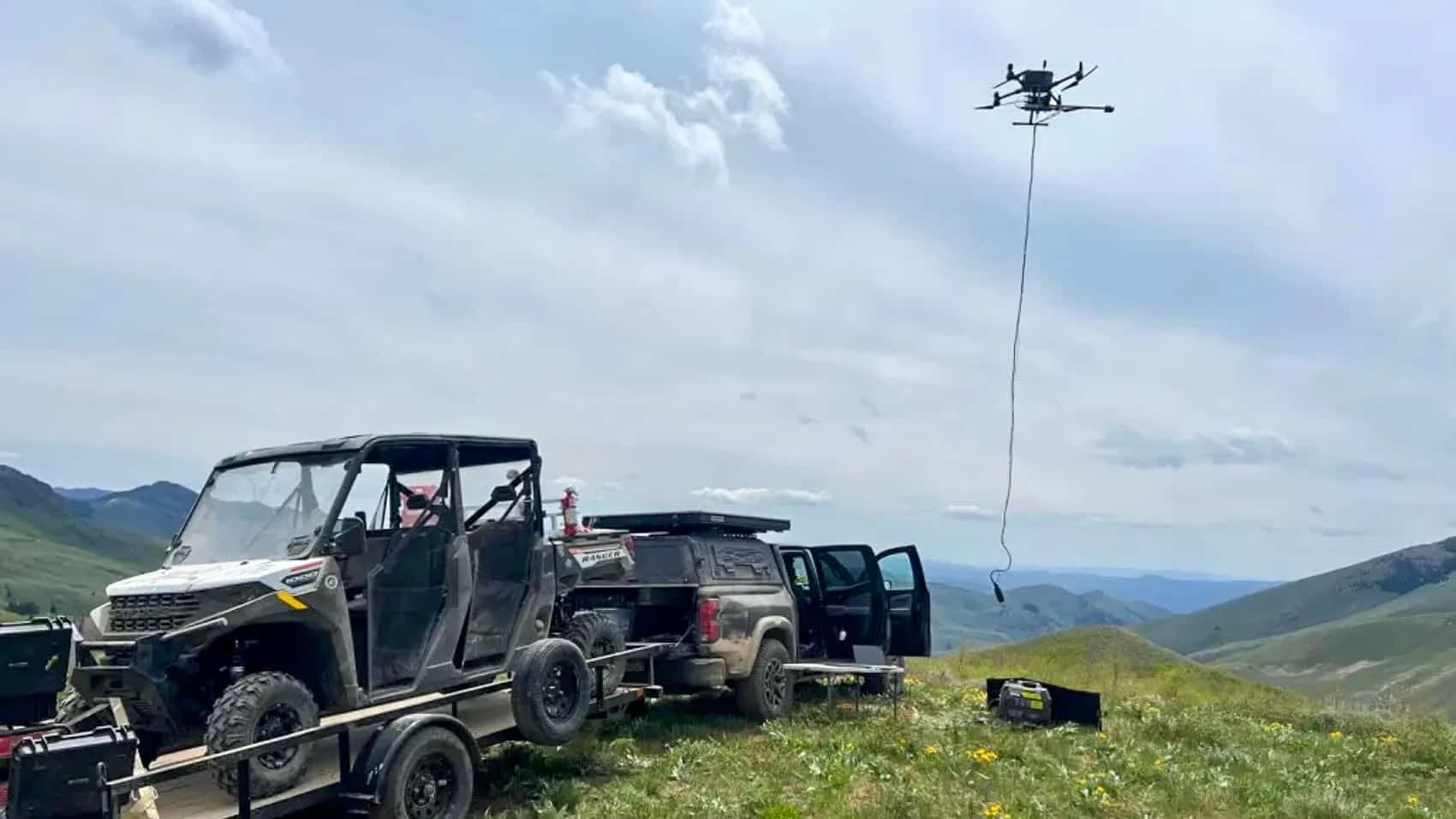
Western Star Resources Uses Drone Magnetometry to Explore Nevada Tungsten Property Dormant for 70 Years
Canadian junior miner Western Star Resources (CSE: WSR) has announced a high-resolution drone magnetometry survey at its White Star tungsten project in Elko County, Nevada — the site's first modern exploration since the 1950s. The survey, combined with soil and rock-chip sampling, aims to identify skarn-style tungsten-molybdenum mineralization zones and define drill targets.

Highlights
- Western Star Resources(CSE: WSR)於2025年6月22日宣布,對內華達州 Elko 郡 White Star 鎢礦項目啟動高解析度無人機磁力測量,為該地點近75年來首次現代化勘探。
- 該礦區於2025年5月以70,000美元現金加300萬股股份取得,原業主保留1% NSR 權利金,顯示公司以低成本策略切入關鍵礦物勘探。
- 同公司稍早於6月17日發布的 Rowland 鎢礦項目無人機磁力結果,已成功識別出多條北東至西南走向斷層構造,驗證了此套無人機勘探流程的可行性。
- 兩個項目合計覆蓋逾6公里矽卡岩潛力層位,其中歷史性 Mission Cross 礦山曾產出品位達1% WO₃(氧化鎢)的礦石。
- 中國生產全球逾80%的鎢,美國積極重建關鍵礦物國內供應鏈,使低成本無人機勘探技術在戰略上的重要性持續上升。
Drone Magnetometry Reawakens a Nevada Tungsten Property Dormant for 70 Years
A junior mining company is using drones to map a Nevada tungsten property that has seen no exploration since the 1950s. Western Star Resources (CSE: WSR) announced on June 22 that it is conducting a high-resolution drone magnetometry survey at its White Star tungsten project in the Charleston Mining District of Elko County, Nevada, targeting skarn-style tungsten-molybdenum mineralization.
The survey forms the centrepiece of an integrated exploration program, complemented by soil and rock-chip sampling. Assay results from the contractor are expected within several weeks.
Magnetometer-Equipped Drones Map Subsurface Mineralization
The survey is being conducted by drones carrying magnetometers — standard sensors for detecting subsurface mineralization. Magnetic data captures contrasts in the rock that often correspond to faults, fractures, and alteration zones — the geological controls on hydrothermal fluid movement and, by extension, tungsten skarn deposits.
By deploying drones over the property, Western Star is building a high-resolution structural map of a site that has had no modern exploration in nearly 75 years.
That is the unusual aspect of this case. Most productive tungsten districts across the American West were last worked in the 1950s, when geological operations relied entirely on manual mapping. Any mineralization that was not visible at the surface was likely missed.
Drone magnetometry datasets can reveal targets that original prospectors had no means of identifying — and without anyone carrying instruments across rugged terrain.
CEO Blake Morgan stated the rationale plainly: "Conducting an integrated UAV magnetic survey at the White Star mining district, along with focused soil and rock chip sampling, is the fastest path to defining drill targets." In junior mining, "fastest" typically also means "most cost-effective" — a critical consideration for a company that acquired the White Star property in May for USD 70,000 in cash plus 3 million shares, with a 1% net smelter return royalty retained by the vendor.
Drone Magnetometry Has Quietly Become the Standard in Junior Mineral Exploration
Historically, helicopter-borne magnetic surveys were the only practical method for aerial coverage of Nevada-scale properties, but they carried high costs, slow mobilisation times, and were often impractical for junior companies with limited budgets.
Drone magnetometry has changed that equation. UAVs fly at lower altitudes, yielding higher resolution data on near-surface structures, at a fraction of the daily cost of a helicopter, and can be deployed by a two-person team with a pickup truck.
This means companies that previously lacked the budget to produce detailed structural maps can now generate data precise enough to position a drill rig. The underlying physics and magnetometer technology remain the same — the difference is a smaller aircraft operating a few hundred feet above ground.
Drones are doing in mineral exploration exactly what they have done in every sector they have entered: making accessible what was previously expensive and available only to well-capitalised players. That shift began with cinematography, moved to surveying, and has now reached mineral exploration.
The Rowland Project Validates the Approach
According to Mining.com.au, White Star is not Western Star's first application of this workflow. On June 17, the company released early drone magnetometry results from its Rowland tungsten project, also located in Elko County. After processing for total magnetic intensity (TMI), first and second vertical derivatives, and analytic signal, a series of northeast-to-southwest-trending linear features were extracted from the data.
These features are interpreted as faults or fractures that may have channelled hydrothermal fluids responsible for tungsten skarn mineralisation in the area.
The Rowland results give Western Star a template to replicate at White Star. Together, the two projects cover more than six kilometres of skarn-prospective stratigraphy. The historic Mission Cross Mine within this system produced 1,000 tonnes of ore grading 1% tungsten trioxide (WO₃) — a grade that remains highly attractive in today's market if confirmed at scale.
Drones are completing work that would once have required a full field season and crews on foot, across ground that has not been touched for decades.
Analysis
The most significant aspect of this story is how quietly drones are reshaping the economics of mineral exploration. There are no high-profile defence contracts, no law enforcement applications, no trade show booths. There is simply a junior tungsten company in Nevada, operating with limited cash, a property that has been untouched for half a century, and a drone that allows it to produce a modern structural map for the cost of a few drill days.
Tungsten matters for the reasons this story illustrates. The United States has been working to rebuild domestic supply chains for critical minerals, and tungsten appears on every relevant list. China produces more than 80% of global tungsten supply and has previously deployed export controls on related materials as a geopolitical instrument.
Any viable domestic source carries strategic weight — but only if the cost of discovery and deposit verification is low enough to attract real capital. Drone magnetometry is gradually making that possible.
Drones are reopening dormant mineral districts because exploring them is once again economically viable. This is as consequential a drone application as any military use case, even if it rarely makes front-page news.
The outstanding question is what Western Star will find once the contractor delivers processed magnetic data and a drilling programme begins. A clear structural map is one thing; whether there is tungsten in the ground is another. The metric to watch: whether the survey defines targets sharp enough to launch a drill programme this year, or whether the property is ultimately filed back under "interesting but not yet mature."
Image credits: Wikipedia, Western Star Resources
原文來源: 查看原文
FAQ
Newsletter
Subscribe to our Low-Altitude Industry Newsletter
Daily curated news on low-altitude economy and drone industry, delivered to your inbox.