UK Logs 1,672 BVLOS Flights While the US Still Waits for Part 108
The UK Civil Aviation Authority (CAA) has published its 2025–2026 Test and Evaluation Annual Report (CAP 3266), documenting 1,672 BVLOS flights and over 350 hours of operational data from partners including Amazon, Wing, and Matternet. The data feeds directly into forthcoming routine BVLOS regulations. Meanwhile, the FAA's Part 108 rulemaking remains unresolved, widening the regulatory gap between the two countries.

Highlights
- 英國CAA的CAP 3266年報記錄了2024年10月至2026年3月間共1,672架次BVLOS飛行及逾350小時飛行數據。
- BVLOS沙盒計畫涵蓋Amazon Prime Air、Wing、Matternet、NPAS等業者,在G類及D類空域產生逾150GB操作數據。
- AAE計畫在逾450架次飛行中僅記錄1次航線偏離事件,無任何空域侵入案例,安全紀錄極為亮眼。
- 英國已完成4處無人機測試場地預評估(最高SAIL 2),可加速中小企業取得飛行授權,降低海外試飛依賴。
- 美國FAA的Part 108 BVLOS法規仍懸而未決,美國業者持續依賴逐案豁免申請,與英國監管進展差距擴大。
UK Logs 1,672 BVLOS Flights While the US Still Waits for Part 108
The UK Civil Aviation Authority (CAA) has officially published its 2025–2026 Test and Evaluation Annual Report (CAP 3266) — and the data inside is precisely the kind of empirical evidence that US operators have long been asking the FAA to produce.
CAP 3266 documents 1,672 BVLOS flights and more than 350 hours of flight time accumulated by industry partners between October 2024 and March 2026. That data will feed directly into policymaking for routine BVLOS operations in UK airspace.
The 1,672 Flights Behind the Policy
The CAA's internal Test and Evaluation Team began collecting structured operational data from authorised BVLOS operators in October 2024. By March 2026, the cumulative record stood at 1,672 flights and over 350 hours.
Flight volumes surged during the autumn and winter of 2025, with another spike between February and March 2026 as three "last-mile delivery" operators began submitting data.
This data is not simply a press-release number. It is split across two parallel programmes with distinct regulatory pathways and policy objectives: the BVLOS Sandbox and the Atypical Air Environment (AAE) framework. Together, they account for all 1,672 logged flights and provide the evidence base for their respective forthcoming regulations.
BVLOS Sandbox: Amazon, Wing, Matternet, NPAS
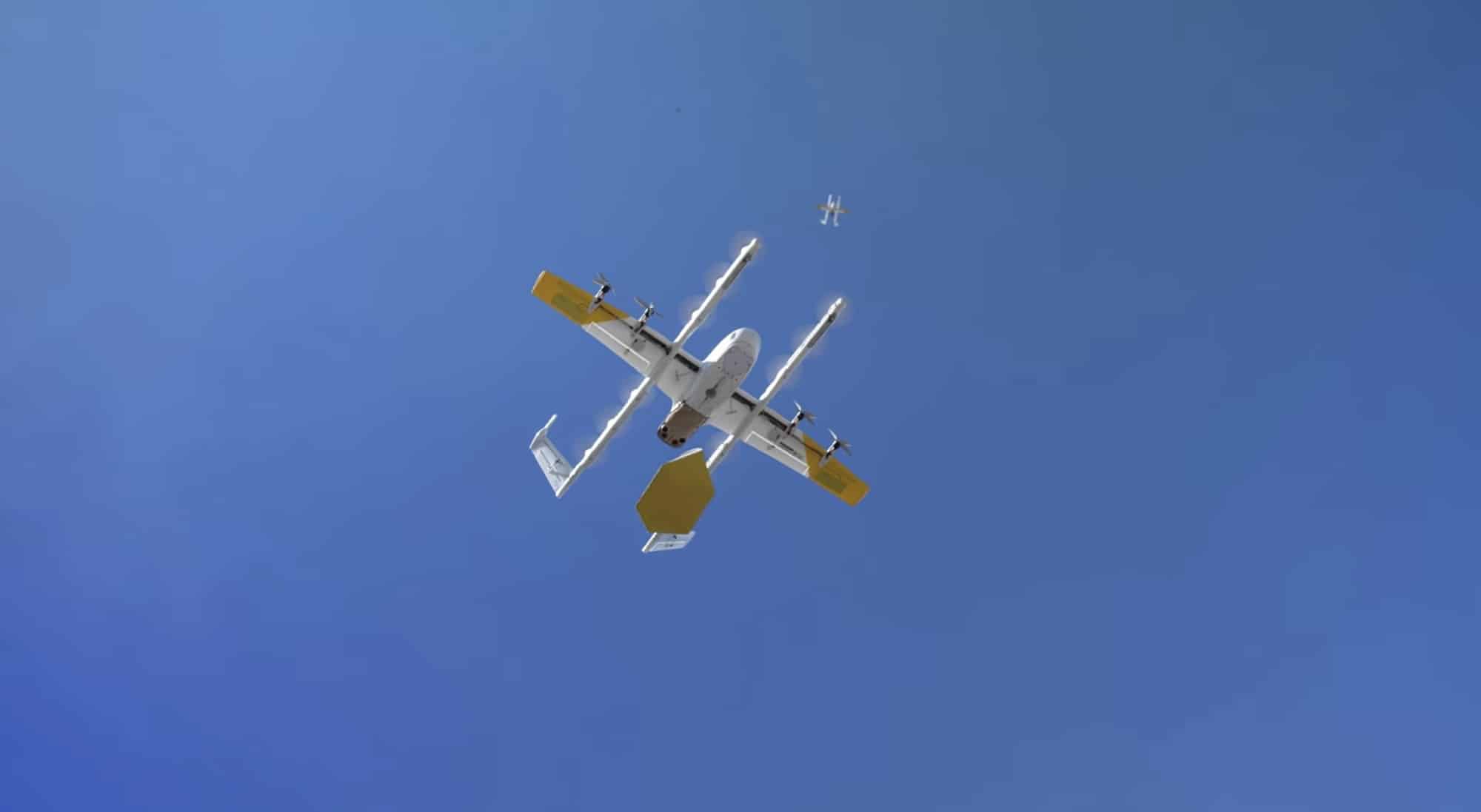
The BVLOS Sandbox operates under the regulatory framework set out in CAP 2533 and CAP 2616. This year, the CAA issued new flight authorisations to Airspection, the National Police Air Service (NPAS), Amazon Prime Air, Matternet, and a joint Wing–Apian programme.
As of March 2026, Sandbox flights had accumulated more than 200 hours and 1,097 sorties across Class G and Class D airspace, generating over 150 GB of operational data.
Amazon Prime Air MK30 delivery drone in flight over Oregon | Image: Prime Air
The use cases align with UK government priorities: infrastructure inspection, emergency aviation services, last-mile delivery, and NHS pharmaceutical delivery. The CAA is mining these datasets for evidence on ground radar performance, airborne detection of manned aircraft, ADS-B accuracy in urban and non-urban environments, GNSS reliability, and command-and-control (C2) link performance using both cellular networks and direct radio links.
One data point stands out: in a single month of operations by one Sandbox operator, the mean horizontal position error between drone-reported position and ADS-B-reported position was 33.93 ft (10.34 m), with a vertical error of ±6.19 ft (1.89 m). The CAA notes these figures are illustrative rather than regulatory thresholds — but real-world benchmark data of this kind is typically found only in academic papers in the US context.
Atypical Air Environment (AAE) and the Safety Record
The AAE framework, governed by CAP 3040 v3, covers operations conducted in environments where the inherent risk of encountering manned aircraft is materially lower — such as offshore wind farms, specific rail corridors, and other tightly defined operational volumes.
Eleven operators have now received AAE authorisations, and the safety data from the past 12 months will attract close attention from regulators on both sides of the Atlantic.
Across more than 450 AAE flights and over 100 flight hours, the CAA recorded just one drone deviation from a planned flight path. No drone left an approved operational volume. No manned aircraft entered an approved operational volume. Eight manned aircraft were detected in adjacent surveillance airspace — logged by the CAA as "early warning indicators" rather than safety events.
That safety record prompted the CAA to expand the AAE policy concept in November 2025, adding new annexes covering smoothing methodology, rail infrastructure, wind farm infrastructure, and operational volume definitions.
CAP 3145 and Four Pre-Assessed Test Sites
The most significant policy output of the year is CAP 3145, the Test Site Drone Operations Policy Concept. First published in July 2025 and revised in November 2025, the document allows the CAA to pre-assess test sites so that individual operators can incorporate pre-agreed ground and air risk assessments directly into their UK SORA applications.
The objective is to reduce duplicated risk assessments, accelerate the authorisation process, and lower the barrier for SMEs — operators who have historically had to travel overseas for test flights due to a shortage of assessed UK test sites.
Four sites have now completed pre-assessment, covering both BVLOS and VLOS operations up to SAIL 2:
- National Drone Hub, Predannack
- Snowdonia Aerospace Centre, Llanbedr
- Drone Test and Development Centre, Westcott
- Drone Certification Agency, Portland
The CAA is currently working with the Military Aviation Authority (MAA) and the Ministry of Defence (MoD) on further guidance expected before the end of 2026, covering dual-use military/civil testing, drone-to-drone collision testing, flight termination systems, and light UAS certificate operations.
The same annual report identifies three policy concepts still in active development, all drawing on the same datasets: CAP 3140 (electronic identification visibility), CAP 3127 (detect and avoid, DAA), and CAP 3154 (command and control links).
What This Means for US Operators
The gap between the CAA and the FAA is now impossible to ignore. While Part 108 remains in the queue and US BVLOS operators continue to rely on case-by-case waiver applications, the CAA has built a system that simultaneously authorises test flights, collects operational data in a standardised format, and loops that evidence back into specific policy concepts on a roughly four-month revision cycle.
The constant waiver applications are exhausting — in terms of resources, morale, and time. That kind of authorisation pipeline changes the game entirely. And when a regulator stops treating every flight as a one-off, everyone in the industry benefits.
DroneXL Perspective
What makes this annual report genuinely significant is that it is not a policy position paper — it is an inventory. The CAA is telling the industry that policy is being built on a dataset comprising 1,672 flights, 150 GB of telemetry data, 11 AAE operators, and 4 pre-assessed test sites. That is a fundamentally different regulatory posture from publishing a Notice of Proposed Rulemaking and asking the industry what it thinks.
The AAE safety record remains the most compelling element: one flight path deviation, zero airspace incursions. That kind of evidence ends arguments in regulatory meeting rooms. The FAA has not accumulated comparable data at scale, in part because no resources have been directed toward building anything equivalent to the CAA's Test and Evaluation Team.
This annual report matters to every operator and manufacturer — it points toward a more orderly sky where all of us can fly safely without getting in each other's way.
Images: Prime Air, Wing, CAA
原文來源: 查看原文
FAQ
Newsletter
Subscribe to our Low-Altitude Industry Newsletter
Daily curated news on low-altitude economy and drone industry, delivered to your inbox.