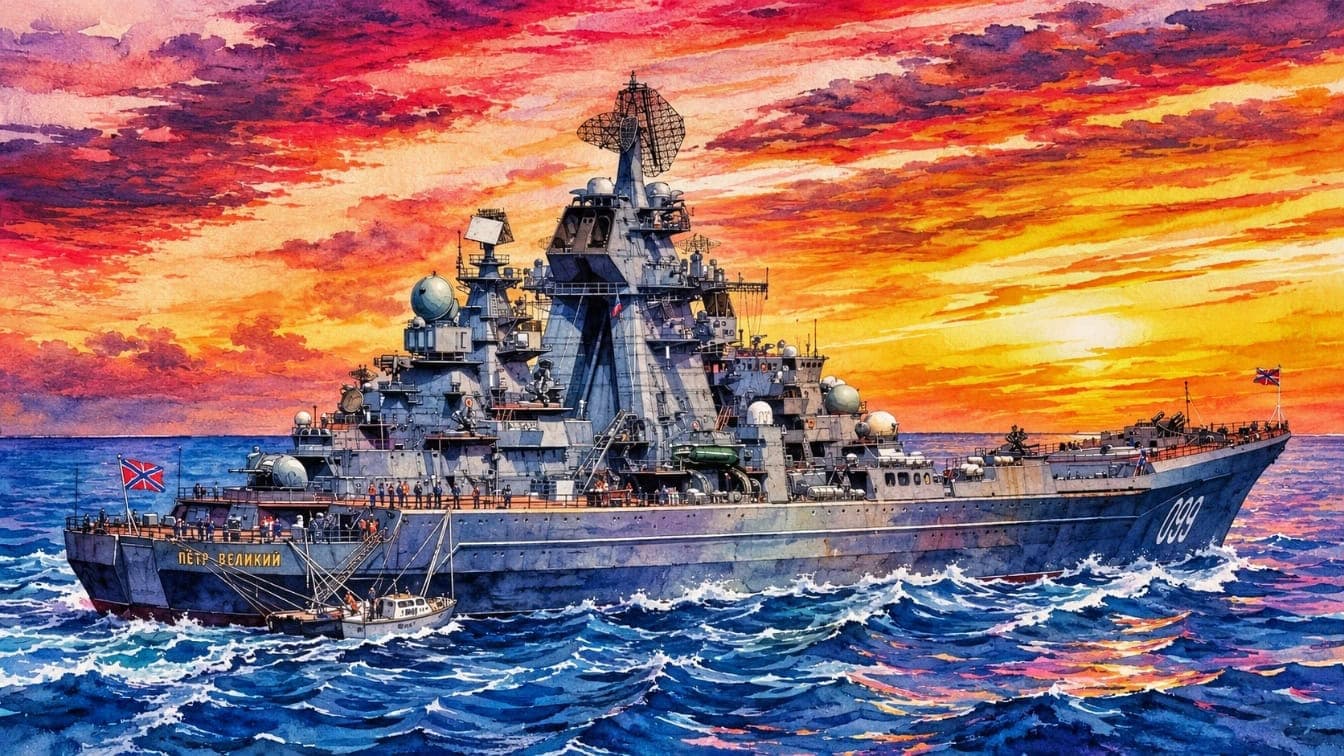
Russia's Rebuilt Battle Cruiser Packs a World-Record 176 Missile Tubes — But Remains a Cold War Relic
Russia's nuclear-powered cruiser Admiral Nakhimov has returned to its home port of Severomorsk after 29 years out of service, armed with 176 vertical launch tubes — more than any other surface warship in the world, surpassing China's Type 055 (112 tubes) and the U.S. Arleigh Burke Flight III (96 tubes). Despite the record-breaking firepower, analysts question the vessel's strategic value given its outdated radar systems, massive radar cross-section, and vulnerability to long-range drone strikes.

Highlights
- Russia's Admiral Nakhimov nuclear cruiser returned to Severomorsk on June 26 after a 29-year service gap, entering its final sea trial phase.
- The ship carries 176 vertical launch tubes — the most of any surface warship globally, outpacing China's Type 055 (112) and the U.S. Arleigh Burke Flight III (96).
- The Admiral Nakhimov is armed with Kalibr, Oniks, and Zircon hypersonic cruise missiles, with the Zircon claiming a range of 1,000 km and speeds up to Mach 9.
- Russia's radar and data-link technology lags behind U.S. and Chinese equivalents, and the ship's large radar cross-section makes it easier to detect and target at long range.
- Russia has already lost multiple large surface vessels to long-range drone strikes in Ukraine, raising serious strategic concerns about operating the billion-dollar cruiser in contested waters.
Russia's Rebuilt Battle Cruiser Packs a World-Record 176 Missile Tubes — But Remains a Cold War Relic
Russia's Kirov-class nuclear-powered missile cruiser Admiral Nakhimov was confirmed to have returned to its home port of Severomorsk on June 26, ending a 29-year service gap and entering the final stage of sea trials.
The vessel was relaunched on July 25, 2025, and later that year sailed under its own power for the first time in nearly 28 years. Its final sea trial phase formally commenced on June 1.
The Admiral Nakhimov's return is widely regarded as a major milestone in Russia's naval modernization program and is considered the most complex warship refit the country has ever undertaken.
Essentially a New Ship — with 176 Missiles
Many naval analysts consider the Admiral Nakhimov to be effectively a new vessel, given the extent of modifications carried out during its nearly three-decade refit.
The Kirov-class nuclear cruiser marks the class's first return to the Russian fleet since 1999. Originally designed at the height of the Cold War to hunt and destroy U.S. carrier strike groups, the Admiral Nakhimov entered service in 1988 and went into dry dock for upgrades after just 11 years — remaining there until 2025.
Kirov-class battle cruisers use a CONAS (Combined Nuclear and Steam) propulsion system, with two conventional boilers serving as backup power in the event of nuclear reactor failure. Both systems drive two geared steam turbines, producing 120,000 shaft horsepower (89 MW) across two propeller shafts for a maximum speed of 31 knots.
All missile systems aboard have been completely replaced, making the Admiral Nakhimov the most heavily armed surface warship in the world in terms of long-range air defense missiles and cruise missiles, with 176 vertical launch tubes.
Significantly Enhanced Anti-Submarine Warfare Capability
The ship's anti-submarine warfare (ASW) capability has also been comprehensively upgraded, with the latest Paket-NK anti-torpedo and anti-submarine system installed alongside Otvet ASW missiles.
The cruiser can carry up to three Ka-27 helicopters, giving it the ability to track and engage submarines at considerable range — a critical capability given the high frequency of NATO submarine activity in the Northern Fleet's patrol areas.
However, Russia's radar and data-link systems lag noticeably behind their U.S. and Chinese counterparts in technical sophistication. The Admiral Nakhimov's large radar cross-section also makes it a more conspicuous target, easier to detect and track at greater distances.
A Warship of Considerable Scale
At 827 feet (approximately 252 meters) in length, the Admiral Nakhimov is the third of Russia's four Kirov-class nuclear-powered missile cruisers. Only three remain in service; sister ship Admiral Lazarev was scrapped in 2021.
The vessel was laid down in Leningrad in 1983 and launched in 1986 under its original name, Kalinin. It belongs to the Project 1144.2 Orlan class — designated Kirov-class by NATO — and following modernization has been reclassified as Project 1144.2M.
Russia's government decided to modernize the ship in 2006, but actual work did not begin until 2014 and has been repeatedly delayed. In December 2024, TASS reported that factory sea trials had commenced and that the nuclear reactor had reportedly been brought back online.
A Diverse and Formidable Missile Arsenal
The Admiral Nakhimov is armed with a mix of Kalibr, Oniks (Onyx), and Zircon (Tsirkon) missiles, delivered via an entirely new launch system.
The 3M22 Zircon is Russia's hypersonic cruise missile, primarily designed for anti-ship operations. It is notable for its extreme speed — up to Mach 9 — and high maneuverability, dramatically compressing an adversary's reaction time. The missile can be launched from surface ships or submarines, and recent tests have demonstrated a ground-based launch capability as well.
The Zircon uses a scramjet engine to sustain hypersonic flight and is designed to defeat advanced air defense systems, including the Aegis Combat System. Its claimed range is 1,000 kilometers, and it has been combat-tested in Ukraine.
More Missile Tubes Than Any Other Surface Warship
The sheer size of the Kirov-class hull is unmatched among cruisers and destroyers — only aircraft carriers are larger. Its iconic S-300 air defense system remains one of its most recognizable features.
The S-300F (naval variant) is a ship-based version of the S-300P land system; integrated into the battle cruiser, it gives the Russian Navy an area air defense and anti-ballistic missile capability it would otherwise lack.
With 176 vertical launch tubes, the Admiral Nakhimov surpasses every other surface combatant in missile capacity:
| Warship | VLS Tubes |
|---|---|
| Admiral Nakhimov (Russia) | 176 |
| Ticonderoga-class cruiser (USA) | 122 |
| Type 055 destroyer (China) | 112 |
| Arleigh Burke Flight III (USA) | 96 |
| Zumwalt-class destroyer (USA) | 80 |
A Strategic Asset Stranded Without Support
According to the Barents Observer, the large cruiser is expected to operate primarily in the Barents Sea, Norwegian Sea, and Arctic, tasked with protecting Russia's ballistic missile submarine "bastions" — one of the Northern Fleet's core missions.
The Admiral Nakhimov is expected to replace sister ship Pyotr Velikiy as the Northern Fleet's flagship. The Pyotr Velikiy has been docked at Severomorsk since autumn 2022 and is expected to be decommissioned and scrapped.
The Admiral Nakhimov is, without question, a formidably armed warship — but also an enormous target. A single battle cruiser cannot sustain prolonged independent operations at sea, and Russia's maintenance infrastructure is far inferior to that of the United States. With multiple large Russian surface vessels already lost to long-range drone strikes in Ukraine, deploying this multibillion-dollar ship in a heavily contested maritime environment presents a serious strategic dilemma for the Russian Navy.
For all its impressive firepower, the Admiral Nakhimov remains, at its core, a Cold War relic — and its true combat effectiveness in an era defined by drones and precision strike weapons has yet to be proven.
原文來源: 查看原文
FAQ
Newsletter
Subscribe to our Low-Altitude Industry Newsletter
Daily curated news on low-altitude economy and drone industry, delivered to your inbox.