Hanwha Unveils Striker MUSV Family at Eurosatory 2026
South Korean defense giant Hanwha Systems has debuted its Striker Medium Uncrewed Surface Vessel (MUSV) family at Eurosatory 2026, showcasing the Striker-S and Striker-M. The Striker-S measures 35 meters in length with a displacement of approximately 250 tonnes, integrates a modular Chunmoo missile launcher, and features autonomous navigation with networked strike capability. Hanwha is actively marketing the platform to both the U.S. Navy and the Republic of Korea Navy.

Highlights
- 韓華系統在 Eurosatory 2026 發表 Striker-S 與 Striker-M 兩款中型無人水面艦艇(MUSV)。
- Striker-S 全長 35 公尺、排水量約 250 噸,可搭載 10 噸模組化天舞飛彈發射器,具備自主導航與網路化打擊能力。
- 整合 CTM-ASBM 反艦彈道飛彈,保留 280 mm 彈徑,新增 IIR 導引頭與 GPS/INS,可追蹤移動水面目標;母型 CTM-MR 射程約 160 公里。
- AESA 雷達對空偵測距離約 50 公里、水面監偵約 30 公里,並具備專用反無人機(C-UAS)功能。
- 韓華正向美國海軍及韓國海軍推銷 Striker MUSV,示範艦預計 2026 年稍晚在韓國展開海上試驗。
Hanwha Unveils Striker MUSV Family at Eurosatory 2026
At Eurosatory 2026, Hanwha Systems' Striker Medium Uncrewed Surface Vessel (MUSV) emerged as one of the exhibition's focal points — among a rare class of concept designs aimed at integrating missile firepower into an autonomous naval platform.
Authored by Tayfun Ozberk, with additional reporting by Xavier Vavasseur
Breaking from Conventional USV Design Philosophy
The Striker-S on display at Hanwha's exhibition stand stands apart from the small, explosive-laden uncrewed surface vessels of the past. What Hanwha presented is a purpose-built missile vessel centered on modular payloads, autonomous navigation, and networked strike warfare.
The vessel measures 35 meters in length and 6 meters in beam, with a displacement of approximately 250 tonnes. While considerably smaller than conventional missile combatants, its internal volume is sufficient to accommodate fuel, sensors, communications equipment, and mission modules. According to specifications published at the show, the platform can carry a containerized payload module with a capacity of up to 10 tonnes.
Low-Observable Design
Visually, the Striker-S features a low radar cross-section (Low-Observable) design. Steeply angled hull surfaces and a compact superstructure reduce radar reflectivity, and with no requirement for crew habitability spaces, the vessel's interior can be entirely dedicated to mission systems.
Chunmoo Missile System Integration
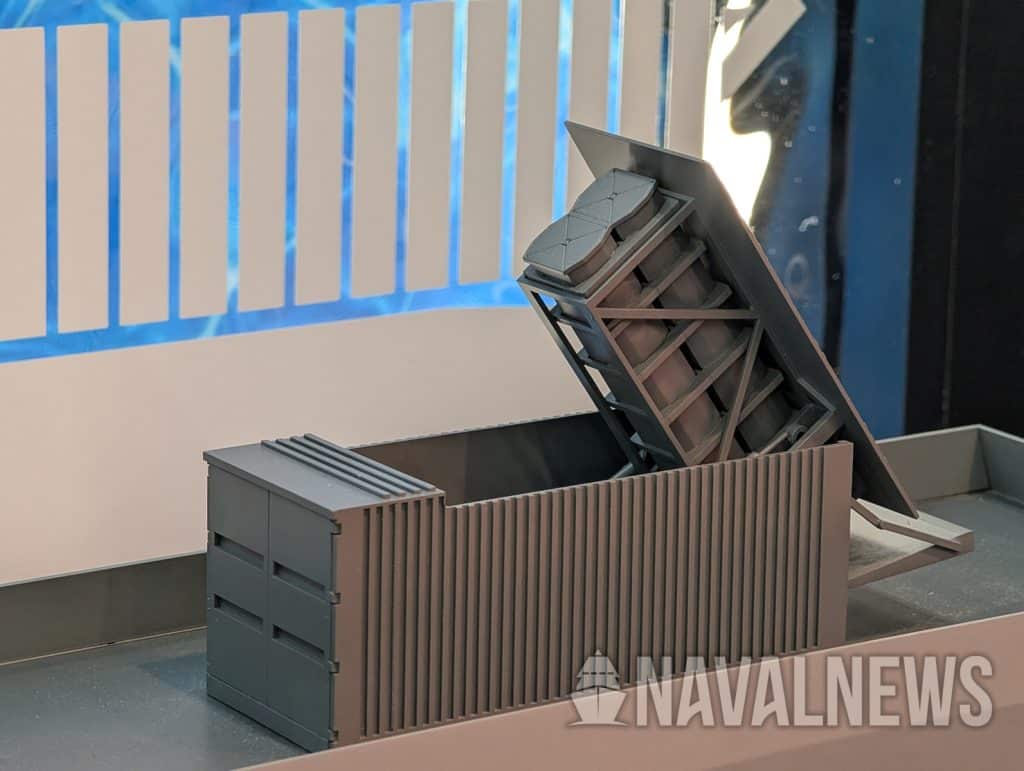
The Striker-S's most prominent feature is its integration of Hanwha's Chunmoo missile family. A containerized launcher mounted on the mission deck can be configured to mission requirements, enabling the vessel to transition rapidly from an intelligence, surveillance, and reconnaissance (ISR) platform to an autonomous strike asset. The launcher concept displayed in Paris employs a modular configuration that differs from the Naval Multiple Rocket Launch System (Naval MRLS) design unveiled by Hanwha at MADEX 2025 in Busan, South Korea, last year.
For anti-surface strike missions, Hanwha Aerospace is developing the CTM-ASBM (Chunmoo Tactical Missile – Anti-Ship Ballistic Missile) variant, an evolution of the CTM-MR (Medium-Range) model. The CTM-MR is reported to have a range of approximately 160 kilometers. The CTM-ASBM retains the same 280 mm caliber and propulsion system, adding an Imaging Infrared (IIR) seeker integrated with GPS/Inertial Navigation System (INS) guidance, enabling active tracking and engagement of moving surface vessels.
Sensor Suite and Counter-UAS Capability
Underpinning the strike capability is an integrated sensor suite centered on an Active Electronically Scanned Array (AESA) radar. Data provided by Hanwha indicates the radar offers a detection range of approximately 50 kilometers against air targets and up to 30 kilometers for surface surveillance. The radar system also incorporates a dedicated counter-UAS (C-UAS) capability.
The Striker MUSV Family
Hanwha positions the Striker-S within a broader family of uncrewed surface vessels. Also on display at Eurosatory was the larger Striker-M MUSV; by comparison, the Striker-S appears more focused on missile strike missions while retaining ISR and autonomous maritime operations capability. Hanwha's exhibition materials emphasized autonomous swarm navigation, distributed engagement concepts, and the ability to receive targeting data from external assets.
Mission concept graphics released at the show illustrated how multiple MUSVs could operate in coordination with manned surface combatants, shore-based command centers, and other sensor nodes. Within this construct, the vessels function primarily as stand-off missile carriers, extending the strike reach of a maritime task group while reducing the exposure risk to high-value crewed platforms.
Market Outreach and Next Steps
The unveiling comes as navies across the West and Asia-Pacific continue to show growing interest in medium-sized uncrewed naval platforms. Systems such as the Striker-S are viewed as force multipliers capable of carrying sensors, missiles, or electronic warfare payloads within distributed formations — rather than replacements for conventional warships.
Hanwha representatives told Naval News that the company is actively marketing the Striker MUSV family to both the U.S. Navy and the Republic of Korea (ROK) Navy. However, the ROK Navy's current "Navy Sea Ghost" concept has not yet called for offensive strike capability on uncrewed surface vessels. According to Naval News, a Striker MUSV demonstrator is expected to begin sea trials in South Korea later this year.
原文來源: 查看原文
FAQ
Newsletter
Subscribe to our Low-Altitude Industry Newsletter
Daily curated news on low-altitude economy and drone industry, delivered to your inbox.