China Unveils 55-lb Soldier-Portable Laser Weapon That Can Down a Drone in 4 Seconds
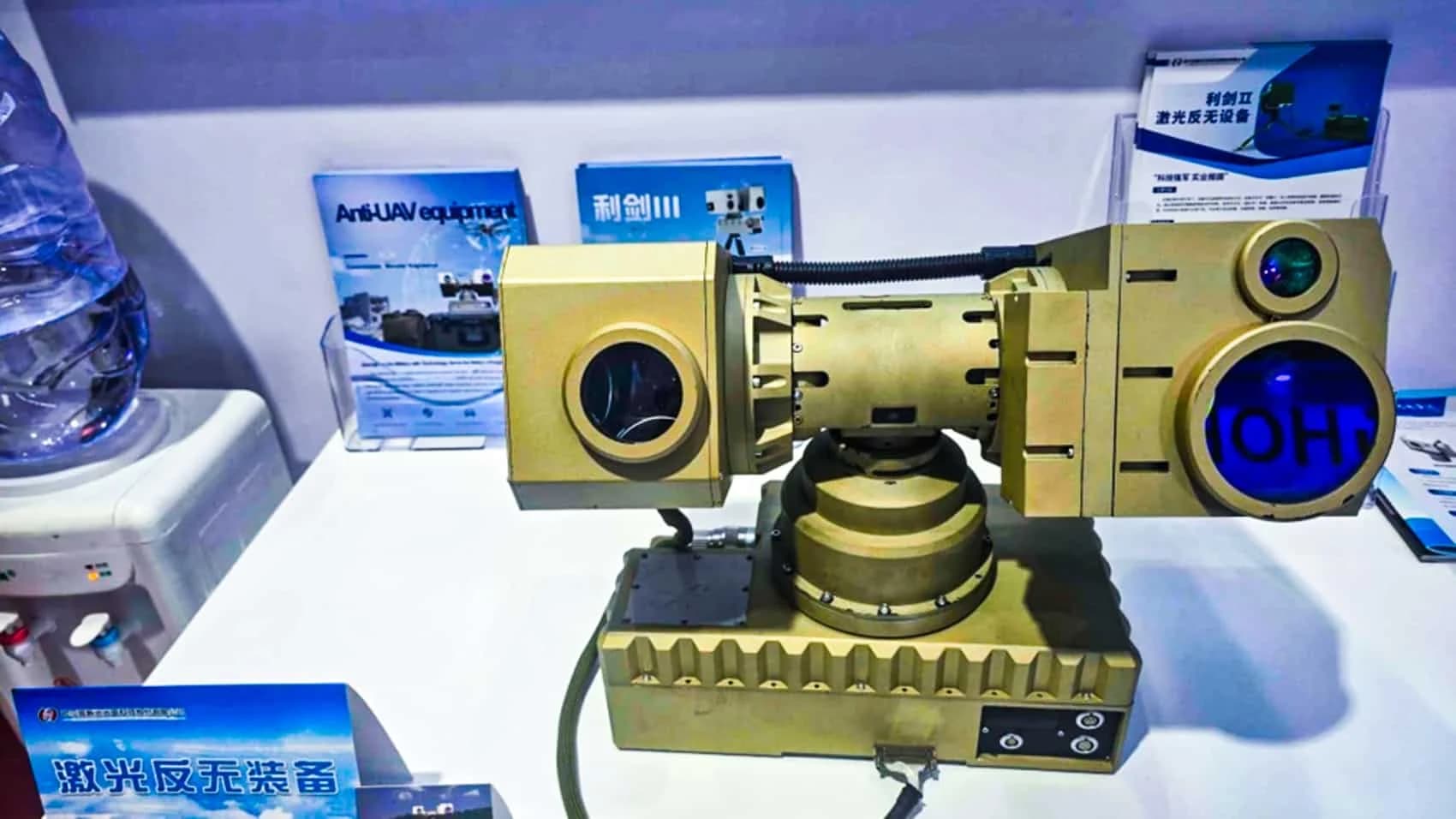
Harbin Xinguang Optoelectronics, a Chinese state-linked defense firm, displayed two man-portable laser weapons — the LiJian II and LiJian III — at a Beijing defense expo on June 16. The LiJian III weighs 25 kg (55 lbs), uses an approximately 2 kW laser and AI-assisted targeting, and can destroy a drone at 500 meters in roughly 4 seconds. Each unit is priced at approximately 2 million RMB (around USD $280,000), fundamentally altering the cost calculus of counter-drone defense.

Highlights
- Harbin Xinguang Optoelectronics unveiled the LiJian II (30 kg) and LiJian III (25 kg) man-portable laser weapons at the Beijing Defense Information Equipment and Technology Exhibition on June 16.
- The LiJian III uses an approximately 2 kW laser with AI-assisted targeting and can down a drone at 500 meters in roughly 4 seconds, with a cooldown of under 5 seconds between shots.
- Each system is priced at approximately 2 million RMB (around USD $280,000), making the cost-per-shot essentially the electricity consumed — a major shift from missile-based counter-drone defense.
- Higher-end models in the LiJian product line can engage targets at up to 1,200 meters, while the man-portable variants are rated for 500 meters.
- Unlike existing vehicle-mounted directed-energy systems such as China's Silent Hunter, the LiJian series is designed to be carried and operated by a single infantryman from a standard backpack.
China Unveils 55-lb Soldier-Portable Laser Weapon That Can Down a Drone in 4 Seconds
China has put a counter-drone laser system on a soldier's back. At the Defense Information Equipment and Technology Exhibition, which opened in Beijing on June 16, state-linked manufacturer Harbin Xinguang Optoelectronics introduced two man-portable laser weapons: the LiJian II and LiJian III.
Both weapons are designed to allow a single soldier to shoot down a drone within approximately 500 meters (roughly 1,600 feet) in about 4 seconds.
One operator. One backpack. Four-second kill.
LiJian III: The Lighter, Faster Option
The LiJian III is the smaller of the two variants, weighing 25 kg (55 lbs). Its core is an approximately 2 kW laser emitter paired with an AI-assisted targeting system.
The entire system breaks down into three components — the laser emitter, an air-cooling unit, and a handheld control terminal — all packed into a single backpack that one soldier can carry independently. The system can burn through a drone in approximately 4 seconds and requires less than 5 seconds of cooldown before the next shot.
The LiJian II is the heavier variant at 30 kg (66 lbs), designed for one to two operators rather than solo carry. Higher-end models in the LiJian product line can engage targets at up to 1,200 meters, though the man-portable versions displayed are rated for a 500-meter effective engagement range.
According to Chinese media reports, each system is priced at approximately 2 million RMB, or roughly USD $280,000. That figure has not been officially confirmed by Harbin Xinguang, but it is enough to illustrate the procurement-level implications of weapons like these.
The Real Story Is Economics, Not Lasers
As reported by MSN, the cost ledger of counter-drone defense has been badly lopsided for years. A small commercial drone converted into a one-way attack munition might cost a few hundred dollars, while the missile a Western air defense system fires to intercept it can run six figures.
Using a Patriot interceptor missile against a consumer-grade quadcopter — what military analysts call the "cost exchange problem" — is the central dilemma of drone warfare that keeps defenders up at night.
Laser weapons fundamentally flip that equation. Once the system is purchased, the cost per shot is simply the electricity needed to power it. No missiles to restock, no magazines to reload, no logistics convoy trailing behind a soldier loaded with expensive interceptors. A 2 kW laser burning through a $400 drone in 4 seconds represents the first credible milestone at which defensive cost can genuinely undercut offensive cost.
Counter-UAS is increasingly critical because drones can cause enormous damage in a very short time. A laser capable of eliminating a drone at 500 meters in 4 seconds opens the door to dedicated drone-hunting squads — units whose sole mission is to clear a given airspace of threats within minutes. It is easy to imagine that if Beijing made them available, Russia would want to order dozens tomorrow.
China Is Ahead of the West in Man-Portable Laser Counter-UAS
This is not China's first counter-drone laser system. The Silent Hunter platform has existed as a vehicle-mounted system for years, and Chinese manufacturers have already exported mobile laser counter-drone systems abroad, including the NI-L3K demonstrated in Malaysia earlier this year. The genuine breakthrough here is miniaturizing the system to backpack scale and putting it directly in an infantryman's hands, rather than mounting it on top of an armored vehicle.
By comparison, Western counter-drone programs rely more heavily on radio frequency (RF) jammers, kinetic interceptors, and larger vehicle-mounted directed-energy systems.
The United States does have man-portable counter-drone solutions in development, but no fielded, camera-ready, AI-guided, soldier-carried laser system has yet appeared. Beijing is clearly happy to put its hardware on display first.
The exhibition context itself is significant. Defense expos are exactly where state-linked manufacturers simultaneously demonstrate capability and intent. Unveiling two portable laser weapons of different weights for different mission profiles represents a full product line, not a single prototype. Harbin Xinguang has clearly given thought to what potential customers need.
DroneXL Perspective
Something nobody is saying loudly: for the past decade, drones have been the cheap offensive tool, and counter-drone has been the expensive response. A 25 kg, battery-powered laser that terminates a target in 4 seconds is the first credible signal that the defensive side is about to win the cost war.
This matters far beyond China. Ukraine has shown the world that a $500 quadcopter can disable a $3 million tank, and every Western military is scrambling for a defensive answer that will not bankrupt the budget.
Whoever can first deploy a reliable, low-cost-per-shot, man-portable counter-drone system at scale will rewrite the economics of every battlefield where small drones are active — and today, that means almost every battlefield.
Counter-drone laser development has been underway for many years. Large defense contractors have successfully mounted such systems on ships and vehicles, but nothing this portable — something that can literally be carried on a person's back — has appeared before. The immediate question is straightforward: how does it perform in real combat conditions, and is it safe enough for the soldier carrying it?
The most critical unanswered question is whether these systems can perform in actual battlefield conditions as well as they do on an exhibition floor. Laser weapons have a long history of being impressive at shows and disappointing in the field — rain, dust, smoke, and atmospheric scattering can rapidly degrade effective range.
Engaging a target at 500 meters inside a Beijing exhibition hall is a very different proposition from achieving the same result on a haze-filled summer battlefield. Whether the LiJian series ends up in operational deployments or only in product catalogues remains to be seen.
Image credits: Official / The War Zone
原文來源: 查看原文
FAQ
Newsletter
Subscribe to our Low-Altitude Industry Newsletter
Daily curated news on low-altitude economy and drone industry, delivered to your inbox.