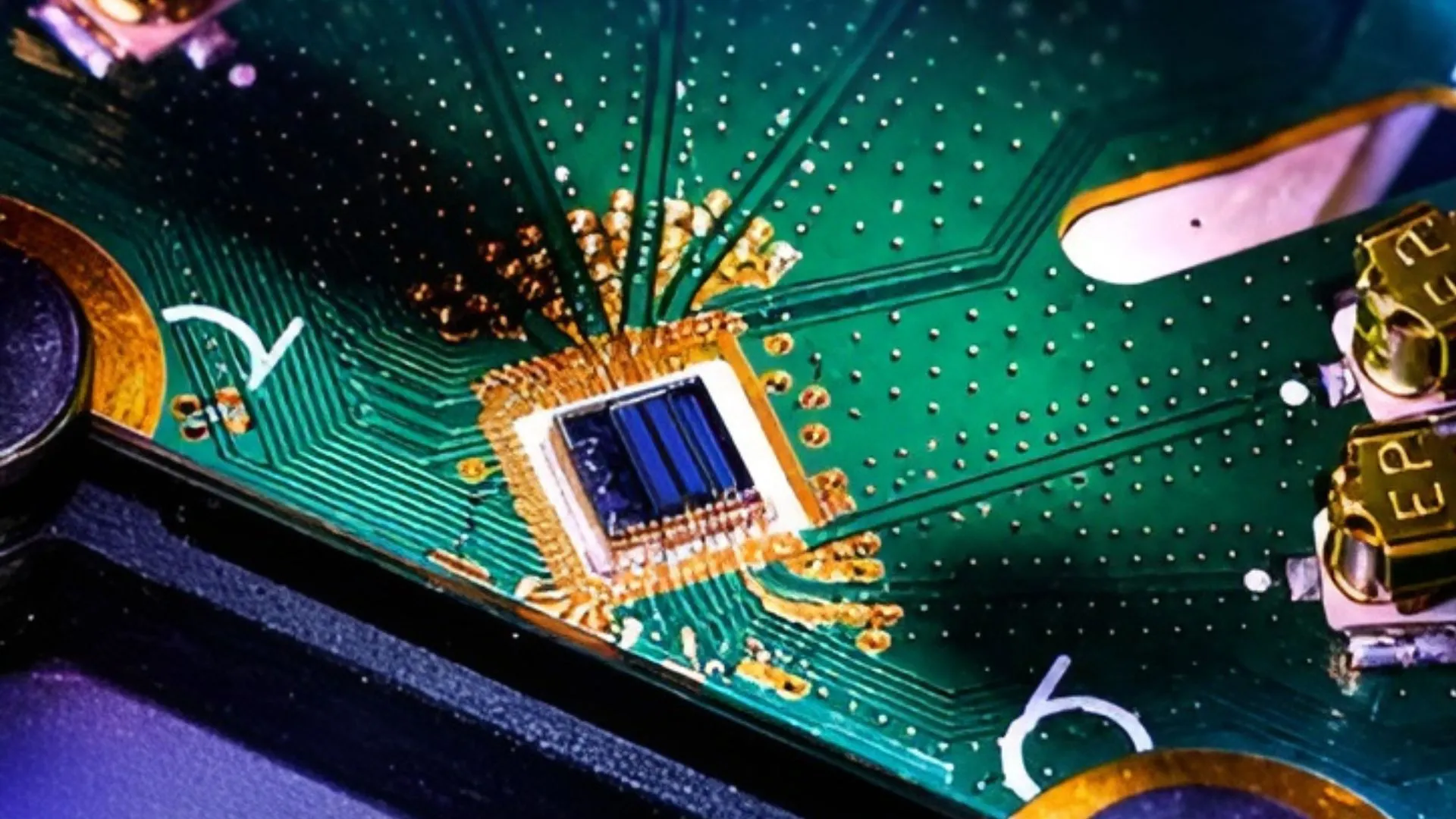
Singapore Researchers Develop Quantum Chip That Self-Verifies Hardware Integrity While Generating Secure Random Numbers
A research team at the National University of Singapore (NUS) has developed a quantum random number generator (QRNG) chip that continuously self-verifies its hardware integrity during operation. Using a measurement-device-independent protocol, the chip eliminates the need to trust detector components, significantly enhancing cryptographic security. Potential applications include encrypted drone communications and other connected-device security systems.

Highlights
- NUS Associate Professor Charles Lim led the development of a QRNG chip that uses a measurement-device-independent (MDI) protocol to continuously self-verify hardware integrity during operation.
- The chip's detectors achieved 69.1% overall efficiency, surpassing the protocol's minimum requirement of 67%, and it generates more certified random bits than it consumes in input seeds.
- The current experimental system produces 64 bits per second; however, laboratory photodiodes at 92.4% efficiency suggest future chip versions could reach 68 Mbps.
- The chip is fabricated on standard 8-inch semiconductor wafers and operates at room temperature, requiring no cryogenic cooling.
- The research was published in the journal PRX Quantum and has potential applications in drone communications encryption, finance, healthcare, and AI security.
Quantum Chip Achieves Hardware Self-Verification, Strengthening Digital Encryption Security
A research team at the National University of Singapore (NUS) has successfully developed a quantum random number generator (QRNG) chip capable of continuously verifying its own hardware integrity while generating random numbers — addressing a long-standing security challenge in digital encryption systems.
Random numbers are critical for encryption keys, secure transactions, digital signatures, and other cybersecurity applications. Existing random number generators, including quantum versions, rely on users trusting that hardware components continue to operate according to their design specifications. Should a component degrade or be tampered with, outputs could become predictable without detection.
This new chip is specifically designed to eliminate that risk by continuously checking whether its measurement hardware is functioning as expected during operation.
The research team, led by Associate Professor Charles Lim of the NUS Department of Electrical and Computer Engineering, stated that the technology has the potential to strengthen security across finance, healthcare, artificial intelligence, and connected-device sectors.
Breaking the 'Trusted-Device' Model
Most quantum random number generators operate under what researchers call the "trusted-device model," in which components such as lasers, modulators, and detectors are assumed to meet their specifications throughout their operational lifespan.
The new chip instead employs a measurement-device-independent (MDI) protocol, requiring users to trust only the quantum optical signals entering the system — not the detectors responsible for measurement.
During operation, the chip generates known quantum optical states and compares detector responses against predictions derived from quantum theory. If results match expectations, the system converts the data into certified random numbers; if they do not, the process automatically halts.
"The measurement unit in quantum random number generators has always been very difficult to characterise precisely, making its reliability in practical use hard to guarantee. Our solution eliminates the need to trust that unit to operate according to specification throughout its lifetime," said Associate Professor Lim.
The device integrates a signal encoder and optical detector onto a single silicon chip, fabricated using the eight-inch wafer processes common in the semiconductor industry. Unlike some quantum technologies, the chip operates at room temperature, requiring no cryogenic cooling equipment.
The research team also addressed a known challenge with silicon-based optical modulators: adjusting the phase of light can inadvertently alter its intensity, potentially compromising security. The team developed a compensation control method that maintains a stable optical signal.
Security Prioritised Over Speed
The chip's detectors achieved an overall efficiency of 69.1%, exceeding the protocol's minimum threshold of 67%. Testing also confirmed that the system generates more certified random bits than it consumes in input seed bits, verifying that it produces genuine new randomness.
The researchers describe this device as the most secure QRNG chip demonstrated to date. Its security analysis assumes a worst-case scenario in which an attacker may possess quantum correlations with the detectors themselves.
This high level of security comes with a speed trade-off. The current experimental system generates just 64 bits per second, far below the speeds exceeding 100 Gbps achievable by conventional QRNG systems.
The research team believes performance can be substantially improved through advances in detector technology. Photodiodes developed in the laboratory have already achieved 92.4% efficiency, and simulations suggest future chip versions could reach data rates of 68 Mbps.
"This chip paves the way for integrating practical, self-testing quantum random number generators into compact, secure systems," Associate Professor Lim added.
The findings have been published in the journal PRX Quantum.
原文來源: 查看原文