Neuromorphic Vision Chip Integrates Sensing, Processing and Memory in a Single Device, Laying Groundwork for Next-Generation Autonomous Systems
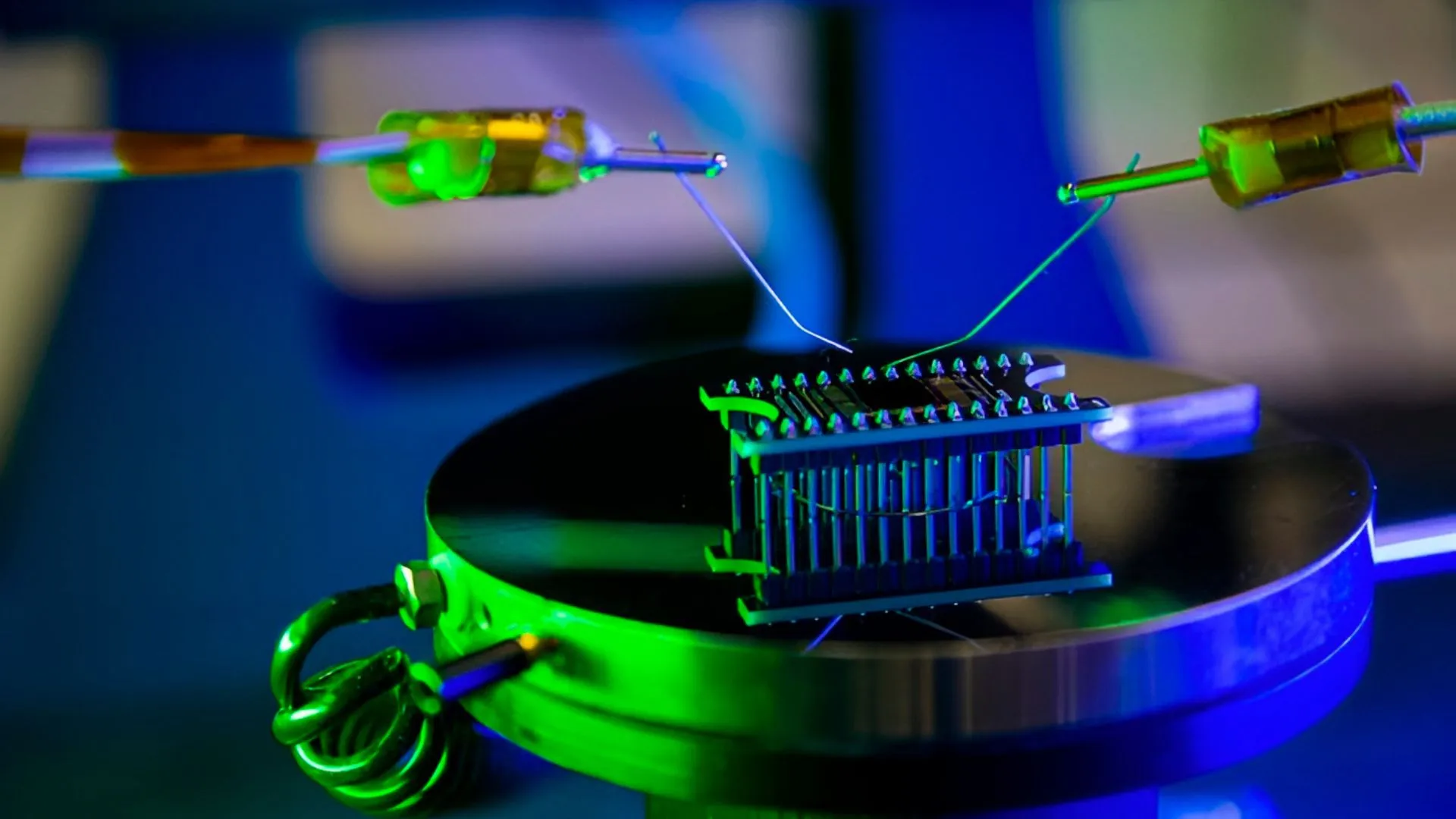
Researchers at RMIT University in Australia have developed a neuromorphic vision chip made from doped indium oxide that combines visual sensing, signal processing, and memory storage in a single device, mimicking the eye-brain relationship. The chip reduces reliance on external processors and accelerates real-time decision-making, with potential applications in autonomous vehicles, robots, and hazardous environment monitoring. The findings have been published in Advanced Functional Materials.

Highlights
- RMIT University, in collaboration with Deakin University and the University of Melbourne, developed a neuromorphic vision chip from doped indium oxide that integrates sensing, processing, and memory in a single device.
- The chip's sensing layer is thousands of times thinner than a human hair and retains visual information without frequent electrical refresh signals, significantly reducing power consumption.
- Principal investigator Professor Sumeet Walia stated the chip enables real-time decision-making by eliminating data-transfer delays to external processors.
- The device has been tested under ultraviolet light, with the team now extending it to visible and infrared wavelengths to unlock broader applications.
- The research, supported by the Australian Research Council and National Computational Infrastructure, has been published in Advanced Functional Materials.
Australian Researchers Build Bioinspired Vision Chip That Senses, Processes and Remembers in One Device
Researchers in Australia have developed a neuromorphic vision chip capable of simultaneously sensing, processing, and storing visual information within a single device — mirroring the way the human eye and brain work together. Fabricated from doped indium oxide, the miniature chip is designed to reduce dependence on external processors and enable faster decision-making in autonomous system applications.
The project was led by engineers at RMIT University, with participation from Deakin University and the University of Melbourne. The team says the device integrates sensing, processing, and memory functions on a single platform, eliminating the separate hardware components that typically slow down conventional machine vision systems.
Unlike traditional imaging systems that first capture data and then transmit it to an external processor, the new chip performs computation directly at the point of light detection. The sensing layer is thousands of times thinner than a human hair and has been specially engineered to respond to light and retain information over time, making its operation more closely analogous to biological vision.
The researchers say the integrated design helps reduce power consumption and improves response speed in real-time environments. The device has so far been tested using ultraviolet light, and the team is now working to extend its capabilities to visible and infrared light to broaden its range of applications.
A Vision System Modelled on the Brain
The chip is designed to emulate how the human eye captures light and the brain processes and stores visual input — performing multiple tasks on a single platform, including sensing incident light, processing the signal, and retaining visual information for subsequent use.
Principal investigator Professor Sumeet Walia said the goal was to eliminate the latency and energy costs associated with transferring data between separate systems. "Our invention enables real-time decision-making because it does not need to process large amounts of irrelevant data and is not slowed down by transmitting data to a separate processor," he said.
The device also demonstrated the ability to retain visual information for extended periods without requiring frequent electrical refresh signals, further reducing power consumption and improving efficiency.
First author and RMIT PhD researcher Aishani Mazumder said the system drew inspiration from how the brain handles information. "Neuromorphic vision systems use analogue processing similar to the human brain, which can drastically reduce the energy needed to perform complex visual tasks compared with existing technologies," she said.
Future Applications in Autonomous Machines
The researchers identified potential applications in autonomous vehicles, self-governing robots, and surveillance systems operating in hazardous environments. Specific use cases include object recognition for vehicles, detection systems in remote or dangerous locations, and advanced imaging for forensic analysis and industrial inspection.
Because the chip consolidates multiple functions into a single component, it could also support extended autonomous operation without requiring substantial computational infrastructure — a quality the team believes makes it particularly well-suited for systems that must adapt rapidly to dynamic environments.
By replicating the retina's ability to capture full images and the brain's capacity to interpret and store them, the device offers a more compact and efficient pathway to machine vision. The researchers believe it could ultimately give rise to visual systems that evolve continuously with experience, much like biological systems do.
The team made use of RMIT University's specialist nanofabrication and microscopy facilities. The research received support from the Australian Research Council and the National Computational Infrastructure.
The findings have been published in the peer-reviewed journal Advanced Functional Materials.
原文來源: 查看原文
FAQ
Newsletter
Subscribe to our Low-Altitude Industry Newsletter
Daily curated news on low-altitude economy and drone industry, delivered to your inbox.