Commercial Drone Market Forecast: Massive Potential Held Back by Regulatory Barriers
Multiple industry reports show the global commercial drone sector growing at 7–10% annually, yet regulatory hurdles remain the single biggest constraint. Global drone investment hit a record $3.86 billion in 2025, over 540 delivery pilots launched worldwide, but roughly 43% of commercial operators faced permit delays. Slow BVLOS rulemaking is cited as the industry's top challenge.

Highlights
- Global drone investment reached a record $3.86 billion in 2025, rebounding sharply after a 52% decline in 2024, with 77% directed at dual-use companies.
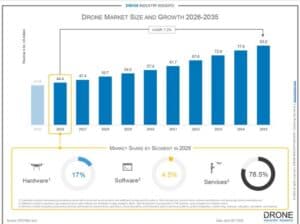
- DII projects the civil drone market will grow at a 7.2% CAGR from 2026 to 2035, with commercial and dual-use applications as the primary growth engines.
- Approximately 43% of commercial drone operators experienced aviation permit delays in 2025, and enterprise compliance costs rose by nearly 29%.
- Fortune Business Insights forecasts the global drone market will reach $210.26 billion by 2034, up from $91.88 billion in 2025, at a CAGR of 9.63%.
- Valour Consultancy projects the global commercial drone fleet will exceed 5.6 million units by 2050, with agriculture—led by DJI's 300,000+ spraying drones in China—accounting for the largest share.
Commercial Drone Market Forecast: Massive Potential Held Back by Regulatory Barriers
"In 2025, more than 540 drone delivery pilot programmes were launched globally, spanning medical, food delivery, and e-commerce sectors." — Fortune Business Insights
Several of the latest commercial drone industry forecasts paint a consistently optimistic picture of 7–10% annual growth—but one persistently overshadowed by regulatory friction.
Record Investment, Regulatory Drag
According to Drone Industry Insights (DII) and its Drone Market Report 2026–2035, the civil drone sector is forecast to expand at a compound annual growth rate (CAGR) of 7.2% over the period.
The report notes: "Investment momentum has shifted dramatically. After a 52% decline in 2024, drone investment reached a record $3.86 billion in 2025—77% of which flowed to dual-use companies. The first two months of 2026 alone recorded $1.7 billion in investment… yet challenges remain. BVLOS regulations are advancing slowly, compliance costs remain high, and the recreational market has plateaued. Growth is now almost entirely driven by commercial and dual-use applications."
Market Composition: Hardware vs. Software
DII's report breaks the market into distinct segments. Hardware—covering drone platforms, components, and systems manufacturers (excluding counter-drone and crewed air vehicle makers)—accounts for 17% of total market share, while software—encompassing workflow tools, data analytics, flight and fleet management, UTM systems, navigation, and computer vision—accounts for 4.5%.
"In terms of applications, surveying and mapping continues to lead globally. Despite persistent regulatory headwinds, drone delivery remains the fastest-growing application segment, with primary use cases in medical logistics (vaccines, medical samples), emergency response (AEDs, life vests), and commercial delivery (parcels, food)," DII states.
The report also flags structural risks: "Despite positive growth trends, the drone industry faces structural challenges that limit its full potential. Regulatory barriers remain the most frequently cited concern among industry stakeholders. Whether in the EU or the US, progress toward standardised BVLOS rules has been slow, and compliance costs remain high—particularly for low-risk operations. Without meaningful regulatory reform, many commercial applications will continue to be constrained."
Global Commercial Drone Fleet to Surpass 5.6 Million by 2050
Valour Consultancy's latest research projects the global commercial drone fleet will exceed 5.6 million units by 2050, with agriculture accounting for the largest share. Its new report, The Future of Commercial Drones — 2026, notes that the agricultural drone market is already well-established—particularly in China, where DJI alone operates more than 300,000 agricultural spraying drones.
"Agriculture, as well as inspection and surveillance, currently demonstrates the most compelling operational and economic benefits," said report author Summer Staninski.
"Agricultural and many inspection drones primarily operate within visual line of sight (VLOS), meaning adoption is not constrained by the slow pace of BVLOS rulemaking. This results in fewer deployment barriers compared to delivery applications, which depend heavily on normalised BVLOS operations to achieve economies of scale," Valour notes.
Valour forecasts that the global delivery drone fleet will surpass 500,000 units before 2050.
Staninski was candid about the conditions required for that growth to materialise: "For the broader commercial drone market to truly scale, we need regulators to open the door to routine BVLOS operations. Until that happens, it will be very difficult to roll out last-mile delivery or linear asset inspection services—such as power line surveys—on a wide basis."
Fortune Business Insights: Global Market to Reach $210.26 Billion by 2034
According to a June 2026 forecast from Fortune Business Insights, the global drone market (civil and military combined) was valued at $91.88 billion in 2025. "The market is projected to grow from $100.74 billion in 2026 to $210.26 billion in 2034, representing a CAGR of 9.63% over the forecast period."
In the US commercial drone segment specifically, "agricultural monitoring across more than 210 million acres of farmland is driving demand for imaging drones and crop analytics platforms. Infrastructure inspection programmes covering highways, power transmission lines, and oil pipelines are accelerating the deployment of autonomous drone fleets."
Broader market trends point to growing momentum around autonomous operations, AI-driven analytics, and lightweight compact drone architectures, as enterprise users increasingly adopt platforms equipped with thermal cameras, multispectral sensors, and LiDAR systems for industrial monitoring.
Key Statistics at a Glance
- Industrial facilities deploying autonomous drones for infrastructure assessment have reduced inspection downtime by nearly 41%
- More than 540 drone delivery pilot programmes were launched globally in 2025
- Approximately 43% of commercial drone operators experienced delays when applying for aviation permits for industrial operations in 2025
- Compliance costs for enterprise-grade drone operators—covering licensing, pilot certification, and cybersecurity standards—rose by nearly 29%
- Global commercial drone production exceeded 4.3 million units in 2025
Regulatory fragmentation across jurisdictions is creating complex operating environments, posing significant challenges for manufacturers and service providers working across multiple markets. Without meaningful regulatory breakthroughs, the path to large-scale commercial drone deployment remains a difficult one—regardless of how promising the underlying market fundamentals appear.
Further Reading:
Image: Shutterstock
原文來源: 查看原文
FAQ
Newsletter
Subscribe to our Low-Altitude Industry Newsletter
Daily curated news on low-altitude economy and drone industry, delivered to your inbox.