Ecuador's Drone War on Drug Traffickers: What Is the Cost of Tech-Driven Counter-Narcotics?
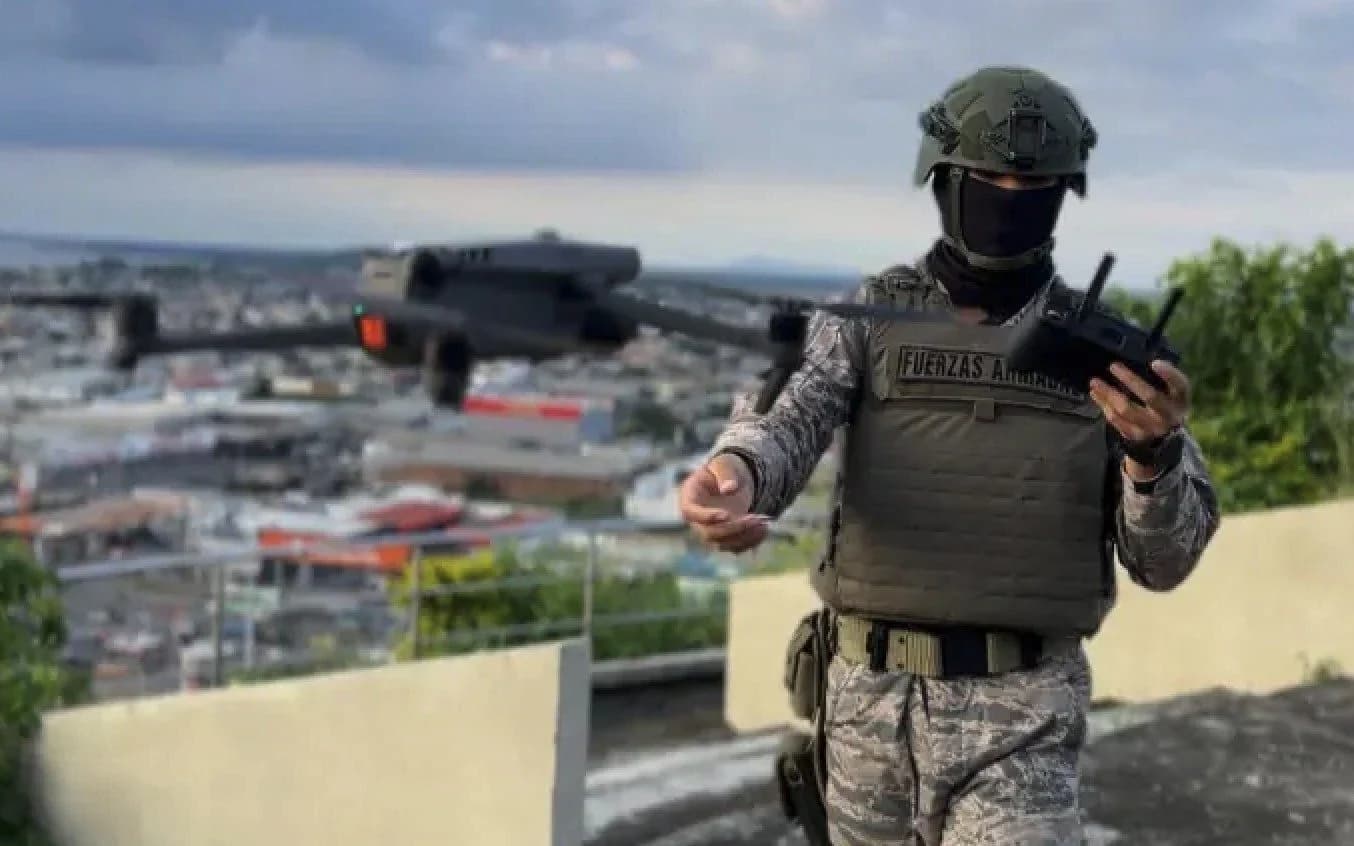
Ecuador, a transit point for roughly 70% of the world's cocaine, has deployed commercial drones including the DJI Matrice 30T as part of a US$19 million U.S.-backed counter-narcotics push—US$6 million of which is earmarked for drone systems. While drones extend ISR reach into jungle and coastal smuggling corridors, analysts warn that ambiguous legal frameworks, civilian casualty risks, and weak accountability mechanisms threaten the legitimacy of the entire strategy.

Highlights
- Ecuador is a transit point for approximately 70% of the world's cocaine, prompting President Daniel Noboa to declare an 'internal armed conflict' and secure US$19 million in U.S. security funding.
- US$6 million of the U.S. aid package is specifically allocated to drone system procurement, with the DJI Matrice 30T identified as a platform in active use for ISR missions.
- A mistaken drone strike on a fishing vessel near the Galápagos Islands demonstrates that civilian casualty risk is a concrete and present danger in Ecuador's drone-based counter-narcotics operations.
- Analysts warn that technological superiority cannot offset gaps in human intelligence or ambiguous rules of engagement, and that without independent incident review, drone strikes risk undermining operational legitimacy.
- U.S. Southern Command (Southcom) is scaling Ecuador's drone model across Latin America; whether host nations can maintain credible human-rights oversight will determine if the approach becomes a regional template or a cautionary example.
Ecuador's Drone War on Drug Traffickers: What Is the Cost of Tech-Driven Counter-Narcotics?
Ecuador has increasingly turned to drones as a central tool in its fight against drug-trafficking networks—a strategy that showcases both the promise and the peril of technology-driven counter-insurgency operations. The approach is examined in depth by The Telegraph journalist Gemma Brown in her piece, "How Ecuador Is Using Drones to Dismantle the 'Cocaine Superhighway.'"
Approximately 70% of the world's cocaine passes through Ecuador. After President Daniel Noboa declared an "internal armed conflict," the country secured up to US$19 million in U.S. funding, with US$6 million specifically allocated to the procurement of drone systems. The move reflects a broader shift by national security forces toward unmanned aerial systems (UAS) to reduce personnel risk and extend surveillance coverage into ungoverned territories.
The Strategic Logic
Drones allow reconnaissance to reach jungle and coastal areas long dominated by smugglers, while enabling police to track fleeing suspects without exposing officers to ambush risk.
The so-called "Ukraine effect"—whereby combat-tested commercial platforms such as the DJI Matrice 30T are being repurposed for domestic security operations—signals the rapid maturation of a market for attritable intelligence, surveillance, and reconnaissance (ISR) assets well beyond conventional state-on-state conflict.
Unavoidable Friction Points
The new approach is not without serious problems.
Target identification difficulties: Confirming strike targets is extremely challenging under an ambiguous legal framework, and disputed strike outcomes have occurred repeatedly.
Civilian casualty risk: The mistaken strike on a fishing vessel near the Galápagos Islands is a concrete demonstration that civilian harm is a genuine, present danger.
The core contradiction: Technological superiority cannot compensate for deficiencies in human intelligence (HUMINT) or divergent legal interpretations—and it is precisely those two factors that determine whether a given strike is genuinely precise or merely a pretext.
Lessons from the Case
Drones can compress the find-fix-finish cycle against smuggling networks, but without transparent rules of engagement and independent incident-review mechanisms, the tools themselves risk eroding the legitimacy on which counter-narcotics operations ultimately depend.
As the United States, through U.S. Southern Command (Southcom) and its newly established autonomous operations command architecture, scales this model across Latin America, the ability of host nations to maintain meaningful human-rights oversight will determine whether Ecuador's approach becomes a template for others to follow—or a cautionary tale to be avoided.
This article was originally published in Small Wars Journal at Arizona State University.
原文來源: 查看原文
FAQ
Newsletter
Subscribe to our Low-Altitude Industry Newsletter
Daily curated news on low-altitude economy and drone industry, delivered to your inbox.