Chino PD Scales Up July 4th Fireworks Enforcement to 65 Officers as Drone Program Expands from Single-Unit Test
The Chino Police Department will deploy multiple drones alongside 65 dedicated officers for July 4th fireworks enforcement this year, a major expansion from its 2025 single-drone pilot. Neighboring San Bernardino is introducing drones for the first time, paired with a social host ordinance holding property owners liable. The trend is spreading across California's Inland Empire, even as Stanton's $929,000 in fines and an ACLU lawsuit cast legal shadows over the enforcement model.

Highlights
- Chino PD is scaling its July 4th fireworks enforcement from a single drone in 2025 to multiple drone teams plus 65 officers in 2026, with each drone crew comprising a pilot, observer, and camera operator.
- San Bernardino is deploying drones for fireworks enforcement for the first time in 2026, pairing aerial surveillance with a social host ordinance that holds property owners liable regardless of their presence during the violation.
- Stanton, California issued $929,000 in drone-based fireworks fines to 18 homeowners in 2025, including one $300,000 citation, prompting all recipients to contest the fines and triggering broader legal scrutiny.
- California law caps fireworks fines at $1,000 for possession of under 25 pounds, limiting Chino's per-citation revenue potential and distinguishing its legal exposure from Stanton's per-explosion billing model.
- The ACLU Foundation of Northern California filed a 2025 lawsuit in Sonoma County challenging a sheriff's drone program as unconstitutional warrantless aerial surveillance, with the outcome potentially affecting all similar programs nationwide.
Chino PD Scales Up July 4th Fireworks Enforcement to 65 Officers as Drone Program Expands from Single-Unit Test
The Chino Police Department will deploy multiple drones over residential areas this July 4th alongside 65 dedicated enforcement officers tasked with citing illegal fireworks — a major escalation from the city's single-drone test the previous year. Each drone is operated by a two-person crew consisting of a pilot and an observer, with camera operators zooming in to document individuals setting off fireworks and the residences they return to.
The expansion puts Chino on the same path already taken by other cities across Southern California's Inland Empire in 2025, where drone-assisted fireworks citations and five-figure fines have turned Independence Day into a proving ground for aerial enforcement. Neighboring San Bernardino is introducing drones for the first time this year, pairing the technology with a social host ordinance that holds homeowners, tenants, and party organizers jointly liable for fireworks discharged on their property. Across the Inland Empire, what began as early-adopter experiments is rapidly becoming standard municipal enforcement practice.
The approach — originating in Sacramento and Riverside — has become the default answer to a persistent challenge: how to identify fireworks violators in the dark, amid hundreds of simultaneous calls for service, without placing officers directly inside crowds.
From One Drone to Multiple Teams
Chino ran a single-drone fireworks enforcement test in 2025 and plans a significant upgrade for the 2026 holiday, deploying multiple drone teams alongside 65 officers — a substantial jump in personnel for a single-night operation.
"Last year we piloted with one drone. This year we will have multiple drone teams deployed throughout the city," Chino Police Chief Kevin Mensen told the city council at a June 16 meeting.
Drones handle evidence collection that ground officers cannot. "Behind each drone is a team — what we call an observer and a pilot," said Chino PD Lieutenant Michael Johnson. The camera capability is central to the operation. "They can zoom in and get a pretty clear picture of who's setting off the fireworks and which residence they return to," Johnson explained.
City officials were candid about the value of recorded evidence. "It's very interesting when people are caught on camera and deny doing anything wrong until they're told they've been recorded. The whole story changes," said Mayor Eunice Ulloa at the same council meeting.
The volume of calls justifies the staffing scale. Johnson said Chino typically receives around 500 calls for service within a few hours on July 4th. Local outlet Champion Newspapers reported 519 calls last year, 305 of them fireworks-specific — a six-year department record. That same night, a fireworks explosion on Hastings Court left three people with minor injuries and damaged five vehicles; a juvenile on Grape Avenue was cited after an M-80 damaged a residence.
Results from the single-drone test were modest. KTLA reported Chino issued 18 fireworks-related citations at $1,000 each; Mensen told the council 17 citations were issued, with proceeds going into the city's general fund. The $1,000 ceiling is a California statutory limit — not a city policy choice — applying to possession of under 25 pounds of fireworks, which explains why Chino's per-citation fines are lower than the per-explosion models used elsewhere.
San Bernardino Pairs Drones with Social Host Ordinance
San Bernardino will deploy drones for fireworks enforcement for the first time this year, combining aerial surveillance with a social host ordinance that holds property owners responsible for illegal fireworks discharged on their land — regardless of whether they personally lit them. The ordinance may prove more consequential than the drones themselves, because it changes who pays when the camera captures a violation.
Under city rules, "safe and sane" fireworks are permitted only south of the 210 Freeway and only during authorized hours. Officials warned that fines for illegal use and possession of dangerous fireworks — including firecrackers, bottle rockets, and Roman candles — can accumulate rapidly. A similar social host ordinance already exists in Chino.
The social host model is the connective tissue between aerial surveillance and fine revenue: drones confirm which property fireworks came from, and the ordinance makes the owner or tenant liable, whether or not they were present. This combination produced the most controversial fireworks enforcement incident of 2025 and is now being implemented in a second Inland Empire city.
The 2025 Enforcement Wave Set the Template
Chino and San Bernardino are following the California enforcement script developed in 2025, when cities deployed drones against fireworks violators with widely varying outcomes. What distinguished the programs from each other was fine structure, not the aircraft.
In Riverside, five drone teams more than doubled the citation count, with individual fines reaching $1,500. Sacramento Fire used a progressive structure: $1,000 for a first offense, $2,500 for a second, and $5,000 per explosion thereafter — a captain noted a single-night tally could climb from $1,000 to $30,000. San Jose launched its own pilot the same summer.
Then there is the Stanton case, which exposed the legal vulnerabilities of the model — and which anyone inclined to view drones overhead as a solved problem should understand first.
Stanton's $929,000 in Fines Reveals Where Enforcement Can Go Wrong
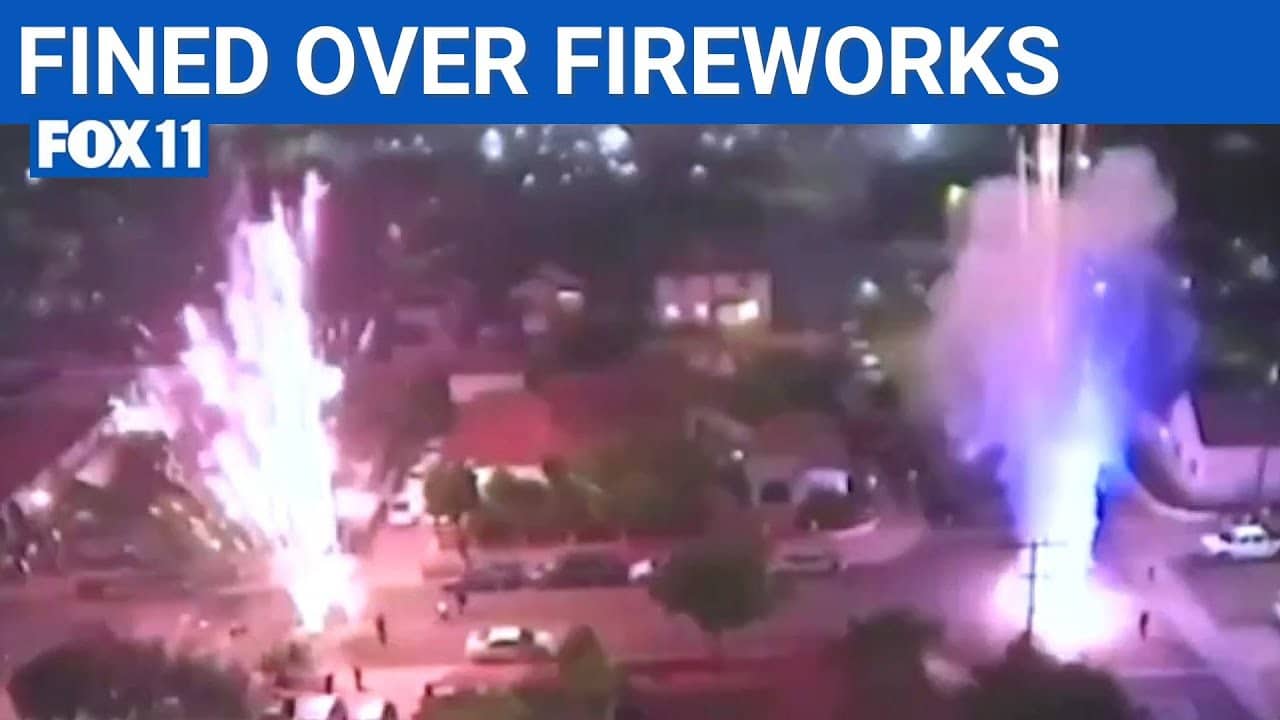
Stanton cited 18 homeowners for a combined $929,000 in fireworks fines in 2025 based on drone footage, including a single $300,000 citation issued to a homeowner who said she was not home at the time. All 18 recipients contested the fines, directly challenging the scope of drone-based administrative enforcement.
The highest fine was issued against one homeowner whose property was recorded with approximately 300 explosions, billed at $1,000 per explosion. "I wasn't even home," the owner told FOX 11 Los Angeles, questioning what the drone footage actually proved. As DroneXL reported in detail last October, Stanton's social host ordinance — passed in April 2025 and the same legal instrument now being adopted by San Bernardino — holds owners liable regardless of whether they set off the fireworks or were even present.
Image credit: FOX 11 Los Angeles
The disparity between cities is striking. While Stanton issued nearly $1 million in fines, neighboring Brea ran its own drone program and issued a single $500 citation. Identical technology, radically different enforcement philosophies. Stanton also retains 35% of each fine, with the remaining 65% remitted to the State Fire Marshal — an arrangement that gives the city a direct financial incentive to maximize fine amounts rather than simply deter violations.
Constitutional Questions Have Entered the Courts
Drone-based fireworks enforcement is colliding with constitutional limits on warrantless surveillance and excessive fines, and the litigation is no longer hypothetical. The ACLU Foundation of Northern California filed suit in June 2025 in Sonoma County, alleging that the sheriff's drone program constituted unconstitutional warrantless aerial surveillance.
Two independent constitutional theories are now in play. The Fourth Amendment question is whether persistent drone observation of backyards constitutes a search. The Eighth Amendment question — raised by an Orange County Register editorial targeting Stanton — is whether five- and six-figure fines violate the Excessive Fines Clause, which the Supreme Court applied to the states in Timbs v. Indiana (2019). As DroneXL reported last December, police drone programs nationwide have surpassed 6,000, and this enforcement model has already lost in court — including a Citrus Heights case in which a landlord's $25,000 fine was overturned because California law requires prior owner knowledge.
That is the legal environment into which Chino and San Bernardino are stepping. Both cities are adopting tools that, in a narrow sense, work: drones do capture clear footage and do link fireworks to addresses. Whether the legal framework underlying those tools will hold is being decided elsewhere, right now.
DroneXL Editorial Perspective
This reporter has tracked this story city by city from the second half of 2025 through 2026 — from Riverside's post-Harding Fire drone deployment last June, to Stanton's near-million-dollar fine controversy in October, to the nationwide 6,000-program milestone at year's end. Chino joining the list is not surprising. What stands out is the staffing arithmetic: a city of roughly 95,000 people committing 65 officers for a single night represents serious intent. Police departments have clearly concluded that drone-assisted fireworks enforcement is worth real overtime budgets, not just novelty.
What lingers is the gap between what the tool does well and what it does to public trust. Drones are genuinely suited for this task. An elevated camera with optical zoom solves a problem that ground officers cannot. The same capability saves lives in legitimate emergency response — search and rescue, active-shooter situations — and this publication has argued for those applications for years and will continue to do so. But every Stanton-style headline, every $300,000 citation issued to someone who says they weren't home, every city quietly keeping a third of the fine revenue, makes it harder for the public to distinguish the rescue drone from the citation drone. The industry pays a price for that confusion.
The open question Chino's expansion has not yet answered: what happens when its drone footage meets California's $1,000 statutory cap? Stanton's legal exposure came from stacking per-explosion fines into six figures. Chino is constrained from replicating that approach, which may make its program both harder to monetize and easier to defend legally. Watch whether San Bernardino attempts to work around the cap through its new social host ordinance, as Orange County cities have tried. And keep watching the Sonoma County ACLU case — if a court draws a clear line on warrantless backyard surveillance, every program in this story, including Chino's, will be rewritten by a judge rather than a city council.
Sources: KTLA, Champion Newspapers
DroneXL uses automated tools to assist with research and source discovery. All reporting and editorial commentary is written by Haye Kesteloo.
原文來源: 查看原文
FAQ
Newsletter
Subscribe to our Low-Altitude Industry Newsletter
Daily curated news on low-altitude economy and drone industry, delivered to your inbox.