Irvine PD Drone-as-First-Responder Program Tracks Walmart Theft Suspect Hiding in Pickup Truck Bed
On June 24, the Irvine Police Department's Drone as First Responder (DFR) program led to the arrest of 26-year-old Guillermo Hazael Martinez Diaz after he attempted to hide in a pickup truck bed following a Walmart theft. Backed by a $2 million Real Time Crime Center integrating over 1,000 cameras and a partnership with Flying Lion, the program demonstrates how routine property crimes—not just high-profile incidents—are becoming the operational backbone of DFR deployments.

Highlights
- On June 24, Irvine PD's DFR drone tracked theft suspect Guillermo Hazael Martinez Diaz hiding in a pickup truck bed, leading to his arrest on three charges including commercial burglary and possession of a controlled substance.
- Irvine's Real Time Crime Center cost $2 million to build and integrates live drone footage with license plate recognition and streams from over 1,000 citywide cameras.
- The DFR program launched with approximately $100,000 in startup funding through a partnership with Flying Lion, with drones pre-deployed on two downtown rooftops.
- Irvine reports double-digit drops in both property and violent crime since the DFR system went live.
- A 2025 California court ruling requiring Chula Vista PD to release drone footage publicly sets a transparency precedent that all California DFR programs—including Irvine's—will eventually need to address.
Retail Theft Call Becomes a DFR Program Case Study
According to the police report, 26-year-old suspect Guillermo Hazael Martinez Diaz pushed a shopping cart full of stolen merchandise out of a Walmart in Irvine, California. The Irvine Police Department's Real Time Crime Center (RTCC) dispatched a drone the moment the call came in, and the aircraft quickly locked onto the suspect as he fled the store on foot.
Diaz then climbed into the bed of a pickup truck and lay flat, apparently betting that officers on the ground would not spot him. The drone saw everything. The RTCC immediately relayed coordinates to officers already patrolling the parking lot, allowing them to walk straight to the correct vehicle without a wide-area search or perimeter sweep.
Martinez Diaz was booked into Orange County Jail on three charges: commercial burglary, possession of a controlled substance, and resisting arrest. The first charge triggered the call; the latter two emerged after officers made contact.
The entire sequence took only minutes—no K-9 unit, no patrol cars circling the lot, no air support unit requiring ten minutes of spin-up time. The drone had eyes on the suspect before ground units even reached the scene.
The $2 Million Real Time Crime Center Is the Real Story
The drone is the visible part. The Real Time Crime Center behind it is what makes the drone useful. Irvine has built a $2 million facility that fuses live drone footage, license plate recognition, and video streams from more than 1,000 cameras deployed across the city.
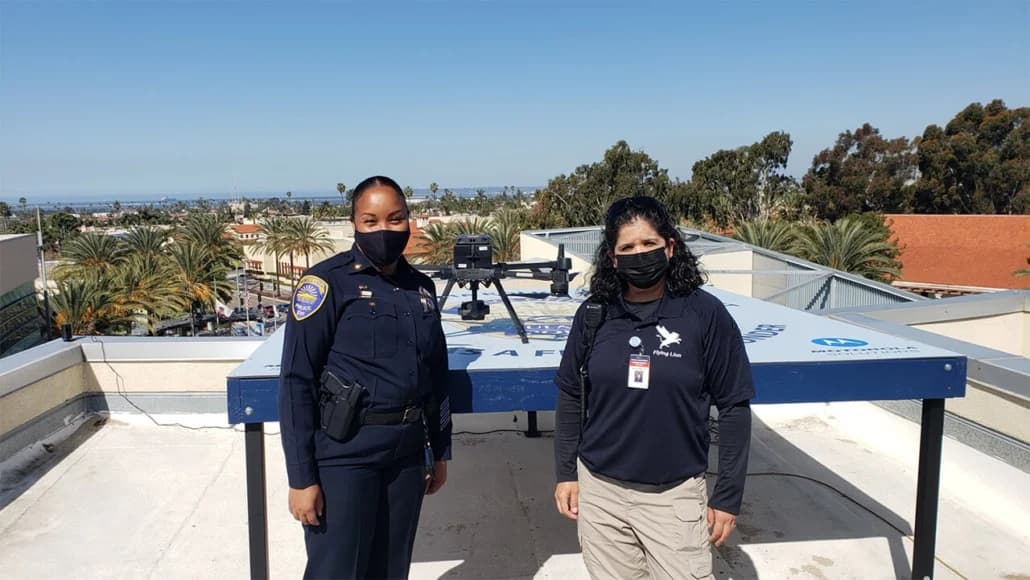
According to New Santa Ana, Irvine operates its DFR program through a partnership with drone services company Flying Lion, which has helped set up DFR operations for multiple police departments across the United States. The program launched with approximately $100,000 in startup funding, with drones pre-positioned atop two downtown buildings and made available for shared use by both the Irvine Police and Fire departments.
The workflow: a dispatcher assesses whether a call warrants a drone response, the aircraft launches from a rooftop base, and live footage and coordinates stream to the RTCC and then directly to patrol units. Irvine reports double-digit drops in both property and violent crime since the system went live.
Pre-positioning is the program's core operational advantage. The drones sit on charging docks—fully powered and on standby—without consuming battery life hovering. Because the launch is triggered by the call rather than the other way around, the aircraft can be overhead within minutes instead of waiting for equipment to be driven to a scene, a launch zone established, and a flight plan plotted. The dock-deployment model was pioneered in the enterprise market by the DJI Dock; Skydio later released its own platform, and Flock joined through Aerodome.
Theft Calls Are What Keep DFR Programs Running
The DFR incidents that draw headlines are dramatic: an armed robbery suspect tracked through a neighborhood, a missing child found in minutes, a barricaded subject located from the air before a SWAT team deploys. Those are the stories that get covered. The suspect in this case was a man who took a cart of stolen merchandise and hid in a truck bed.
But routine calls like this one are what sustain the system. A $2 million Real Time Crime Center cannot pass a city council budget review year after year on dramatic rescues alone—it runs on case volume, on the property-crime arrests that used to consume hours of officer time and now close in minutes.
This is where the DFR economic argument is clearest: the patrol officer hours spent searching a parking lot, the paperwork on a pursuit that went nowhere—all of it replaced by a drone that already knew where the suspect was hiding.
Every case like this is a small win. Stack enough of them over a year, and a department has the justification to request a second drone, a third rooftop deployment site, a larger crime center. Chula Vista, California's earliest DFR adopter, has expanded its program every year for exactly this reason. Irvine is on the same trajectory.
Privacy Questions Remain Unanswered
Every DFR program in California currently operates under the same unresolved question: transparency. A 2025 California court ruling forced the Chula Vista Police Department to release drone footage to the public, setting a precedent that every law enforcement agency in the state now has to reckon with.
Irvine has not yet faced a comparable public records lawsuit—at least not publicly. But a program feeding more than 1,000 cameras into a single fusion center, integrated with drone imagery, will eventually have to answer the same questions: how long is footage retained, who reviews it, what gets released, and what gets withheld.
The June 24 arrest was clean—a clearly visible suspect, a specific call, a straightforward public safety rationale. Not every DFR flight will be that clean, and California courts have already signaled they are willing to scrutinize the record.
DroneXL Editorial Perspective
To be direct: the significance of this story is not the arrest itself, but the fact that a shoplifting call now routinely triggers a tactical drone launch. That is a qualitative shift in law enforcement operations, and it happened without any public vote—building by building, contract by contract, with companies like Flying Lion laying the infrastructure and city councils approving it under line items that look like ordinary public safety budgets.
The system works. The arrest data supports it. Irvine, Chula Vista, the San Francisco Police Department—every department that has built a mature DFR program reports faster response times and higher arrest rates on drone-assisted calls. The technology is delivering on what the brochure promised, which is rarer in this industry than it sounds.
The framing of DFR as "mass surveillance in uniform" does not hold up so far. These drones have demonstrated more benefit than harm at active law enforcement scenes, and the system is doing what it was designed to do. When it starts going wrong, the criticism will have clearer ground to stand on. Until then, the noise around DFR is louder than the data warrants.
The question worth asking more carefully: what happens when DFR becomes the default response to every property crime call—not just the ones that actually merit a drone—rather than a tool deployed selectively? Drone sorties are cheap to execute but expensive to litigate. Most departments will keep flying until something forces a pause—a privacy ruling, a budget cycle, or a case where the drone captured something it should not have been watching. That reckoning will look very different from one California city to the next.
Image credits: Flying Lion, Irvine PD
原文來源: 查看原文
FAQ
Newsletter
Subscribe to our Low-Altitude Industry Newsletter
Daily curated news on low-altitude economy and drone industry, delivered to your inbox.