Anti-Drone Warfare: The Missing Layer in Maritime Defense Architecture
The proliferation of one-way attack (OWA) drones has exposed a critical gap in existing defense frameworks. Anti-Drone Warfare (ADW) is neither traditional air defense nor C-UAS, but a distinct operational domain with unique threat physics, engagement economics, and platform requirements. In maritime environments, shore-based systems alone cannot bridge this gap—unmanned surface vessels (USVs) are identified as the essential solution.

Highlights
- OWA drones costing USD 20,000–50,000 each represent a distinct Tier 2 threat category that existing C-UAS and traditional air-defense systems are each structurally unsuited to counter at scale.
- Shore-based radar systems detect OWA drones with 0.1 m² RCS at under tens of kilometers in real sea-clutter conditions, leaving less than 3.5 minutes of engagement time at 200 km/h drone speeds.
- A USV equipped with AESA radar and forward-deployed 30 km along the threat axis provides up to ten additional minutes of warning time compared to shore-based equivalents.
- Operational analysis from Ukraine confirmed that countering Shahed-class loitering munitions requires cost-proportionate effectors such as radar-guided artillery, not advanced missile interceptors designed for higher threat tiers.
- U.S. Navy commanders returning from Red Sea operations identified adequate magazine depth and integrated C2 as the two core requirements for sustained maritime counter-drone defense.
Anti-Drone Warfare: The Missing Layer in Maritime Defense Architecture
The mass proliferation of autonomous one-way attack (OWA) drones has revealed a critical gap in existing defense frameworks: Anti-Drone Warfare (ADW) is neither traditional air defense nor counter-small unmanned aircraft systems (C-UAS), but a distinct operational domain with its own threat physics, engagement economics, and dedicated platform requirements. In maritime environments, this gap is structural—and shore-based systems alone cannot bridge it.
This article was written by Hasan Özyurt, a retired Turkish Rear Admiral and current Naval Systems Coordinator at ULAQ Global.
The Fundamental Problem of Threat Classification
The warning signs appeared well in advance. Israeli operations around 2016–2017 and the 2020 Nagorno-Karabakh conflict had already demonstrated that unmanned systems could deliver decisive effects at the operational and tactical levels—documented in detail by John Antal in Seven Seconds to Die. Yet in spring 2022, one of Europe's most heavily defended ground corridors proved unable to counter massed waves of low-cost OWA drones. The core lesson was not a failure of sensors or weapons performance, but a fundamental misclassification of the threat—a problem that should have been corrected long ago and remains unresolved, particularly in maritime settings.
Defense planners have long sorted airborne threats into two familiar categories: traditional air defense, covering manned aircraft, cruise missiles, and large drones; and C-UAS, covering small commercial quadcopters. Between them lies a rapidly expanding middle tier—autonomous OWA drones capable of carrying 40–100 kg warheads, flying hundreds to thousands of kilometers, resisting GNSS jamming, and arriving in saturation waves of tens to hundreds of units per strike, each costing only USD 20,000–50,000.
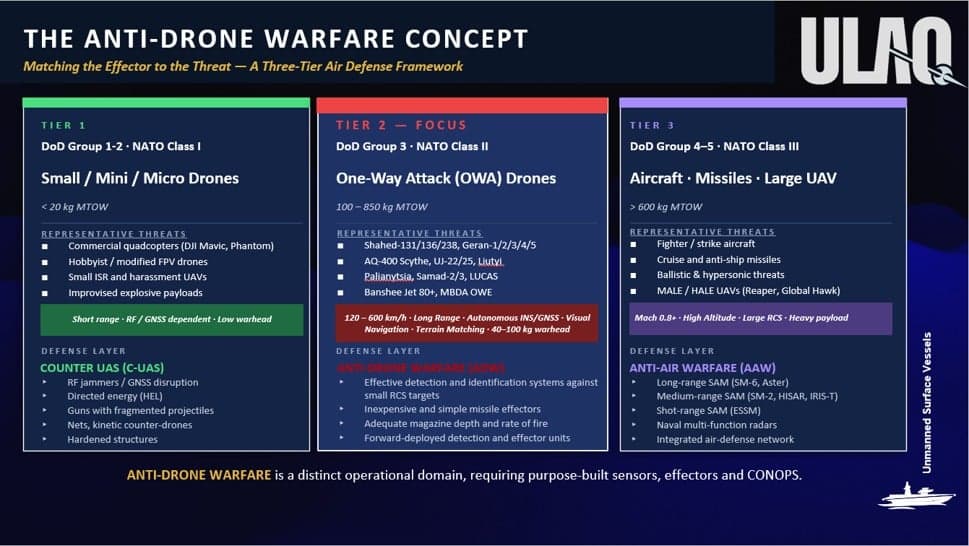
A three-tier air defense framework effectively resolves this classification problem (see Figure 1):
- Tier 1: Sub-20 kg small commercial systems, typically countered with electronic jamming and close-in kinetic interceptors.
- Tier 2 — Anti-Drone Warfare (ADW): 100–850 kg-class OWA drones, characterized by low radar cross-section, low cost, mass producibility, unmanned operation, and the ability to saturate defensive architectures designed for a different era.
- Tier 3 — Anti-Air Warfare (AAW): Manned aircraft, cruise missiles, ballistic threats, and large military drones—a mature, well-resourced operational domain.
The UK government's maritime counter-drone guidance now explicitly adopts the same classification framework, distinguishing small commercial drones from weaponized "loitering munitions" such as the Shahed-136, and excluding large drones and anti-ship missiles from its scope.
No single system can address all three tiers simultaneously: systems designed for Tier 1 will be overwhelmed by Tier 2 volumes; systems designed for Tier 3 will exhaust any nation's defense budget. A complete ADW architecture requires capabilities purpose-built for each tier.
The Economics of Attrition
Misclassifying the threat carries direct economic consequences. When planners treat all drone threats as a single problem, only two outcomes are possible: either expensive interceptors are used against cheap targets, consuming budgets far faster than the attacker can sustain production; or precision-engagement investment is misdirected to the wrong threat tier, leaving OWA drones effectively unopposed. In either case, the defender spends far more per engagement than the attacker spends per drone—and the attacker needs only to increase production to exceed the defender's intercept rate. The U.S. Department of Defense has formally designated unmanned systems as an urgent and persistent threat, investing accordingly in classification frameworks, doctrine, and the equipment required to counter them at scale. This cost-exchange problem is a strategic vulnerability, not merely a budget issue.
Adversaries can produce long-range OWA drones for approximately USD 20,000–50,000 each and sustain daily strike waves of 50–150 units for months on end. Defending against them with conventional surface-to-air missiles costing orders of magnitude more is neither logical nor sustainable—political will collapses before the attacker's production capacity is exhausted. A comprehensive cost-benefit analysis of counter-drone technologies covering 2022–2026 confirmed that per-engagement costs vary by more than five orders of magnitude across system categories, and concluded that sustainable defense architectures must prioritize low-cost effectors over advanced missile interceptors when facing high-volume threats. Operational analysis from Ukraine reached the same conclusion: countering Shahed-class loitering munitions requires cost-proportionate, purpose-built effectors—radar-guided artillery and small precision systems—not interceptors designed for higher threat tiers.
Why Shore-Based Systems Cannot Solve the Maritime Problem
Operationally proven shore-based C-UAS systems exist and have been deployed in combat, with demonstrated detection and engagement capabilities against Tier 1 and Tier 2 drones. Against smaller platforms—those reliant on radio frequency or GPS, operating within fixed sensor coverage, and arriving in numbers manageable by point-defense effectors—shore-based systems are a cost-proportionate and effective response. For fixed ground infrastructure with defined threat axes, layered sensor coverage along known corridors is a mature and appropriate defensive layer.
However, when the threat axis shifts to the maritime domain, three compounding structural limitations emerge that no improvement to shore-based systems can overcome.
Limitation 1: Detection Range. The radar cross-section of DoD Group 3 / NATO Class II OWA drones—as low as 0.1 m² depending on aspect angle—severely constrains detection range over open water. Some radar systems claim detection ranges of 20–50 km against drone targets, but real-world operational experience indicates effective detection ranges of tens of kilometers or less under realistic sea clutter conditions. At a conservative 10 km, a drone traveling at 200 km/h leaves less than three and a half minutes from first detection to impact—an extremely compressed engagement window.
Limitation 2: Engagement Range and Reaction Time. Even where shore-based kinetic effectors achieve ranges beyond 20 km, the usable engagement window is bounded by detection range, not weapon range. This narrow available depth structurally forces shore-based ADW toward close-in, reactive effectors with little margin for re-engagement if the first shot misses. Against jet-powered OWA variants traveling at 500–650 km/h, this window compresses to seconds.
Limitation 3: Fixed Position. Shore-based systems are geometrically fixed to the coastline—precisely where available engagement depth is exhausted. They cannot exploit early warning advantage further forward along the threat axis, reposition along extended coastlines, or escort underway maritime assets. The coast is not a defensive position against maritime threats—it is the last line of defense, and often the only one. The problem is not shore-based capability per se, but the failure to exploit the warning time and early-engagement opportunity that forward maritime deployment provides. The ocean itself is defensive space—failing to use it is the strategic-level gap.
Unmanned Surface Vessels: The Right Platform for ADW
Unmanned surface vessels (USVs) directly address each of these structural limitations. A USV equipped with an active electronically scanned array (AESA) radar and forward-deployed 30 km along the threat axis provides an additional 30 km of warning distance—not because its sensors outperform shore-based systems, but because it encounters the threat earlier. At 185 km/h, that is approximately ten additional minutes; against a 600 km/h jet-powered variant, it is three minutes—and those three minutes are the difference between a manageable engagement sequence and an impossible compressed timeline. A USV picket line can also reposition along shifting threat axes, concentrate on intelligence-indicated attack corridors, or escort underway maritime assets—none of which any shore-based installation can achieve.
The signature advantage is equally significant. A 10–15 m unmanned vessel presents a far smaller visual, radar, and thermal signature than a manned warship, substantially reducing the probability of detection, targeting, and interception. The hardest platform to detect is also the one best able to sustain a forward position.
For the ADW mission, a complete kill chain—comprising an air-search radar optimized for low-RCS targets, a multi-spectral electro-optical sensor for target identification and fire control, and cost-proportionate close-in precision guided effectors—fits comfortably within the deck space, weight budget, and power generation capacity of a purpose-designed medium or small USV. These are precisely the qualities needed to counter the OWA drone threat: platforms that can rapidly reposition, concentrate force in response to intelligence, and absorb losses without catastrophic degradation of overall capability.
Doctrine, Not Hardware Alone
Hardware without doctrine produces individual capability without systemic effectiveness. In a saturation attack of 40–80 drones across a 30 km front, a USV picket line must complete target allocation and handoff coordination in second-level cycles—coordination that must be automated at the force level, not improvised at the point of contact. U.S. Navy commanders returning from Red Sea operations have identified adequate magazine depth and integrated command and control (C2) as the core lessons for sustained maritime counter-drone defense, and the Navy's adoption of low-cost interceptors such as the Coyote reflects exactly this cost-exchange logic.
Three conclusions follow:
- ADW must be resourced as a distinct operational domain, not absorbed into existing AAW or C-UAS programs.
- Maritime capability must prioritize forward-deployed unmanned platforms equipped with AESA detection and cost-proportionate effectors—shore-based C-UAS constitutes the inner defensive layer, while the outer layer barely exists at the scale the threat demands.
- Hardware investment must be matched by equivalent investment in doctrine and C2: a USV picket line without coordination infrastructure is a collection of point-defense units, not an area-defense capability.
The adversaries driving this threat made their investment decisions years ago, and their production lines are running at full capacity. Defenders who recognize ADW as a distinct operational domain and build the corresponding platforms and doctrine will maintain a viable maritime posture. Those who treat it as an adjunct to existing air defense will find themselves fighting the wrong threat, with the wrong systems, on entirely the wrong cost terms.
原文來源: 查看原文
FAQ
Newsletter
Subscribe to our Low-Altitude Industry Newsletter
Daily curated news on low-altitude economy and drone industry, delivered to your inbox.