How Interceptor Missiles Work: The Technology Behind Destroying Missiles in Flight
Intercepting a missile in flight is one of the most demanding challenges in defense technology. Within minutes, a missile defense system must detect, track, calculate trajectories, and collide with a target traveling at several times the speed of sound. This article breaks down the three intercept phases, hit-to-kill technology, and how major systems such as THAAD, PAC-3, and SM-3 operate — and where the field is headed.

Highlights
- Ballistic missile defense systems rely on infrared satellites and ground/sea-based radars to detect and track incoming missiles before any interceptor is launched.
- Interceptors are guided to a predicted future position of the target — not its current location — using fire-control computers that factor in speed, altitude, and trajectory.
- Ballistic missile flight has three phases (boost, midcourse, terminal), each requiring different interceptor systems: GMD/SM-3 for midcourse, THAAD and PAC-3 for terminal.
- Hit-to-kill (HTK) technology, used by THAAD, SM-3, and Patriot PAC-3, destroys targets through kinetic impact alone, without a conventional explosive warhead.
- The Glide Phase Interceptor (GPI) is currently in development to counter hypersonic glide vehicles, which can maneuver unpredictably and are difficult to engage with existing systems.
How Interceptor Missiles Work: The Technology Behind Destroying Missiles in Flight
Intercepting a missile may sound straightforward — launch one missile to knock down another before it reaches its target. In reality, it is one of the most technically demanding challenges in defense. Unlike offensive missiles, an interceptor must detect, track, compute firing solutions, and collide with a target that may be traveling at several times the speed of sound — all within minutes. Some interceptors carry no explosive warhead at all, relying entirely on the kinetic energy of a direct collision to destroy the threat. Here is how missile defense systems accomplish this.
It All Starts with Detection
An interceptor missile is only as effective as the network supporting it. Before any interceptor is launched, satellites equipped with infrared sensors detect the intense heat signature of a missile at the moment of launch. Ground- and sea-based radars then begin tracking the missile's trajectory, calculating its likely flight path and, most critically, the optimal intercept point.
This information is relayed in real time to a command-and-control network, which determines whether an intercept is warranted, selects the appropriate interceptor, and decides the optimal launch window.
Predicting Where the Missile Will Be
A common misconception is that an interceptor simply chases the incoming threat. In practice, fire-control computers calculate the target's projected future position based on its speed, altitude, heading, and expected flight path. The interceptor is then launched toward that predicted intercept point — not the target's current location.
As both missiles continue their flights, the interceptor's onboard guidance system continuously receives updated tracking data and adjusts its course in real time until contact is made. Against short-range ballistic missiles, the entire sequence from detection to intercept may take only a few minutes.
Three Windows of Opportunity
A ballistic missile's flight is divided into three distinct phases, each presenting a different intercept opportunity.
Boost Phase begins immediately after launch, while the rocket motor is still burning. The missile is highly visible due to its intense infrared signature, but intercept is extremely difficult because defense assets must be pre-positioned close to the launch site.
Midcourse Phase is the longest portion of the flight, during which the warhead travels through space after booster separation. The Aegis Ballistic Missile Defense system, which employs the SM-3 interceptor, and the U.S. Ground-based Midcourse Defense (GMD) system are both designed to engage threats during this phase.
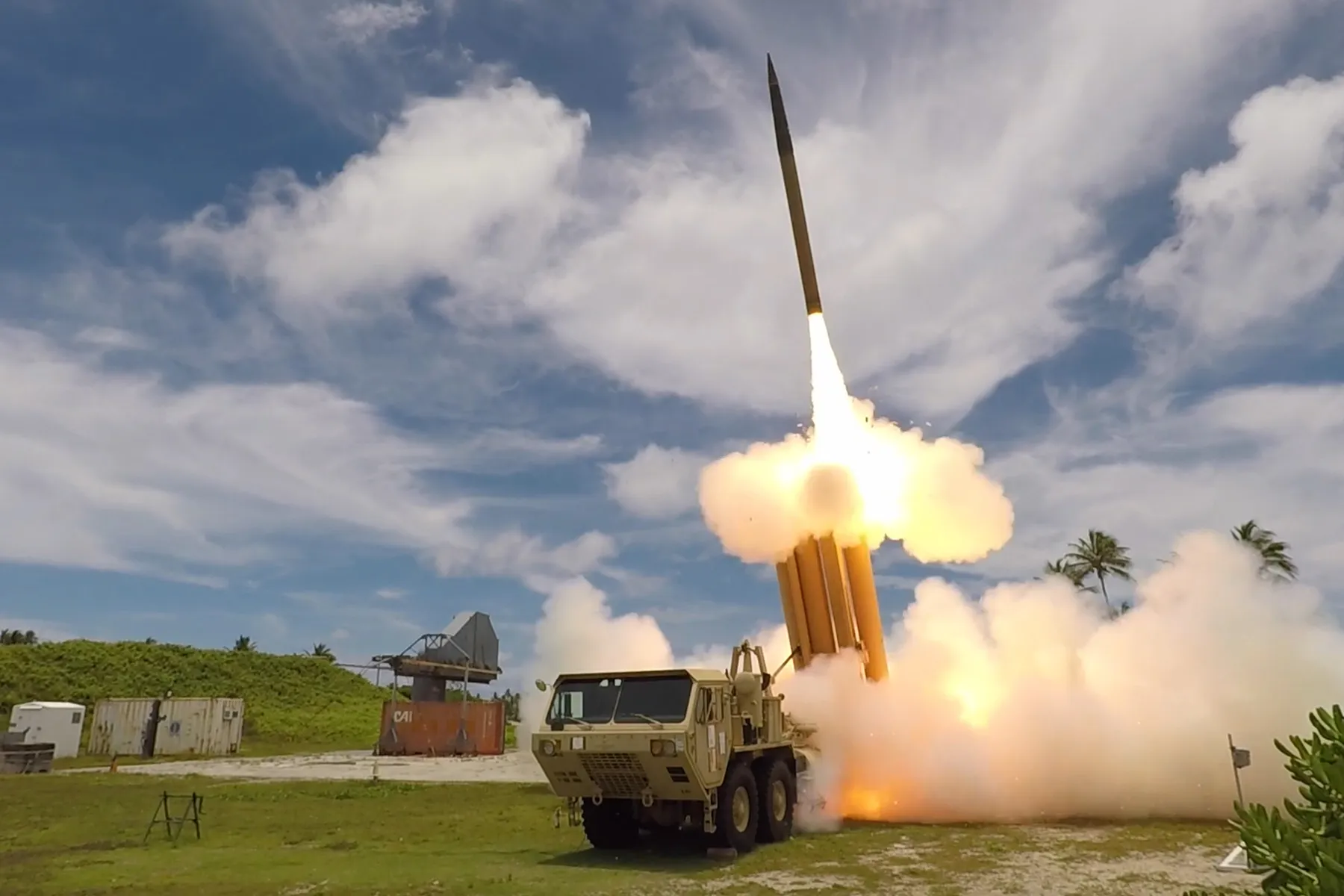
Terminal Phase is the final stage, as the warhead re-enters the atmosphere and dives toward its target. THAAD (Terminal High Altitude Area Defense) and the Patriot PAC-3 operate in this phase, providing a last opportunity to intercept before impact.
A THAAD interceptor missile launches. Image: U.S. Department of Defense
Terminal High Altitude Area Defense (THAAD) interceptor launch. Image: U.S. Department of Defense
Hit-to-Kill vs. Blast-Fragmentation
Not all interceptors destroy their targets in the same way. Many earlier systems used blast-fragmentation warheads that detonate near the incoming missile, shredding it with high-velocity metal fragments.
Modern systems increasingly rely on hit-to-kill (HTK) technology. Rather than detonating an explosive, these interceptors collide directly with the incoming missile at extremely high speed. The kinetic energy released by the impact is sufficient to destroy or neutralize the target without a large explosive payload. THAAD, SM-3, and Patriot PAC-3 all employ hit-to-kill technology for ballistic missile defense missions.
Why Interception Is So Difficult
Missile intercept is often compared to hitting a bullet with a bullet — but the real-world challenge is even greater. Incoming ballistic missiles can travel at several kilometers per second, leaving defenders an extremely narrow reaction window. Modern missiles may also deploy decoys, execute evasive maneuvers in flight, or fly at lower altitudes to complicate tracking.
Weather, electronic jamming, radar coverage gaps, and terrain can all reduce the time available for detection and engagement. For this reason, nations increasingly build layered missile defense architectures, in which multiple interceptor systems operate at different ranges and altitudes in a complementary fashion — so that if one layer fails, another has a chance to engage.
Key Interceptor Systems
Different interceptors are optimized for different threats:
- Patriot PAC-3: Focused on terminal-phase defense of military bases and population centers against ballistic missiles, cruise missiles, and aircraft.
- THAAD (Terminal High Altitude Area Defense): Engages short- to medium-range ballistic missiles at higher altitudes, with an intercept envelope that extends outside the atmosphere.
- SM-3: A ship-launched interceptor designed to engage ballistic missiles in the midcourse phase, protecting naval vessels and allied territory.
- SM-6: Provides additional terminal-phase capability against aircraft, cruise missiles, and certain ballistic threats.
Other nations operate their own systems, including Israel's Arrow-3, David's Sling, and Iron Dome, each tailored to specific threat ranges and categories.
The Future of Missile Intercept
The growing proliferation of hypersonic glide vehicles and maneuvering ballistic missiles presents increasingly severe challenges for conventional intercept methods. Future systems are expected to incorporate more powerful sensors, AI-assisted tracking, and new interceptor concepts such as the Glide Phase Interceptor (GPI), currently in development, designed to engage hypersonic threats before they enter their terminal dive.
No missile defense system can guarantee perfect protection, but modern layered architectures have significantly improved the ability to detect, track, and engage an ever-more-sophisticated threat environment. Ultimately, success depends not on any single interceptor, but on the seamless integration of satellites, radars, command networks, and multiple defensive layers — all working together within seconds.
原文來源: 查看原文
FAQ
Newsletter
Subscribe to our Low-Altitude Industry Newsletter
Daily curated news on low-altitude economy and drone industry, delivered to your inbox.
Reviewed and published by the LAETimes editorial desk ·