China Achieves Full-Chain Independence in Carbon-14 Nuclear Battery Technology with Launch of 'Qianjiyuan' Series in Lanzhou
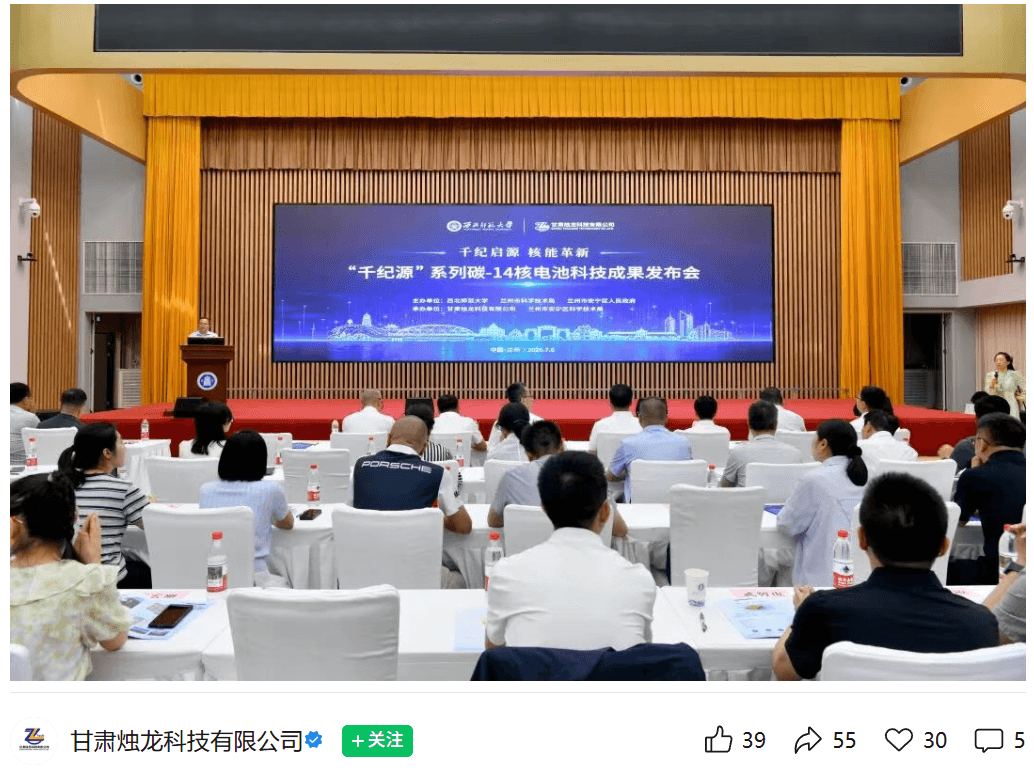
Northwest Normal University and Gansu Zhulong Technology Co. held a technical launch event in Lanzhou on July 6, unveiling the 'Qianjiyuan Tianshu' C-14 nuclear battery and 'Qianjiyuan Nengshu' silicon carbide transducer. Compared to the 'Zhulong-1' engineering prototype released in November 2024, the new series achieves five major technical breakthroughs, including a maximum output power of 1.13 microwatts and a 15.5-fold improvement in volumetric power density, marking a key milestone in China's fully domesticated C-14 nuclear battery supply chain.

Highlights
- The 'Qianjiyuan Tianshu' C-14 nuclear battery, launched on July 6 in Lanzhou, achieves a maximum output power of 1.13 microwatts within a 16.8 cubic centimeter package using a 129 millicurie carbon-14 source.
- Compared to the 'Zhulong-1' prototype released in November 2024, the new series improves volumetric power density by 15.5× and increases maximum output power to 2.6× the previous level.
- The 'Qianjiyuan' series reduces radiation source material usage to just 22% of the previous generation, cutting core material costs while increasing specific activity by 1.5×.
- Carbon-14's 5,730-year half-life gives these batteries a theoretical operational lifespan of thousands of years, with an operating temperature range of -100°C to 200°C.
- The launch marks China's completion of full-chain domestic independence in C-14 nuclear battery technology, covering radiation source production, SiC transduction, packaging, power management, and application validation.
China Achieves Full-Chain Independence in Carbon-14 Nuclear Battery Technology with Launch of 'Qianjiyuan' Series in Lanzhou
A technical achievement launch event titled "Qianji Qiyuan · Nuclear Energy Revolution" was held on July 6 in Lanzhou, Gansu Province. Hosted by Northwest Normal University and organized by Gansu Zhulong Technology Co., the event marked the official debut of two core research products under the new domestic brand: the 'Qianjiyuan Tianshu' carbon-14 nuclear battery and the 'Qianjiyuan Nengshu' silicon carbide transducer.
Strategic Importance of Nuclear Batteries
Nuclear batteries are indispensable long-life power sources for applications such as aerospace exploration, polar scientific expeditions, special-purpose equipment, and unattended systems. They are also considered a key component of China's next-generation energy infrastructure and strategic technology capabilities. For years, the industry has faced persistent bottlenecks including low output power, insufficient structural integration, and high application costs.
Technical Advantages of Carbon-14 Nuclear Batteries
Professor Su Maogen, head of the project team at Northwest Normal University, noted that carbon-14 isotopes have a half-life of 5,730 years, theoretically enabling operational lifespans measured in thousands of years. The material also demonstrates extreme temperature tolerance, functioning across a range of -100°C to 200°C.
The team leveraged carbon-14 radiation sources to push output power to the microwatt level, paired with high-performance silicon carbide (SiC) transducers for energy conversion. The goal is to meet the demand for long-life, maintenance-free power supply in applications such as IoT sensing, deep-sea exploration, and aerospace.
Five Major Technical Breakthroughs
Compared to the 'Zhulong-1' engineering prototype — China's first C-14 nuclear battery, released in November 2024 — the 'Qianjiyuan' series achieves five key technical advances:
- Radiation source adaptation technology
- Silicon carbide energy transduction technology
- Three-dimensional stacked packaging technology
- Intelligent power management technology
- Wireless self-powered sensing technology
Together, these breakthroughs establish a complete, domestically developed and independently controlled technology ecosystem.
Core Performance Specifications
According to official data, the 'Qianjiyuan Tianshu' C-14 nuclear battery uses a 129 millicurie carbon-14 radiation source within a volume of 16.8 cubic centimeters, achieving the following performance metrics:
- Short-circuit current: 0.713 microamps
- Open-circuit voltage: 2.06 V
- Fill factor: 0.77
- Maximum output power: 1.13 microwatts
Significant Improvements Over the Previous Generation
Across all key indicators, the 'Qianjiyuan' series represents a substantial leap over its predecessor:
- Radiation source specific activity increased by 1.5×, while the amount of source material used is only 22% of the previous generation, significantly reducing core material costs
- Short-circuit current increased to 2.5× the previous generation; fill factor improved from 0.73 to 0.77
- Maximum output power reaches 2.6× the previous generation
- Effective volume reduced to just 17% of the previous generation, while maintaining consistent open-circuit voltage and output stability
- Volumetric power density improved by 15.5×
These performance gains collectively overcome the traditional limitations of C-14 nuclear batteries — low efficiency, high cost, large form factor, and low power density — achieving a systematic upgrade toward miniaturization, higher power output, lower cost, and greater integration.
A Milestone in Full-Chain Domestic Independence
The launch of the 'Qianjiyuan' series marks a critical milestone: China has now achieved full-chain domestic independence in C-14 nuclear battery development, spanning radiation source production, core transduction components, safety packaging structures, micro-energy management, and application scenario validation. This represents a significant step forward in the field of long-life specialty power sources.
原文來源: 查看原文
FAQ
Newsletter
Subscribe to our Low-Altitude Industry Newsletter
Daily curated news on low-altitude economy and drone industry, delivered to your inbox.
Reviewed and published by the LAETimes editorial desk ·