Bridgepoint Eyes $1 Billion Sale of Counter-Drone Firm MyDefence, Whose Systems Are Protecting the 2026 FIFA World Cup
Private equity firm Bridgepoint is preparing to sell Danish counter-drone manufacturer MyDefence at a valuation of approximately $1 billion. MyDefence's RF detection and jamming equipment is currently deployed by the U.S. Department of Homeland Security to protect the 2026 FIFA World Cup. The sale comes less than two years after Bridgepoint acquired a majority stake, driven by surging demand including 2,000 Wingman units in Ukraine and a $26 million U.S. Army contract.

Highlights
- 私募股權公司Bridgepoint正籌備在2025年底前以約10億美元估值出售丹麥反無人機廠商MyDefence,已聘請顧問啟動競拍程序。
- MyDefence在2025年7月獲得美國陸軍2,600萬美元訂單,採購485套結合Wingman偵測器與Pitbull干擾器的「Soldier-Kits」,為公司史上最大合約。
- 約2,000台MyDefence Wingman無人機偵測設備目前部署於烏克蘭前線執行敵方無人機偵測任務。
- 美國國土安全部(DHS)於2026年FIFA世界盃期間啟用MyDefence設備,FBI在11個主辦城市部署約60名干擾操作員。
- MyDefence營收預計在2026年翻倍以上,荷蘭Robin Radar Systems同步以約20億美元估值探索出售,反無人機產業整體吸引大量資本湧入。
Bridgepoint Eyes $1 Billion Sale of Counter-Drone Firm MyDefence, Whose Systems Are Protecting the 2026 FIFA World Cup
Private equity firm Bridgepoint is preparing to divest Danish counter-drone manufacturer MyDefence — whose jammers and detection systems are currently helping secure airspace over the 2026 FIFA World Cup. According to the Financial Times, the deal is valued at approximately $1 billion. Bridgepoint has already engaged advisers to prepare a competitive auction process before year-end, with multiple defense contractors and private equity firms reported to have expressed interest.
The valuation is particularly striking given that Bridgepoint acquired a majority stake in the company less than two years ago. MyDefence's revenues are reportedly expected to more than double in 2026, a growth trajectory that has transformed what was once a mid-market industrial investment into a billion-dollar asset capable of attracting a major exit.
MyDefence: RF Detection and Jamming Hardware Built for Front-Line Operators
Founded in 2013 by former Danish military officers and engineers, MyDefence specializes in radio frequency (RF) detection and directional electronic jamming systems designed to protect personnel and infrastructure from drone threats.
Unlike the fixed radar installations that dominate much of the industry, MyDefence's product line centers on wearable, vehicle-mounted, and perimeter-protection equipment — each named after a dog breed:
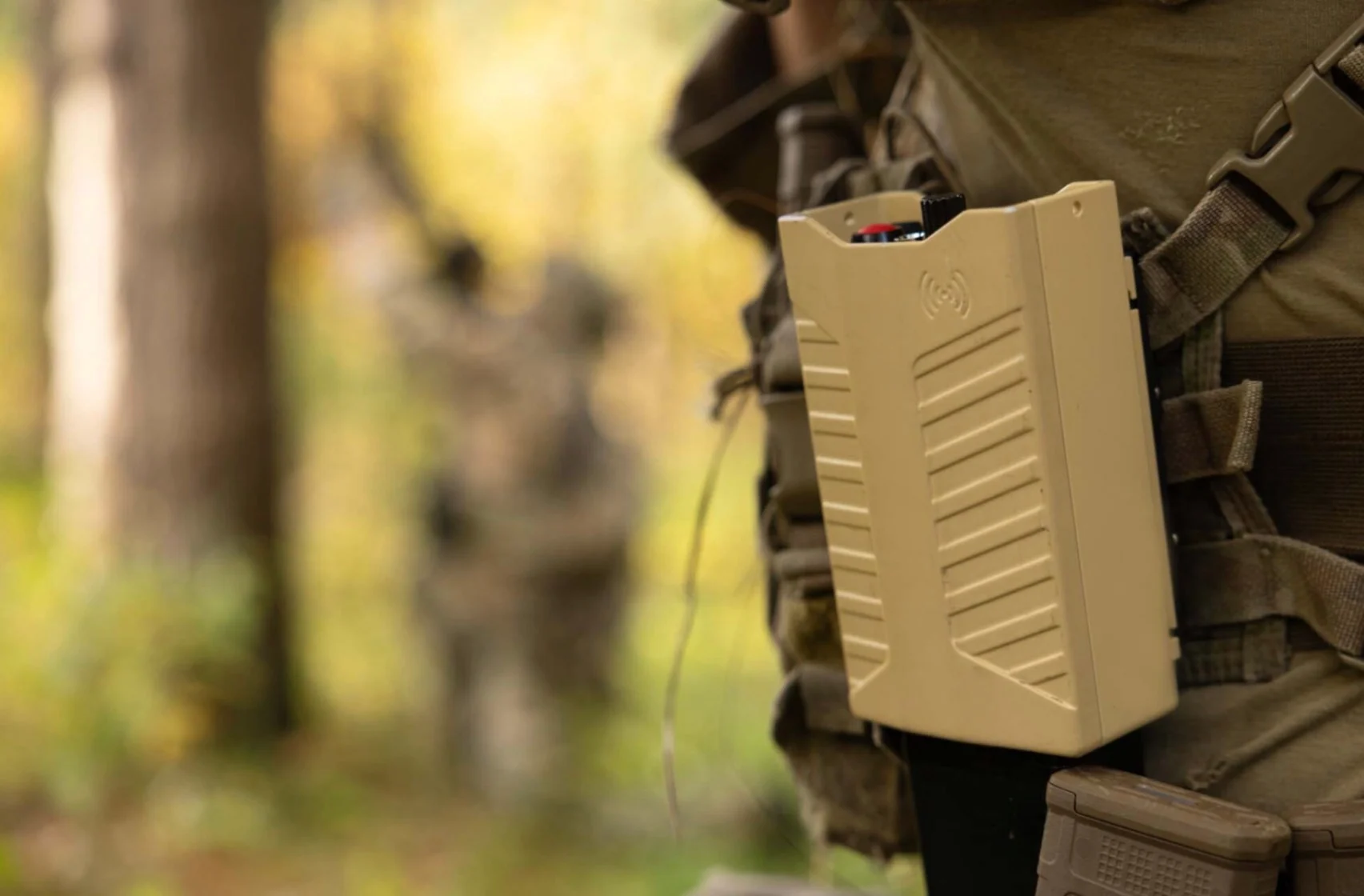
- Pitbull: A lightweight personal wearable jammer designed for individual soldiers
- Dobermann: A larger jammer mountable on vehicles or vessels
- Wingman: A drone detection unit
This design philosophy builds upward from the individual operator — the reverse of how most industry players approach the market. At roughly 2.5 kg and requiring no additional training out of the box, these kits represent a fundamentally different market position compared to radar towers that can cost upward of $500,000.
A Strong Operational Track Record
Approximately 2,000 Wingman units are currently deployed on the front lines in Ukraine for enemy drone detection. In July 2025, MyDefence secured a $26 million U.S. Army order for 485 "Soldier-Kits" — combining the Wingman detector with the Pitbull jammer — the largest contract in the company's history. Prior to full-scale procurement, U.S. European Command (EUCOM) evaluated around 15 of these systems during exercises in Germany.
DHS Deploys MyDefence Equipment at World Cup Venues
The World Cup kicked off this week across the United States, Mexico, and Canada. According to MyDefence, the U.S. Department of Homeland Security (DHS) is working with the company to monitor and protect critical infrastructure, large public gatherings, and transportation corridors during the tournament — covering both authorized and potentially hostile drone activity.
This effort is part of a broader U.S. federal counter-drone deployment. FEMA's $500 million counter-drone program has already allocated $250 million to 11 host states and the Washington D.C. metro area. The FAA has designated all World Cup venues as No Drone Zones, with violations subject to substantial civil penalties and FBI seizure authority. Host cities are rapidly drawing down their grant funds: Dallas added $10.3 million to an Axon contract, while the New York City Police Department stood up a $6.5 million counter-drone unit intended to remain operational after the tournament ends.
The FBI has deployed approximately 60 trained jamming operators across the 11 host cities, relying heavily on detection equipment from vendors such as MyDefence to achieve broad airspace coverage.
Counter-Drone Sector Attracts a Wave of Capital
MyDefence is not the only counter-drone asset drawing investor attention. The Financial Times reports that Dutch drone detection firm Robin Radar Systems has engaged advisers to explore a potential sale at a valuation of around $2 billion. UK defense start-up Cambridge Aerospace is raising new funding for its intercept systems, while Mercedes-Benz Group is partnering with Munich-based Tytan Technologies to protect European critical infrastructure from hostile drones.
The conflicts in Ukraine and the Middle East have placed drones and counter-drone systems at the center of modern warfare, while also exposing a stark cost asymmetry: inexpensive attack platforms such as Iran's Shahed drone pitted against costly air defense systems like the U.S. Patriot missile. This cost imbalance is precisely why RF detection and jamming equipment has become so attractive — a wearable jammer capable of neutralizing a $500 quadcopter without firing a shot fundamentally reshapes the economics of defense.
Bridgepoint acquired a majority stake in MyDefence in 2024 through its Bridgepoint Development Capital IV fund, subsequently investing in production expansion and R&D growth. During the same period, Bridgepoint also acquired Comrod, a Norwegian manufacturer of tactical communications and power equipment, reflecting a broader interest in defense-adjacent businesses. Both Bridgepoint and MyDefence declined to comment to the Financial Times.
What's Next: Strategic Buyer or Financial Sponsor?
The outcome of the auction process will determine not just price, but the company's future direction. If a large defense contractor acquires MyDefence as a strategic buyer, its wearable kits could be integrated into a broader product portfolio and existing U.S. government procurement relationships. If another financial sponsor wins the bid, it may replicate Bridgepoint's playbook and seek a further exit several years down the line.
The Financial Times notes that advisers are preparing the competitive process for a year-end timeline — making the composition of the bidder list a critical watchpoint. Whether front-line counter-drone hardware ends up under the umbrella of a large prime contractor or remains independently operated will significantly affect how quickly this technology reaches front-line soldiers and security agencies.
Also worth watching is how the World Cup contract factors into the valuation: a billion-dollar figure partly anchored to a 39-day sporting event is a meaningfully different proposition from one grounded in recurring Army orders and long-term Ukraine deployments.
Source: Financial Times
原文來源: 查看原文
FAQ
Newsletter
Subscribe to our Low-Altitude Industry Newsletter
Daily curated news on low-altitude economy and drone industry, delivered to your inbox.