EASA and European Commission Propose 'U-space Light' Framework to Accelerate Drone Airspace Management Deployment
The European Aviation Safety Agency (EASA) and the European Commission are planning a simplified 'U-space Light' regulatory framework that divides U-space into three tiers, lowering the adoption barrier for member states and operators. The initiative aims to fast-track BVLOS approvals, with public consultation expected next month and implementation targeted for next year.

Highlights
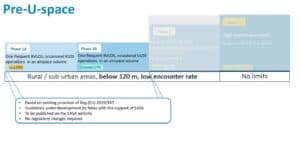
- EASA and the European Commission are proposing 'U-space Light,' a three-tier framework (pre-U-space, intermediate, full U-space) to simplify drone airspace management adoption across the EU.
- Since U-space regulations were adopted in January 2023, only one U-space airspace and three certified USSPs have been established across the entire EU.
- The U-space Light framework aims to enable rapid, large-scale BVLOS operations by removing the airspace risk assessment burden from the SORA process for drone operators.
- Public consultation on U-space Light is expected next month, with implementation targeted to begin in 2026.
- EASA's Natale di Rubbo confirmed that automated SORA functionality is being developed at the Air Mobility Centre, allowing operators to generate risk-gap maps and eliminating airspace risk as a barrier.
EASA and European Commission Propose 'U-space Light' Framework to Accelerate Drone Airspace Management Deployment
By Philip Butterworth-Hayes
The European Commission and the European Aviation Safety Agency (EASA) are planning a streamlined version of the existing U-space regulation — dubbed 'U-space Light' — designed to simplify the adoption process for EU member states, national aviation authorities, and drone industry stakeholders. EASA's Stephane Vaubourg unveiled the initiative today at the European U-space Stakeholder Network meeting held in Luxembourg. As part of the broader effort, EASA is also working to further integrate the JARUS Specific Operations Risk Assessment (SORA) 2.5 ground risk evaluation process into the U-space framework.
Three-Tier Structure: From 'Pre-U-space' to 'Full U-space'
Under the new proposal, U-space would be offered in three forms:
- 'Pre-U-space': Designed for rural and suburban operations, requiring no changes to existing regulations.
- 'Intermediate level': For more complex operational scenarios, requiring amendments to EU Regulation 2021/664.
- 'Full U-space': Intended for high-density operational airspace.
Public consultation on the proposals is expected to launch next month, with implementation potentially beginning as early as next year.
Significantly Lowering the Bar for BVLOS Operations
According to EASA representatives at the meeting, the 'U-space Light' concept would deliver the following benefits:
- Rapid and large-scale enablement of BVLOS (beyond visual line of sight) operations
- Provision of 'ready-to-use' solutions to accelerate deployment
- Elimination of the airspace risk assessment burden within SORA for drone operators
- Simpler, faster, and lower-cost operational approval processes
Stephane Vaubourg noted that the 'pre-U-space' concept would effectively bring the drone traffic management systems currently being developed at Dublin and the Port of Rotterdam into the U-space regulatory framework, while reducing the workload and costs associated with U-space Service Provider (USSP) certification and easing the administrative burden on member states.
Aligned with EU Drone Strategy 2.0
The new concept will be supported by institutional reforms across the EU drone sector, particularly the revision of EU Drone Strategy 2.0 and ongoing JARUS work to incorporate drone-to-drone collision risk into SORA. EASA's Natale di Rubbo indicated that the first related consultation is expected to be published by the end of this year.
Elina Millere from the European Commission's Directorate-General for Mobility and Transport (DG-MOVE) stated at the meeting: "The question is no longer whether we can implement U-space, but how to accelerate and further deploy it across Europe."
Current U-space Deployment Remains Slow
Despite U-space regulations being formally adopted in January 2023, there is currently only one very limited U-space airspace within the EU, along with just three certified USSPs and three certified Common Information Service Providers (CISPs). Member states have widely reported that the current implementation process is overly complex.
Bridging the Gap Between SORA and U-space
One of the key elements of the 'U-space Light' proposal is closing the gap between SORA and U-space operational standards. Natale di Rubbo noted that two of the five risk mitigation measures in SORA can be executed by stakeholders operating within the U-space framework.
"SORA 2.5 performs well on ground risk assessment. At the Air Mobility Centre, we have developed an automated SORA function where operators can generate maps to identify risk gaps, and airspace risk will no longer be an obstacle," he said. However, he acknowledged that SORA still falls short in certain technical areas — for example, it does not currently require an assessment of whether navigation systems can accurately measure drone position. "I think we need to work together, because SORA still has room for improvement," he added.
原文來源: 查看原文
FAQ
Newsletter
Subscribe to our Low-Altitude Industry Newsletter
Daily curated news on low-altitude economy and drone industry, delivered to your inbox.