Airbus and Kawasaki Heavy Industries Sign MOU to Develop Anti-Submarine Eurodrone Variant for Japan
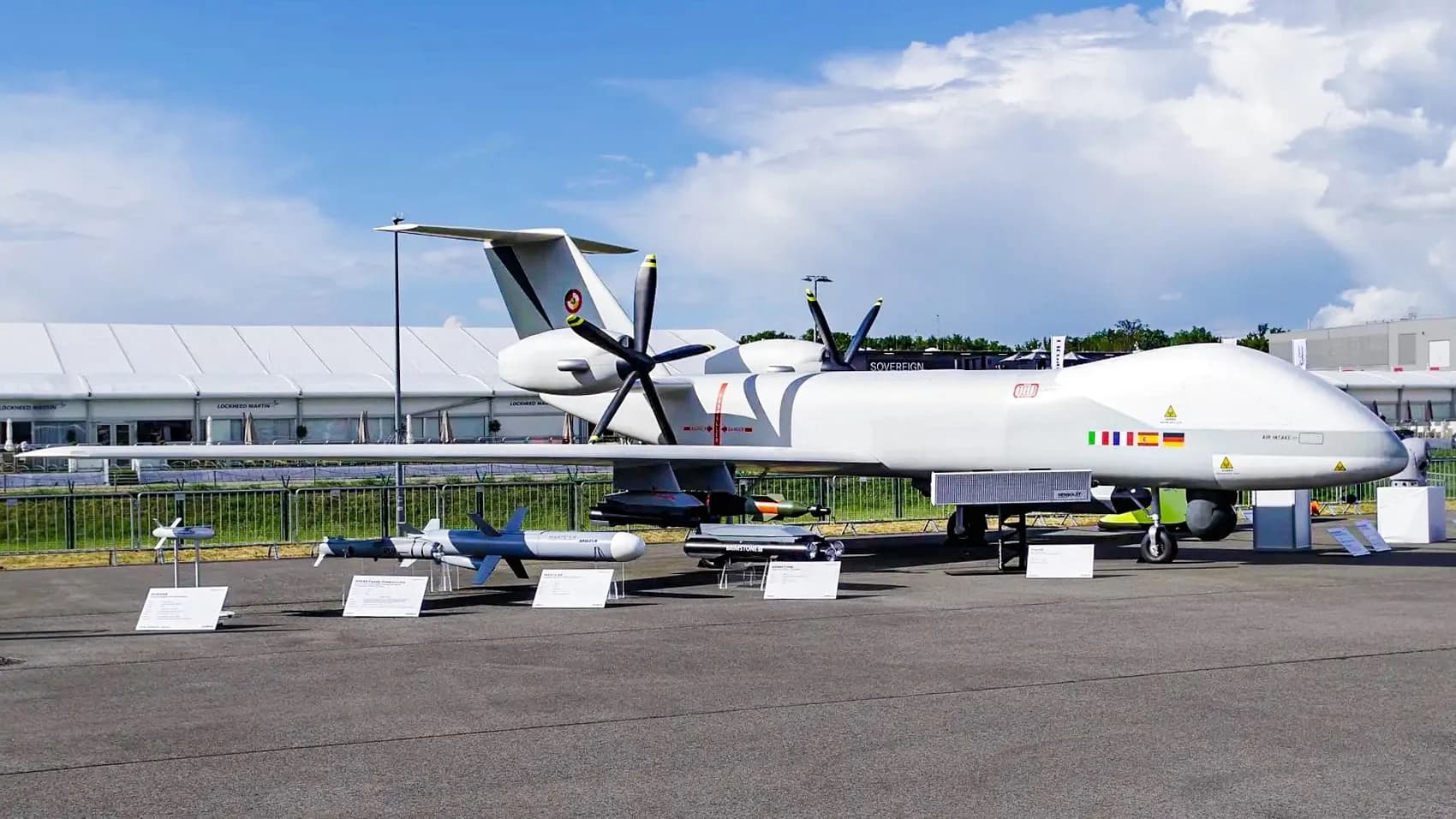
Airbus and Kawasaki Heavy Industries signed a memorandum of understanding on June 26 to jointly develop an anti-submarine warfare (ASW) and maritime patrol variant of the Eurodrone for the Japanese market. The aircraft will carry sonobuoys, lightweight torpedoes, and maritime surveillance sensors, operating alongside the manned Kawasaki P-1 patrol aircraft to counter China's expanding submarine fleet in the Western Pacific. This marks the first concrete export interest in the MALE drone, which has yet to complete its maiden flight.

Highlights
- Airbus and Kawasaki Heavy Industries signed an MOU on June 26 to develop an anti-submarine warfare (ASW) and maritime patrol variant of the Eurodrone for the Japanese market.
- The ASW variant will carry sonobuoys, lightweight torpedoes, and maritime surveillance sensors, operating alongside the manned Kawasaki P-1 patrol aircraft.
- Japan joined the Eurodrone programme as a partner in November 2023 but has not yet placed a formal order; the drone's target first flight date is 2029.
- The Eurodrone is a twin-engine MALE UAV with up to 40 hours of endurance — roughly 13 hours more than the single-engine MQ-9 Reaper.
- The four founding nations — Germany (21 aircraft), Italy (15), France (12), and Spain (12) — maintain combined orders for 60 Eurodrones.
Airbus and Kawasaki Heavy Industries Sign MOU: Eurodrone to Get Anti-Submarine Variant for Japan
Airbus and Kawasaki Heavy Industries (KHI) signed a memorandum of understanding (MOU) on June 26 to jointly develop an anti-submarine warfare (ASW) and maritime patrol variant of the Eurodrone for the Japanese market.
This is the first concrete export opportunity for the European Medium-Altitude Long-Endurance (MALE) drone, which has yet to complete its maiden flight. Japan joined the broader Eurodrone programme as a partner in November 2023 but has not yet placed a formal order.
The ASW variant will be equipped with sonobuoys, lightweight torpedoes, and maritime surveillance sensors. It will operate alongside Japan's manned Kawasaki P-1 patrol aircraft to monitor the increasingly active Chinese submarine fleet across the vast Pacific patrol areas.
Airbus confirmed that the four founding nations of the core programme maintain their existing procurement intentions: Germany for 21 aircraft, Italy for 15, France for 12, and Spain for 12, totalling 60 units.
What Is the Eurodrone ASW Variant?
The Eurodrone, also designated U950, is a twin-engine MALE unmanned aerial vehicle built by Airbus as prime contractor in collaboration with Italy's Leonardo and France's Dassault, with a target first flight date of 2029.
The platform was designed to meet the long-endurance mission requirements of European armed forces while reducing dependence on American hardware, following an independent certification pathway. The baseline aircraft's fuselage length and wingspan each exceed those of the General Atomics MQ-9 Reaper by approximately 5 to 6 metres (16 to 20 feet).
Its maximum take-off weight is more than double that of the Reaper. The Eurodrone is powered by two turboprop engines compared to the Reaper's single engine — a key factor enabling an endurance of up to 40 hours per sortie.
The ASW mission kit that Airbus and KHI plan to integrate represents the most demanding payload package for any maritime patrol mission. Sonobuoys are acoustic sensors dropped from the aircraft to listen for submarine signatures; lightweight torpedoes serve as the attack weapon once a contact is established; and maritime surveillance sensors track surface targets.
Why Does Japan Need Anti-Submarine Drones Now?
Japan operates one of the most capable maritime patrol fleets outside the United States. The Japan Maritime Self-Defense Force (JMSDF) flies the Kawasaki P-1 jet patrol aircraft — a domestically designed four-engine platform — alongside ageing Lockheed P-3 Orions and the Northrop Grumman RQ-4B Global Hawk.
The Global Hawk provides Japan with strategic reconnaissance capability but cannot carry sonobuoys or torpedoes. The P-1 carries a full ASW mission suite but consumes substantial aircrew hours and jet fuel each day, making continuous area coverage difficult to sustain.
A drone capable of remaining on station for 40 hours over a choke point, deploying sonobuoys without putting a crew at risk, fills the gap between strategic reconnaissance and tactical ASW — and allows the P-1 fleet to focus on missions that genuinely require a human crew.
The core strategic driver is the People's Liberation Army Navy (PLAN) submarine force. Chinese nuclear and conventional submarines have been operating with increasing frequency deeper into the Western Pacific in recent years, making persistent coverage gaps a growing operational concern for Japan's patrol planners.
Japan's preference for developing a tailored ASW capability rather than procuring an off-the-shelf platform is consistent with its broader approach: highly customised solutions almost always outperform standardised products for specific national requirements, and Japan has historically demonstrated the patience to see such programmes through.
Eurodrone vs. MQ-9 Reaper
Any Western MALE drone is inevitably benchmarked against the MQ-9 Reaper. The Reaper has been adopted by more than twelve national militaries, has accumulated millions of flight hours since entering service in 2007, and achieves approximately 27 hours of endurance using internal fuel tanks.
The Eurodrone's twin-engine configuration trades some maximum speed for roughly 13 additional hours of endurance and a larger internal volume for mission system integration.
Japan considered acquiring General Atomics' MQ-9B SeaGuardian for a similar maritime role earlier this century. The SeaGuardian is the maritime variant of the Reaper family and has been actively marketed to Indo-Pacific customers including India, Taiwan, and the Philippines.
Choosing the Eurodrone over the SeaGuardian means accepting a later in-service date and a longer development timeline, in exchange for sovereign technology access, an ASW payload designed to Japanese specifications, and a manned-unmanned teaming concept built around the Kawasaki P-1.
Manned-Unmanned Teaming: Kawasaki P-1 and Eurodrone
The Kawasaki P-1 is one of the few maritime patrol aircraft designed from a clean sheet in the past 25 years, featuring domestically developed turbofan engines, fly-by-light flight controls, and an ASW mission suite optimised for Pacific operations.
Pairing the unmanned Eurodrone with the manned P-1 is a practical application of manned-unmanned teaming (MUM-T) in naval aviation. The P-1 carries the crew, retains decision authority, and delivers the heavy weapons load; the drone conducts persistent surveillance, deploys sonobuoy arrays, and holds station after the P-1 returns to base.
This concept mirrors the U.S. Navy's exploration of unmanned tanker and loyal wingman roles — manned aircraft retain decision authority while unmanned platforms absorb the endurance burden and operational risk.
It is worth noting that the Eurodrone is not designed as a carrier-based naval asset; it operates from land-based runways. This reduces basing costs and simplifies maintenance but constrains operational radius to the range of land facilities Japan and its partners can establish along the First Island Chain.
Implications for Eurodrone Export Prospects
This MOU does not constitute a procurement commitment — MOUs rarely do.
However, it marks the first credible expression of customer interest in the Eurodrone programme from outside Europe. Airbus's Jean-Brice Dumont told attendees at the ILA Berlin Air Show in June: "We had and we still have four nations in this programme."
For a drone that has not yet flown, Japan beginning to explore a customised ASW variant ahead of the 2029 first-flight milestone carries significant weight. It puts pressure on General Atomics in the maritime unmanned segment, gives the Eurodrone programme a Pacific customer reference when pitching to Australia, South Korea, and potentially India, and binds KHI as a long-term industrial partner — substantially increasing the likelihood of a formal Japanese order if and when a procurement decision is made.
Editorial Analysis
An MOU signed five years before first flight is not an order — it is a marker. The value of that marker depends entirely on whether Japan's defence budget priorities and threat assessment remain aligned long enough to convert it into a contract.
The threat dimension is not the concern. The PLAN submarine force continues to grow in both numbers and capability, and Japan's defence posture has been moving steadily toward longer-range, more persistent ISR over the past decade.
The real risk to watch is Eurodrone programme execution. The programme has slipped before, and 2029 is the current target. A significant delay would force Japan into the uncomfortable position of waiting further or pivoting directly to the SeaGuardian from General Atomics.
Japan's approach to integrating manned and unmanned aviation mirrors the U.S. model of pairing the F-35 with platforms such as the MQ-20 Avenger: manned assets retain decision authority, unmanned platforms absorb the risk.
The signal to watch for is whether the next ILA or the 2027 DSEI Japan show produces concrete industrial cooperation agreements with hardware funding attached. Until then, the Eurodrone remains a European programme with Japanese interest — not yet a credible Indo-Pacific export platform.
原文來源: 查看原文
FAQ
Newsletter
Subscribe to our Low-Altitude Industry Newsletter
Daily curated news on low-altitude economy and drone industry, delivered to your inbox.