SkyDrive SD-05 eVTOL Hits 100 km/h Milestone, Targeting 2028 Type Certification and Commercial Launch
Japanese eVTOL startup SkyDrive has announced that its SD-05 aircraft successfully reached 100 km/h during high-speed flight testing, validating stability, controllability, and structural integrity at speed. Test data aligned with predictions from the design and analysis phase, marking a significant step toward type certification and the company's planned 2028 commercial launch.

Highlights
- SkyDrive SD-05 eVTOL achieved 100 km/h during high-speed flight testing, validating stability, controllability, and structural integrity at that speed.
- Observed flight characteristics matched predictions from the design and analysis phase, reducing development risk and improving schedule predictability.
- The SD-05 uses 12 independent rotors managed by a centralized flight control system, a compact multicopter design optimized for urban airspace operations.
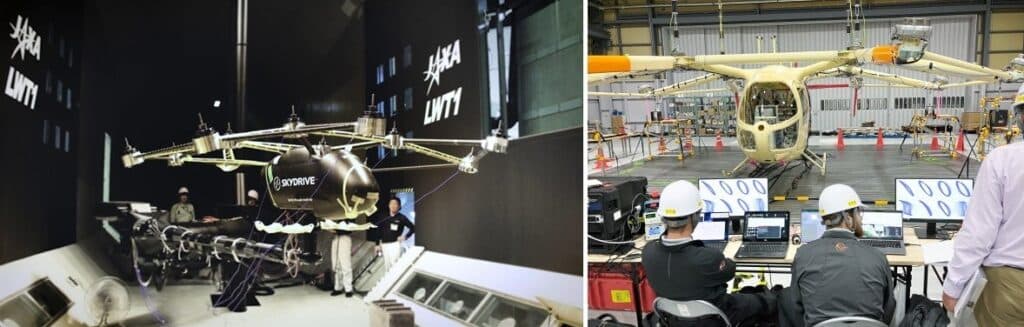
- SkyDrive's test program included JAXA wind tunnel testing, ground vibration testing, and hundreds of incremental test flights dating back to the SD-03 prototype.
- SkyDrive is targeting type certification and the start of commercial operations in 2028, with high-speed flight envelope expansion continuing.
SkyDrive SD-05 eVTOL Hits 100 km/h Milestone, Targeting 2028 Type Certification and Commercial Launch
Japanese eVTOL startup SkyDrive has announced that its SD-05 aircraft has successfully reached 100 km/h during high-speed flight testing — a meaningful speed threshold for the commercialization of short-range urban air mobility.
High-Speed Tests Validate Key Performance Parameters
Through a series of high-speed flight tests, SkyDrive confirmed the aircraft's stability, controllability, and handling characteristics at elevated speeds, while also validating the performance of the propulsion system, flight control system, and onboard avionics.
Data gathered during these tests allowed SkyDrive's engineers to verify the accuracy of aircraft characteristics and dynamic behavior predicted during the advanced design and analysis phase — marking another significant step toward type certification and the company's target of commercial operations by 2028.
Why 100 km/h Is More Than Just a Number
SkyDrive emphasized that achieving stable flight at 100 km/h carries far greater significance than a single figure on a dashboard.
"Aircraft development begins with design and analysis, progresses through individual system testing and ground testing, and then moves into full-scale aircraft manufacturing and flight testing," the company stated. "Throughout this process, simulators are repeatedly used to validate flight characteristics, propulsion systems, and flight control systems."
"Simulation, analysis, and ground testing are all critical elements of the development process, but the final flight test phase is essential — there are things that can only be learned once an aircraft is actually in the air. This is especially true during high-speed flight, where aerodynamic forces, vibration, structural loads, and flight control system responses interact and change in complex ways that only flight testing can validate against the predictions made during the design phase."
The Challenges of an All-New Aircraft Concept
The SD-05 is based on a fundamentally new design concept, distinct from conventional fixed-wing aircraft and helicopters. As a result, SkyDrive cannot draw on established knowledge bases or pre-existing flight data. Each new aircraft type requires flight testing to collect and validate data — and for entirely novel aircraft concepts, this phase is even more indispensable.
During high-speed flight testing, aerodynamic forces, vibration, structural loads, propulsion performance, and flight control behavior all change significantly, and their interactions grow increasingly complex. Any major discrepancy between actual flight test data and the assumptions made during the design analysis phase could necessitate additional testing, design changes, or revisions to the existing development program.
The results of this flight test campaign showed that observed flight characteristics and behavior matched the predictions from the design and analysis phase — providing greater visibility and predictability for subsequent development work.
Compact Multicopter Design Validated for Urban Air Mobility
The high-speed forward-flight tests also validated the compact multicopter design philosophy that SkyDrive has maintained since its founding. Compared to fixed-wing configurations, SkyDrive's multicopter architecture is better suited to urban airspace operations: the compact design offers greater flexibility for takeoff and landing sites, and simplifies both the aircraft structure and operations — contributing to lower operating costs and improved maintainability.
The SD-05 uses 12 independent rotors managed by a centralized flight control system. Test results confirmed that this architecture performed as designed during high-speed forward flight, further supporting the viability of the aircraft for short-range urban routes.
How SkyDrive Achieved Successful High-Speed Flight Testing
Reaching 100 km/h was the result of sustained, cumulative effort. SkyDrive's high-speed flight capability was built on several pillars:
- Extensive flight test experience: The development program traces back to the SD-03 prototype, with hundreds of test flights accumulated to date.
- Diversified test program: In addition to flight testing, the program includes standalone tests of batteries, motors, and rotors; aerodynamic performance testing in JAXA (Japan Aerospace Exploration Agency) wind tunnels; and ground vibration testing.
- Incremental flight envelope expansion: Engineers and pilots carefully reviewed real-time data collected at low and medium speeds at each test phase before making the decision to progress to higher speeds and broader flight envelope exploration.
Next Steps: Continuing Toward Certification and Commercialization
The industry as a whole is shifting from demonstrating that these aircraft can fly to the more advanced phase of gathering evidence of stable high-speed operations, collecting data required by regulators for certification, and validating the feasibility of future commercial operations.
SkyDrive stated that it will continue high-speed testing to expand the aircraft's flight envelope across the speeds required for commercial operations, accumulate further data and technical knowledge, and confirm that flight performance continues to match design analysis predictions. The company's journey toward type certification and the start of commercial operations in 2028 remains on track.
原文來源: 查看原文
FAQ
Newsletter
Subscribe to our Low-Altitude Industry Newsletter
Daily curated news on low-altitude economy and drone industry, delivered to your inbox.