TCab Tech Founder Yon Wui Ng Reveals the Pragmatic Engineering Philosophy Behind the E20 eVTOL
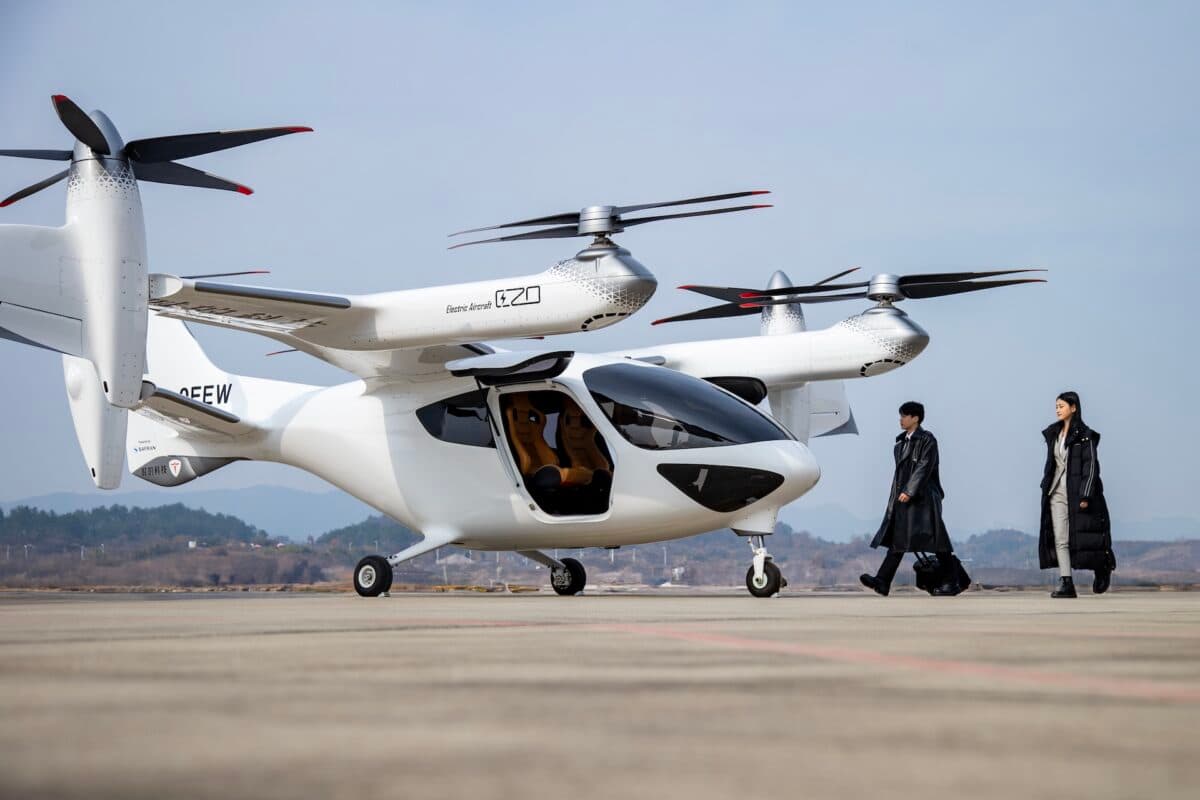
Shanghai-based eVTOL developer TCab Tech is taking a disciplined, engineering-first approach to building the E20, a five-seat tiltrotor aircraft. Founder Yon Wui Ng reports that the E20 has logged over 1,000 test flights since its 2021 debut and completed its first crewed conversion flight in 2025. The company is targeting CAAC type certification in 2027 and commercial operations in 2028, with a target fare of RMB 3–4 per passenger per kilometre.

Highlights
- TCab Tech's E20 tiltrotor eVTOL has completed over 1,000 flight tests since its 2021 maiden flight, including a crewed conversion flight in 2025 with founder Yon Wui Ng on board.
- The E20 carries four passengers plus a pilot at a cruise speed of 260 km/h over a 200 km range, with a 2.6-tonne MTOW and 450 kg payload capacity.
- TCab targets CAAC type certification by end-2027 and commercial operations in 2028, with a ticket price of RMB 3–4 per passenger per kilometre and an overseas aircraft price of approximately USD 3 million.
- TCab has completed its G2 Means of Compliance document — accepted by the CAAC — establishing how the company will demonstrate conformance to the agreed certification basis.
- TCab plans to produce 200 aircraft at a 10-acre factory in China, with pilot simulators ready by end-2026 and the first crews beginning real-aircraft training in late 2027 to early 2028.
TCab Tech Founder Yon Wui Ng Reveals the Pragmatic Engineering Philosophy Behind the E20 eVTOL
The eVTOL sector — known in China as the "low-altitude economy" — has dominated global headlines for nearly a decade. Visions of urban air taxis, point-to-point regional travel, and zero-emission flight have attracted billions of dollars in investment and spawned startups on every continent. Yet for every aircraft that has progressed from concept art to actual flight, many more designs have never left the drawing board.
Shanghai-based eVTOL developer TCab Tech has chosen a deliberately low-profile, engineering-first approach to meet that challenge. The company has kept a modest public footprint, channelling its energy into developing a technically reliable, versatile platform with competitive operating economics — positioning its E20 eVTOL as a serious contender in the advanced air mobility space.
E20 Technical Specifications
The E20 is a five-seat tiltrotor eVTOL carrying four passengers and one pilot, with a cruise speed of 260 km/h, a top speed of 320 km/h, and a range of 200 kilometres.
Those figures are not aspirational targets — they are backed by a real track record: since its maiden flight in 2021, the E20 has accumulated more than 1,000 flight tests. In 2025, the aircraft completed its first crewed conversion flight, with founder Yon Wui Ng himself on board. The programme has now entered compliance verification ahead of type certification from China's Civil Aviation Administration (CAAC).
TCab recently reached a significant regulatory milestone, completing and receiving acceptance of its G2 Means of Compliance (MoC) document — establishing precisely how TCab will demonstrate conformance to the agreed certification basis with the CAAC.
The Founder's Transnational Journey
Yon's background sets him apart from the typical startup founder. A Malaysian national, he studied aerospace engineering in Australia before moving to Singapore and ultimately China, where he joined Airbus and rose to the role of Director of Operations Engineering for Airbus China. Airbus has a substantial footprint in China, including one of the primary A320-family final assembly lines in Tianjin.
Yon later moved to Terrafugia — an early-stage eVTOL developer backed by Chinese automotive giant Geely — as a senior executive, giving him a front-row seat to the rise of the eVTOL industry.
"Around 2018, when I first joined Terrafugia, I realised eVTOL was showing genuine potential," he recalled. "That got me thinking about what the most viable technical path should actually look like."
In 2021, Yon left Terrafugia to found TCab, with the goal of building a vehicle that was both innovative and achievable within a realistic timeframe and budget.
"We worked backwards from the end goal," he said. "We wanted an aircraft that would be five times faster than ground transport, but without the operating costs of a helicopter."
That blend of innovation, performance, and affordability became the design brief for the E20.
Leveraging China's Supply Chain
One thing becomes very clear in conversation with Yon: TCab is not building an expensive high-tech showpiece — it is building a genuine commercial aircraft that can perform missions reliably and at low cost.
"Our goal is to make sure the air taxi is accessible to the general public," he said. "So one of the critical factors is keeping the price low — much lower than a helicopter. The ultimate target is a ticket price of RMB 3 to 4 per passenger per kilometre — roughly USD 0.50. That is our target."
On aircraft pricing, Yon is also targeting approximately USD 3 million for overseas markets — a competitive figure compared to the indicative pricing floated by some leading Western eVTOL manufacturers.
To meet that ambitious goal, Yon relies on China's extensive industrial supply chain.
"We looked at some of the solutions from competitors and quickly saw that they would not be cheap. That does nothing for commercialisation. This is where the Chinese supply chain plays a very positive role. Comparing the US, Europe, and China, we quickly found that in China we have an excellent EV supply chain — motors, batteries, systems… especially batteries."
Yon also credits China's aviation supply chain development largely to state-owned aircraft manufacturer COMAC.
"As the OEM, we can focus on aircraft integration without having to do everything in-house, because suppliers and partners collaborate with us on motors, propellers, flight control systems, batteries, and more. This is one of our core advantages — it allows us to keep R&D expenditure down."
Navigating China's Dynamic eVTOL Ecosystem
TCab has also found a relatively supportive environment for eVTOL development in China, with governments at various levels rolling out policies covering infrastructure, airspace access, and regulatory frameworks.
"We are not currently participating in any specific government project — there are not yet many eVTOL sandbox programmes in China — but we are actively involved in what you might call 'standard-setting': infrastructure standards and airworthiness certification standards. For example, the certification basis we are working through is becoming an industry benchmark. We are also involved in defining infrastructure standards through collaboration with the government."
As Chinese regulators take a leading role in the advanced air mobility space, Yon expects those standards to be adopted by other Asian markets, paving the way for TCab's regional expansion.
"It has already started," he said. "Why? Because eVTOL is a completely new product — there were no standards for it before. But China has now seen different types of eVTOL receive some form of certification."
He cited fellow eVTOL developers EHang and Autoflight as examples: the former has received approval to carry passengers on scenic flights under defined conditions, while the latter has achieved certification for specific cargo missions.
"CAAC's certification experience is increasingly being used as a reference by other Asian markets when evaluating Chinese eVTOL products," Yon added.
Back to Basics: A Lean Engineering Philosophy
If Yon has one obsession, it is design and process efficiency — particularly in optimising the aircraft's architecture, reducing potential failure points, and rigorously controlling weight.
"This is a fundamental principle of aircraft design, because weight is always the enemy. In the eVTOL context, where the aircraft is electrically powered, the battery pack alone weighs 600 kg. Without an aggressive weight-reduction programme, the aircraft may not be able to carry any meaningful payload at all — which means no passengers, and therefore no commercial viability."
He elaborated on TCab's engineering-driven approach: "I would not say we set out to build a highly efficient machine — more precisely, we made sure the aircraft could achieve the payload we needed. On a 2.6-tonne MTOW, we can carry 450 kg of payload. That is down to the entire team — structures, avionics, electric propulsion systems, EV wiring harnesses — saving every gram across every system."
Yon also expressed scepticism about claims made by some eVTOL developers, drawing a clear contrast with what he sees as overly optimistic promises.
"I think many programmes around the world are promising certain flight performance figures, but we rarely see them actually delivering with a meaningful payload on board. We were among the first to complete a dual-occupant loaded flight — that says something. The most important thing is that we can carry payload."
He reaffirmed his patient, methodical approach: "Getting airborne is an achievement, but achieving target range, endurance, and speed while doing so is another matter entirely. First we need to ensure the aircraft can fly; next, that it can carry five people — in our case, four passengers plus a pilot, plus luggage. Our target is 80 kg per person and 50 kg of total baggage. This year, we will advance to flight tests representing a full five-person load."
On balancing weight reduction with safety redundancy, Yon explained: "Our initial focus is on piloted passenger transport, rather than certifying for multiple mission types simultaneously. The E20 is designed as a VTOL aircraft, not a runway-dependent one. Our design meets the applicable certification and safety standards while avoiding unnecessary complexity — elements that add neither safety value nor operational value."
On the tiltrotor configuration specifically, Yon is unfazed by its complexity: "Many people say it is complicated, but ultimately all we need to do is rotate the propellers from 90 degrees to a horizontal position using a linear actuator. Compare that to a lift-plus-cruise configuration, where you need two separate electric propulsion systems — an additional set of rotors, motors, and wiring harnesses — which is actually significantly heavier than our solution."
From Prototype to Production
As of May 2026, TCab is building compliance-demonstration aircraft for the certification process while preparing for the next phase of flight testing.
TCab is targeting type certification (TC) for the E20 in 2027.
"We are still on track," said Yon. "The goal is to obtain type certification by the end of 2027, then begin commercial operations a few months later — around 2028."
If that timeline holds, TCab expects to produce 200 aircraft at a 10-acre facility currently under construction. Some portions of the factory are already operational; the remainder are expected to be completed by the end of 2026.
Pilot training is also being planned well in advance: "At the same time, we are building training capacity, because we need to ensure our first customers have enough qualified pilots. We will have a flight simulator ready by the end of this year; next year, the first cohort of pilots will be able to train on the simulator and then begin flying the actual aircraft between late 2027 and early 2028."
TCab plans to lead pilot training directly in the early commercial phase, partnering with Chinese flight academies to supply the industry with qualified crews. Initial pilots will need to hold a commercial licence under Part 27 (helicopter) or Part 23 (fixed-wing) regulations, followed by approximately 50 to 100 hours of type-specific training.
Commercial Deployment and Market Outlook
With engineering discipline, cost consciousness, and deep integration into China's supply chain, TCab is on a steady course toward its 2027 certification and 2028 commercialisation targets. As the low-altitude economy continues to gain momentum, TCab's pragmatic approach may prove to be exactly the formula needed to move eVTOL from buzzword to boardable reality.
原文來源: 查看原文
FAQ
Newsletter
Subscribe to our Low-Altitude Industry Newsletter
Daily curated news on low-altitude economy and drone industry, delivered to your inbox.