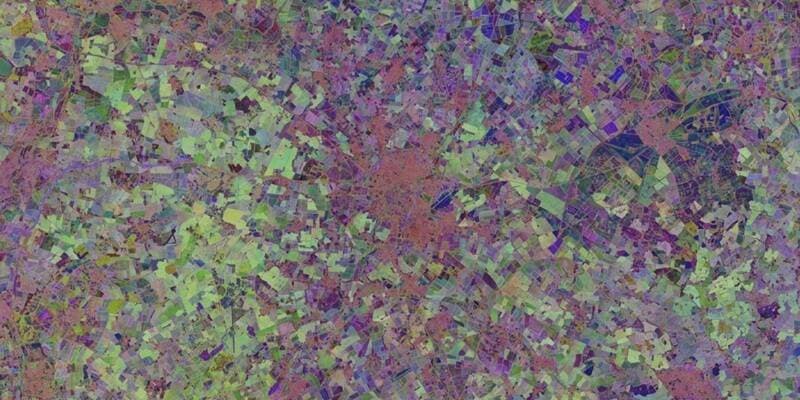
Cambridge AI Tool Promises a New Era of Space-Based Earth Intelligence
A research team at the University of Cambridge is developing an AI-powered tool designed to unlock deeper insights from decades of accumulated satellite Earth observation data. The technology aims to advance the emerging field of 'Earth Intelligence,' with applications spanning climate change monitoring, agricultural forecasting, urban expansion tracking, and early disaster warning systems.

Highlights
- The University of Cambridge is developing an AI tool to convert decades of satellite Earth observation data into actionable 'Earth Intelligence' insights.
- Target applications include climate change trend analysis, agricultural yield forecasting, urban expansion monitoring, and natural disaster early warning.
- Falling satellite data costs and a growing commercial satellite constellation are accelerating AI-driven Earth observation as a major technology opportunity.
- The technology has direct implications for the drone industry, where satellite-derived datasets underpin mission planning and environmental analysis.
- The Cambridge project reflects a sector-wide shift: the key challenge in Earth observation has moved from data collection to data interpretation.
Cambridge AI Tool Promises a New Era of Space-Based Earth Intelligence
Satellites have been monitoring our planet for decades — but a research team at the University of Cambridge believes the true potential of that data has barely been tapped.
The team is developing an artificial intelligence tool aimed at transforming the vast archive of satellite imagery and sensor data into actionable Earth Intelligence: meaningful, real-world insights derived from space-based observation at a scale previously impossible to process manually.
Turning Data into Intelligence
At the core of the project is a suite of AI algorithms capable of performing deep analysis across enormous volumes of satellite imagery and multi-spectral sensor data. Rather than simply storing or cataloguing observations, the system is designed to extract patterns and trends that carry direct practical value.
Key application areas under development include:
- Climate change trend analysis — tracking long-term environmental shifts across land and ocean surfaces
- Agricultural yield forecasting — providing early estimates of crop performance to support food security planning
- Urban expansion monitoring — mapping the growth of cities and changes in land use over time
- Natural disaster early warning — detecting precursor signals for events such as flooding, wildfires, and landslides
A Growing Opportunity
The timing of the Cambridge initiative aligns with a broader transformation in the satellite industry. The number of commercial satellites in orbit has grown sharply in recent years, while the cost of accessing Earth observation data has fallen significantly. Together, these trends are making AI-driven Earth observation one of the most promising technology application areas of the coming decade.
For the drone industry specifically, advances in satellite-based remote sensing and data integration carry significant implications. Drone operators and service providers increasingly rely on satellite-derived datasets — including terrain models, weather feeds, and environmental baselines — to plan missions, assess conditions, and validate findings. A more intelligent and accessible layer of Earth observation data could meaningfully enhance the analytical capabilities available to commercial drone operations, particularly in agriculture, infrastructure inspection, and environmental monitoring.
Looking Ahead
While full details of the Cambridge tool's architecture and timeline have yet to be published, the research underscores a growing consensus across the geospatial and remote sensing sectors: the bottleneck in Earth observation is no longer data collection, but the ability to interpret and act on the data already being gathered.
Editor's note: The original source article was incomplete at the time of translation. This report is based on available information and will be updated as further details are released.
原文來源: 查看原文
FAQ
Newsletter
Subscribe to our Low-Altitude Industry Newsletter
Daily curated news on low-altitude economy and drone industry, delivered to your inbox.