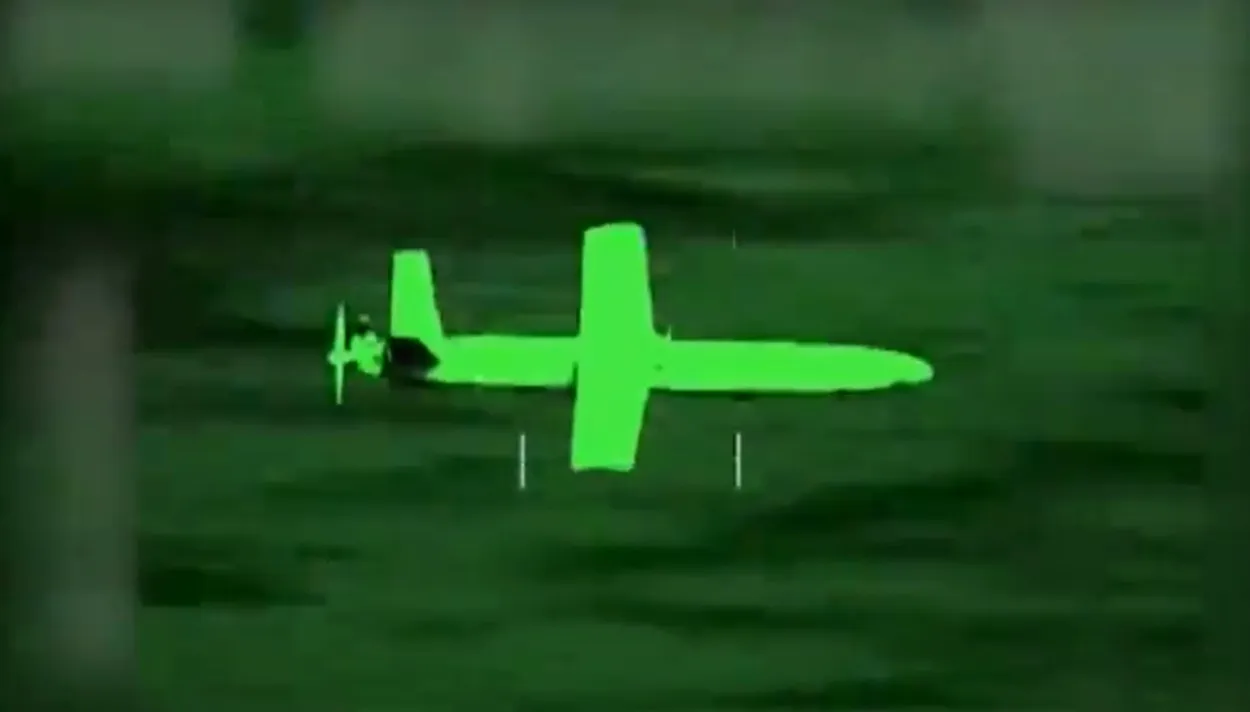
Retired U.S. Lieutenant General Compares Drones to WWI Machine Guns, Argues They Are Not the Decisive Weapon of Future Warfare
Retired U.S. Army Lieutenant General Eric Wesley, former commander of the Army Capabilities Integration Center, has published a paper at the Modern War Institute arguing that drones are not the future of warfare — they are a new problem awaiting a solution. Drawing a parallel to the machine gun in World War I, Wesley contends that while drones have frozen the front lines in Ukraine much as machine guns did on the Western Front, they cannot replace infantry in seizing and holding ground.

Highlights
- Retired U.S. Army Lt. Gen. Eric Wesley published a paper at the Modern War Institute arguing that drones are not the decisive weapon of future warfare, but a new tactical problem awaiting a solution.
- Ukrainian FPV drones have accounted for approximately 80% of Russian battlefield casualties, and Ukraine's drone operational range now exceeds 2,500 kilometres.
- Wesley draws a direct parallel between modern drones and WWI machine guns, noting both froze front-line movement — in Ukraine's case producing trench-warfare conditions similar to 1914 — without eliminating the need for infantry to seize and hold ground.
- Wesley argues the Clausewitzian logic of war remains intact: compelling a determined adversary requires physically contesting and taking the ground they value, something drones cannot accomplish.
- Wesley predicts the solution to the drone problem will resemble the tank's role against the machine gun — potentially electronic warfare, directed-energy weapons, or affordable interceptor drone systems.
Retired U.S. Lieutenant General Compares Drones to WWI Machine Guns, Argues They Are Not the Decisive Weapon of Future Warfare
Since the outbreak of the war in Ukraine, drones have become an indispensable tool for military planners and strategists worldwide. According to former Ukrainian Commander-in-Chief Valerii Zaluzhnyi, first-person-view (FPV) drones have accounted for 80% of Russian battlefield casualties. Ukraine's drone operational range now exceeds 2,500 kilometres, enabling Kyiv to strike targets deep inside Russia, thousands of kilometres from the front line.
Reports have even emerged that Ukraine is offering its long-range drones to Germany as an alternative to expensive U.S.-made Tomahawk cruise missiles — both sharing a 2,500-kilometre range.
Ukrainian President Volodymyr Zelenskyy has proposed building a "drone wall" and plans to replace frontline soldiers with unmanned ground vehicles. Meanwhile, a growing number of defence analysts have begun writing obituaries for tanks, armoured vehicles, and even manned fighter jets, arguing that drone technology will render these legacy systems obsolete.
Yet this drone enthusiasm is beginning to tip into obsession.
History tells us this is not the first time. Every era has produced its own generation of "superweapon" prophets — strategists convinced they had finally witnessed the weapon that would forever change the nature of war.
Lt. Gen. Wesley's Counterargument
Retired U.S. Army Lieutenant General Eric Wesley, former commander of the U.S. Army Capabilities Integration Center, has published a pointed paper at the Modern War Institute (MWI) offering a sharply different perspective.
Wesley argues that drones are not the future of warfare — they are a new problem in need of a solution. He maintains that human beings remain irreplaceable on the battlefield: seizing and holding territory requires soldiers; clearing basements and driving the enemy from city streets requires infantry.
"Today, a chorus of defence commentators, Silicon Valley tech evangelists, and think-tank scholars are converging on a consensus: aerial drones will define the next century of conflict. They are wrong — or more precisely, they are asking the wrong question," Wesley writes.
"The right question is not 'What can drones do?' but 'What can drones not do?' And the answer to that question is both ancient and decisive: drones cannot take ground, cannot hold it, cannot compel a people to submit, cannot plant a flag on a hilltop and give it meaning."
The Machine Gun — The 'Drone' of World War I
To support his argument, Wesley draws a direct parallel between the rise of drone warfare and the emergence of the machine gun in World War I.
"After the trenches of the Somme, there was the machine gun. After the Russia-Ukraine war, there is the drone," Wesley writes.
In August 1914, as World War I erupted, European armies marched into a battlefield quietly transformed by machine guns and industrial artillery. The machine gun turned the infantry and cavalry charges that had defined Napoleonic warfare — open-field assaults — into suicide missions.
"Tacticians who had spent their entire careers studying Napoleonic manoeuvre suddenly found that launching an open-field infantry assault into interlocking fields of fire was simply futile."
The Western Front locked into stalemate. Despite years of fighting and millions of casualties, the front line between France and Germany barely moved. Some observers concluded that offensive ground operations were finished — that trench warfare was the future. They were wrong.
The machine gun was not the future; it was a new weapon, a new problem without a solution. That solution was found within four years.
"In less than four years, British engineers produced a lumbering, underpowered, mechanically unreliable iron box on tracks that could cross no-man's-land and suppress machine gun positions at close range."
The tank solved the machine gun problem — sufficiently enough to restore what the machine gun had taken away: the ability to move, exploit breakthroughs, penetrate enemy lines, and pour through into the rear. Manoeuvre warfare returned, and decisive victory became possible once again.
The Parallels Between Ukraine and World War I
Despite the deployment of sophisticated weapons systems — FPV drones, satellite-guided long-range drones, and fibre-optic drones — the trajectory of the front lines in Ukraine bears a striking resemblance to World War I. Trench warfare has returned, just as in 1914. Front-line movement is agonisingly slow; sometimes months of fierce fighting and thousands of casualties yield advances of just a few kilometres.
In the Ukraine war, drones are playing the same role the machine gun played in World War I.
"Drones hunt tanks in open terrain, loitering munitions strike artillery positions kilometres behind the line, and commercial quadcopters drop grenades into trenches with remarkable precision."
Just like the machine gun in 1914, drones have stripped away mobility and frozen the front. But the critical distinction is this: drones have made manoeuvre costly and imposed a heavy price on infantry movement — they have not made it unnecessary.
"Because after every drone strike, after every armoured column destroyed from the air, someone still has to walk across that field. Someone still has to occupy the tree line, clear the basement, and stand in the rubble and say: this is ours. Drones cannot do that, and likely never will."
The reason the war in Ukraine has failed to produce a decisive outcome, Wesley argues, is precisely because air power — whether drones or otherwise — is a tool of attrition, not decision. "It degrades, disrupts, delays, and yes, kills. But the Clausewitzian logic of war remains stubbornly intact: to compel a determined adversary to submit, you must ultimately confront him on the ground, in the physical space he values, and take it from him."
Drones are thus analogous to the WWI machine gun: they have sharply raised the cost of moving in the open, forcing infantry to dig deeper trenches, disperse more widely, and move only at night or under electronic cover; they have made tanks, armoured vehicles, trucks, and all ground platforms vulnerable in ways unimaginable a decade ago. Yet they have not "abolished centuries of validated military principle," nor have they invented a new theory of victory. They have simply created a new problem for manoeuvre forces — one that awaits a solution.
What Comes Next?
According to Wesley's analysis, the answer to the drone problem will not be more drones, but something capable of restoring mobility under drone threat — just as the tank did under machine gun fire.
"That could be electronic warfare systems — and agile management of them — capable of blinding and jamming drone swarms; it could be directed-energy weapons able to defeat mass drone attacks at low cost; or it could be more innovative, more affordable counter-drone technologies that exploit the vulnerabilities of lightweight aircraft."
Indeed, many countries have already developed interceptor drones capable of shooting down incoming drones without expending costly missiles. These interceptor drones are not yet perfected and continue to evolve. Nevertheless, they have already demonstrated that drones are neither invulnerable nor the final form of modern warfare's evolution.
"Drones are a remarkable and lethal tool. But remarkable and lethal tools have always been the prelude to the next problem, not the answer to the last one. Those who understand this will win the next war."
原文來源: 查看原文
FAQ
Newsletter
Subscribe to our Low-Altitude Industry Newsletter
Daily curated news on low-altitude economy and drone industry, delivered to your inbox.