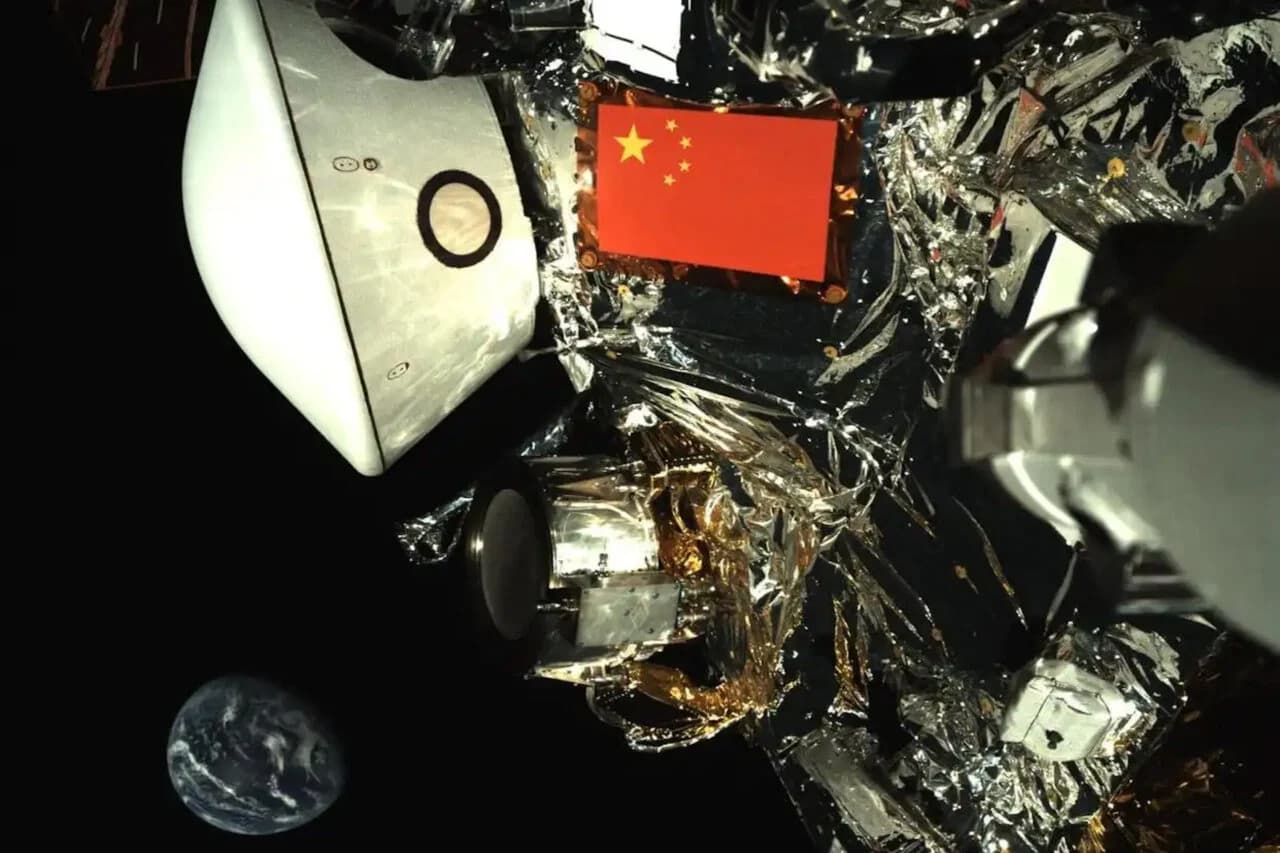
China Prepares for First Mission to Land on Earth's 'Quasi-Moon' Asteroid
China's Tianwen-2 probe is set to attempt a landmark sample-return mission to asteroid Kamo'oalewa, a near-Earth object that orbits in close proximity to Earth and is sometimes called Earth's 'quasi-moon.' If successful, it will be the first time humanity has retrieved physical samples from an Earth quasi-satellite asteroid.

Highlights
- China's Tianwen-2 probe plans to land on near-Earth asteroid Kamo'oalewa and return physical samples to Earth, in what would be humanity's first sample-return mission from an Earth quasi-satellite.
- Kamo'oalewa was discovered in 2016 and is classified as Earth's 'quasi-moon' due to its orbital proximity to Earth; its composition may be similar to lunar rock.
- If successful, Tianwen-2 will provide scientists with unprecedented material for studying the early formation of the solar system and the Earth-Moon system's evolution.
- Tianwen-2 builds on Tianwen-1's successful Mars landing, marking a more complex technological leap in China's growing deep-space exploration program.
- Detailed mission timelines and technical parameters are still being finalized, with the international space science community closely monitoring progress.
China Prepares for First Mission to Land on Earth's 'Quasi-Moon' Asteroid
China's Tianwen-2 spacecraft is planning a historically significant space mission — an attempt to land on asteroid Kamo'oalewa and return collected samples to Earth.
What Is Kamo'oalewa?
Kamo'oalewa is a unique near-Earth asteroid whose orbital path closely mirrors that of Earth, causing it to travel alongside our planet over long periods. Scientists refer to it as Earth's "quasi-moon" or "quasi-satellite." Discovered in 2016, some research suggests its composition may resemble lunar rock, giving it exceptional scientific value.
Tianwen-2 Mission Objectives
The core objective of Tianwen-2 is to conduct close-range reconnaissance of Kamo'oalewa and use sample-return technology to bring asteroid material back to Earth for scientific analysis. Should the mission succeed, it would mark the first time humanity has obtained physical samples from an Earth quasi-satellite asteroid — a milestone with far-reaching implications for understanding the early formation of the solar system and the evolutionary history of the Earth-Moon system.
A Major Milestone in China's Deep-Space Exploration
This mission forms a key component of China's deep-space exploration program. Following the successful Mars landing of Tianwen-1, Tianwen-2 will tackle the more complex challenge of asteroid sample retrieval, further demonstrating China's growing capabilities in space exploration.
Detailed mission timelines and technical specifications continue to be updated, and the international space science community is watching developments closely.
原文來源: 查看原文
FAQ
Newsletter
Subscribe to our Low-Altitude Industry Newsletter
Daily curated news on low-altitude economy and drone industry, delivered to your inbox.