Sukhoi vs. MiG: How the Flanker Family Helped Sukhoi Win Russia's Fighter War After the Soviet Collapse
During the Cold War, the MiG design bureau dominated the frontline fighter market while Sukhoi focused on attack aircraft. After the Soviet Union's collapse, the extraordinary success of Sukhoi's Su-27 Flanker family — combined with MiG's deepening financial troubles — ultimately led to both bureaus being merged into the United Aircraft Corporation (UAC), with Sukhoi taking the lead on all next-generation Russian fighter programmes, including the fifth-generation stealth fighter Su-57.

Highlights
- In 2006, Russia merged Sukhoi, MiG, Tupolev, and Yakovlev into the state-owned United Aircraft Corporation (UAC), with Sukhoi assuming leadership of all major new fighter programmes.
- Su-27 Flanker export contracts with India and China provided Sukhoi with the revenue to self-fund next-generation fighter development after Soviet-era defence budgets collapsed.
- MiG's MiG 1.44 MFI stealth programme failed, costing the bureau its position as Russia's leading advanced fighter developer and accelerating its decline relative to Sukhoi.
- The MiG-21 remains the highest-production supersonic jet fighter in history, with more than 60 operator nations and peak annual output of approximately 300 aircraft during the Cold War.
- Sukhoi's Su-57 fifth-generation stealth fighter now represents Russia's primary next-generation combat aircraft programme, developed entirely under the UAC framework dominated by Sukhoi.
Sukhoi vs. MiG: How the Flanker Family Helped Sukhoi Win Russia's Fighter War After the Soviet Collapse
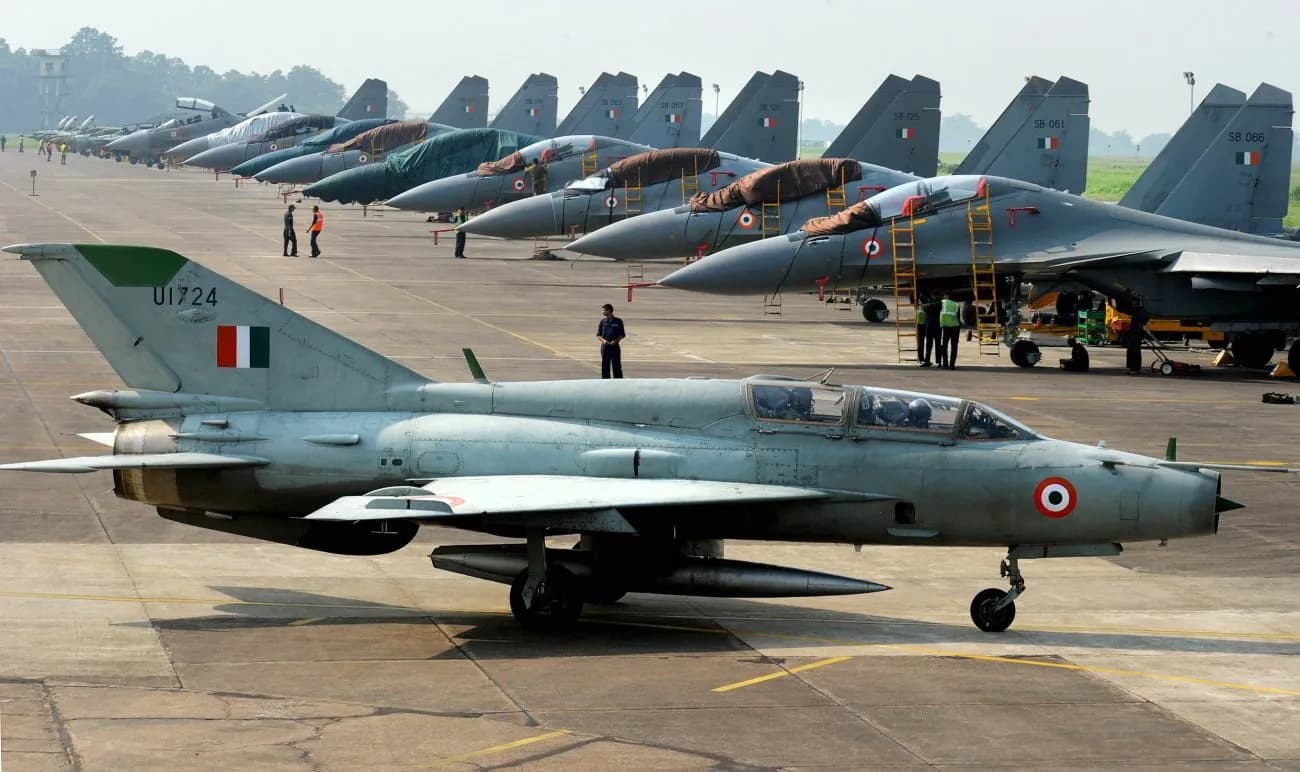
During the Cold War, the Mikoyan-Gurevich (MiG) design bureau held a near-monopoly on the frontline fighter market — producing aircraft such as the MiG-21 and MiG-29 — while Sukhoi concentrated on the attack aircraft segment. However, the unprecedented success of the Su-27 Flanker family ultimately allowed Sukhoi to eclipse the legendary MiG camp. Following the dissolution of the Soviet Union, MiG fell into severe financial difficulty, prompting the Russian government to merge both bureaus under the United Aircraft Corporation (UAC).
The heavy air-superiority fighter Su-27, originally designed in the 1970s, was renowned for its substantial weapons payload, exceptional manoeuvrability, and combat radius stretching hundreds of kilometres. Its high degree of platform adaptability allowed Sukhoi to successfully develop a range of derivative variants, including the Su-30, Su-35, and Su-34. By contrast, the Mikoyan-Gurevich MiG-29 was constrained by its airframe volume and payload capacity, making equivalent large-scale upgrades far more difficult.
After the Soviet collapse, domestic military R&D funding plummeted, forcing design bureaus to seek survival in international markets. The Su-27 series — particularly export variants delivered to India and China — generated considerable revenue for Sukhoi, enabling self-funded development of next-generation fighters. MiG actively promoted upgraded variants of the lightweight MiG-29 and the MiG-35, but was hampered by inherent limitations including short combat radius and persistent maintenance issues. The failure of the MiG 1.44 MFI (Multifunctional Frontline Fighter) stealth programme further cost MiG its standing as Russia's premier advanced fighter developer.
In 2006, to rescue a struggling aerospace industry, the Russian government consolidated Sukhoi, MiG, Tupolev, Yakovlev, and other leading design bureaus into a single state-owned conglomerate — the United Aircraft Corporation (UAC). Within this centralised management structure, Sukhoi effectively absorbed MiG's design heritage and assumed control of all major new fighter contracts, including Russia's fifth-generation stealth fighter, the Su-57.
MiG's legacy was built on small, fast, lightweight interceptors. This strategy proved effective at the height of the Cold War, but modern aerial combat places greater emphasis on long-range endurance, heavy weapons payloads (including long-range munitions), and sufficient internal space for advanced avionics and radar systems — precisely the strengths of Sukhoi's heavy fighter philosophy.
The Mikoyan Design Bureau
The Mikoyan Design Bureau (MiG) is one of Russia's foremost aerospace enterprises and a defining institution in military jet fighter design. Founded in 1939 by Artem Mikoyan and Mikhail Gurevich — after whom it is named — the bureau has produced more than 15,000 aircraft and is celebrated worldwide for its highly manoeuvrable fighters and interceptors.
MiG aircraft became the backbone of Soviet Air Forces and allied air arms across the globe, seeing direct combat against U.S. forces during the Korean War and the Vietnam War. The iconic MiG-15 was among the world's first successful swept-wing jet fighters to enter mass production; its performance during the Korean War stunned Western nations and forced the United States to urgently deploy the North American F-86 Sabre in response. The two aircraft were closely matched in their swept-wing designs, and they fought fierce aerial engagements over the so-called 'MiG Alley.'
The MiG-17, a direct development of the MiG-15, was produced in 10,900 examples. The twin-engine MiG-19 and its licensed derivatives reached a combined global production figure of 6,672, with China producing more than 4,500 under licence as the Shenyang J-6.
The MiG-21 is the highest-production supersonic jet fighter in aviation history, serving in more than 60 countries. At the peak of the Cold War, annual production averaged approximately 300 aircraft. India and China together produced or reverse-engineered more than 3,000 examples: India locally assembled multiple MiG-21 variants, making it the largest overseas operator until the type's retirement in 2025; China reverse-engineered the design to produce the Chengdu J-7, which was widely used domestically and exported extensively.
Casualties inflicted by the MiG-21 during the Vietnam War were significant enough to prompt the United States Navy to establish its Naval Fighter Weapons School — widely known as TOPGUN, or the 'MiG Killer' school.
During the 1971 Indo-Pakistani War, aerial combat between Indian Air Force MiG-21s and Pakistani Air Force F-104 Starfighters proved particularly intense. The highly manoeuvrable MiG-21FL overwhelmingly suppressed the F-104, shooting down several Starfighters and ultimately contributing to Pakistan's decision to retire the type.
The MiG-23 and MiG-27 Family
The MiG-23 and MiG-27 family represents the Soviet era's legendary variable-sweep 'swing-wing' series. The MiG-23 was configured as an air-superiority interceptor, while the MiG-27 was extensively redesigned as a dedicated ground-attack aircraft, distinguished by its slanted 'duck-bill' nose and heavier armour. Combined production of both types exceeded 6,000 aircraft. India was the largest export operator of the MiG-27.
The MiG-25 Foxbat is a supersonic interceptor and reconnaissance aircraft capable of reaching Mach 2.83, designed primarily to intercept high-altitude American bombers and reconnaissance aircraft. Its theoretical maximum speed of Mach 3.2 could be reached but at the cost of severe engine damage. The airframe was constructed predominantly from heavy stainless steel and nickel alloys rather than titanium, facilitating field maintenance.
In September 1976, Soviet pilot Viktor Belenko defected to Hakodate, Japan, in a MiG-25, revealing its true capabilities to the West for the first time — namely that it was optimised for high-speed interception and reconnaissance rather than close-in dogfighting. The incident also served as an indirect catalyst for accelerated U.S. development that gave rise to the F-15 Eagle. A total of 519 MiG-25s were produced.
The MiG-29 Fulcrum is a twin-engine air-superiority fighter that entered service in 1983, developed in parallel with the Sukhoi Su-27 to counter the F-15 and F-16. Renowned for its exceptional close-range dogfighting manoeuvrability, the MiG-29 continues to serve in more than 20 air forces worldwide; more than 1,600 were produced between 1981 and 2019.
The MiG-31 Foxhound is an all-weather supersonic interceptor developed from the MiG-25, with a maximum speed of approximately 3,000 km/h, and is expected to remain in service until 2030. The MiG-31K variant is capable of carrying the Kh-47M2 Kinzhal hypersonic air-launched ballistic missile.
The MiG-35 is a modernised Generation 4.5 multirole upgrade of the MiG-29, now integrated under UAC. Approximately 10 examples have been completed, and no potential buyers — including India and Egypt — have followed through with procurement orders.
The Sukhoi Family
The Sukhoi Design Bureau was founded by Pavel Sukhoi in 1939 and is headquartered in Moscow. It is now a core subsidiary of the state-owned United Aircraft Corporation (UAC), specialising in the design, construction, and testing of advanced military and civil aircraft.
The Su-7 Fitter is a highly swept-wing ground-attack aircraft, with 1,847 examples produced. The Indian Air Force employed the Su-7 extensively during the 1971 Indo-Pakistani War, flying nearly 1,500 sorties across six squadrons (140 aircraft), with individual pilots flying up to six sorties per day. Fourteen aircraft were lost, most to anti-aircraft fire, yet the type demonstrated exceptional battle-damage survivability.
The Su-9 Fishpot is a delta-wing interceptor with 1,150 produced, retired in 1979. The Su-15 Flagon is a twin-engine supersonic interceptor that entered service in 1965, with 1,290 produced and fully retired by 1996.
The Su-17 Fitter is a variable-sweep fighter-bomber derived from the Su-7 and was the Soviet Union's first variable-sweep production aircraft. A total of 2,867 were produced between 1967 and 1990, with export variants designated Su-20 and Su-22.
The Su-24 Fencer is a supersonic all-weather tactical bomber featuring variable-sweep wings, twin engines, and a side-by-side two-seat configuration — the first Soviet aircraft equipped with an integrated digital navigation/attack system. It first flew in 1967, entered service in 1974, and production ended in 1993 after more than 1,400 were built. The type continues to serve in Russia, Iran, Ukraine, and Algeria, among others.
The Su-25 Frogfoot is a single-seat, twin-engine subsonic close air support aircraft with a role analogous to the American A-10 Thunderbolt II. Mass production began in 1978 and ended in 2010, with more than 1,000 built. The Su-25 has seen combat in numerous conflicts, including the Soviet–Afghan War and the ongoing Russo-Ukrainian War.
The Su-27 Flanker is a twin-engine supersonic super-manoeuvrable fighter designed as a direct counterpart to large Western Generation 4 fighters such as the F-14 Tomcat and F-15 Eagle. A total of 809 examples were produced.
原文來源: 查看原文
FAQ
Newsletter
Subscribe to our Low-Altitude Industry Newsletter
Daily curated news on low-altitude economy and drone industry, delivered to your inbox.