LiDAR Technology Moves Beyond Autonomous Vehicles Toward Smart City Infrastructure
LiDAR technology, long associated with self-driving vehicles, is expanding into smart city applications. Fixed sensors mounted on intersections, bridges, and buildings now enable real-time traffic monitoring, urban planning, infrastructure inspection, and public safety detection. Combined with drones, LiDAR is becoming a cornerstone technology for intelligent city management.

Highlights
- LiDAR technology is expanding from autonomous vehicle sensors into fixed smart city infrastructure including intersections, bridges, and buildings.
- Fixed LiDAR sensors provide city managers with continuous real-time 3D data for traffic management, structural monitoring, and public safety detection.
- Drone-mounted LiDAR enables rapid large-area 3D mapping and post-disaster environmental assessment, improving urban management efficiency.
- Falling LiDAR sensor costs and rising computing power are making city-wide smart infrastructure deployment increasingly feasible.
- The shift from automotive to infrastructure applications represents a significantly larger addressable market for the LiDAR industry supply chain.
LiDAR Technology Moves Beyond Autonomous Vehicles Toward Smart City Infrastructure
For many, LiDAR technology remains synonymous with autonomous vehicles — sensors scanning roads, detecting pedestrians, cyclists, lane markings, and obstacles. That association is understandable, given that self-driving has long been one of the most high-profile applications driving LiDAR development.
However, the future of LiDAR extends well beyond the vehicle. A more compelling question is emerging: what new possibilities arise when LiDAR shifts from a moving vehicle platform to fixed smart infrastructure?
From On-Board to Roadside: A Shift in Role
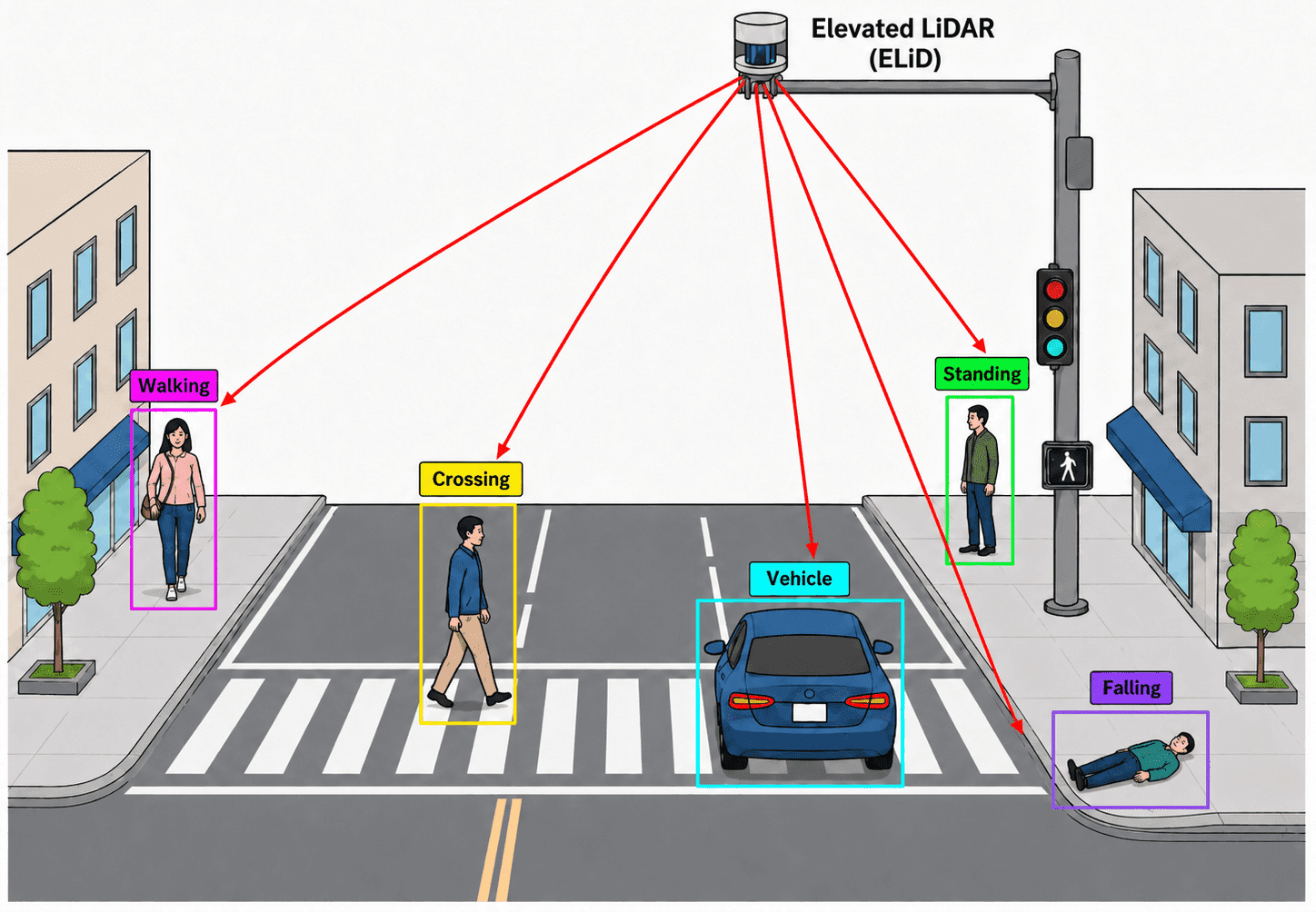
As smart city initiatives accelerate, LiDAR is evolving from an onboard sensor into a core component of urban infrastructure. Fixed LiDAR sensors installed at intersections, on bridges, and across building facades can continuously monitor traffic flow, detect anomalous events, and deliver real-time 3D environmental data to city managers.
Diverse Applications in the Smart City
Within the smart city framework, LiDAR's use cases are broad and growing:
- Traffic Management: Real-time monitoring of vehicle flow and pedestrian movement to optimize signal control and traffic routing
- Urban Planning: High-precision 3D modeling to support city design and construction decision-making
- Infrastructure Inspection: Monitoring deformation and structural damage in bridges, roads, and buildings
- Public Safety: Enabling security detection in public spaces without capturing identifiable imagery, addressing privacy concerns
Integration with Drone Technology
Drones equipped with LiDAR are playing an increasingly important role in smart city deployments. By combining UAV mobility with LiDAR precision, operators can rapidly complete large-area 3D mapping, infrastructure inspections, and post-disaster environmental assessments — significantly improving both the efficiency and accuracy of urban management.
Industry Outlook
LiDAR's expansion from autonomous driving into smart infrastructure represents a considerably larger market opportunity. As sensor costs continue to decline and computing power increases, widespread deployment of LiDAR across smart cities is becoming increasingly viable — creating new growth momentum across the broader industry supply chain.
原文來源: 查看原文