Lockheed Skunk Works C2 System Integrates Patriot, MRIC, and MADIS to Build Guam's Defensive Shield
The U.S. Army is leading the Guam Defense System Joint Program Office through a series of missile defense tests running through August 2026. A command-and-control system developed by Lockheed Martin's Skunk Works integrates the Patriot missile system, the Marine Corps' Mid-Range Intercept Capability (MRIC), and MADIS into a unified battle network — serving as the blueprint for the Pentagon's 'Golden Dome' initiative.

Highlights
- Lockheed Martin Skunk Works開發的C2系統將Patriot、MRIC與MADIS整合為統一作戰網絡,作為五角大廈「黃金穹頂」計畫的藍圖範本。
- MRIC電池搭載SkyHunter攔截彈(Iron Dome美製版),III MEF已部署至關島參加Valiant Shield 2026演習並進行實彈展示。
- 愛國者PAC-2 GEM實彈演習及MADIS Mk 1/Mk 2測試將於7月24日在帛琉的Tenacious Archer 2026演習中進行。
- 美國陸軍Task Force Talon預計於2026年10月改編為第43防空砲兵團第3營(43rd ADAR),愛國者強化掩體今夏趕工建設中。
- Skunk Works為美國空軍秘密開發的防空系統已在太平洋部署,可融合數十套雷達圖像為單一整合畫面,提供自動接戰能力。
Lockheed Skunk Works C2 System Integrates Patriot, MRIC, and MADIS to Build Guam's Defensive Shield
The U.S. Army's Program Executive Office (PEO) Missiles and Space is leading the Guam Defense System (GDS) Joint Program Office through a series of missile defense and combat system evaluations expected to run through August 2026. The tests are designed to pave the way for an Initial Operational Capability (IOC) on Guam — one that gives the island the ability to defeat both ballistic and non-ballistic threats under a unified command-and-control (C2) operational picture. That integrated picture is being built by Lockheed Martin's Skunk Works division.
Guam's defense architecture has been designated by the Pentagon as the blueprint for its 'Golden Dome' initiative, driving the development of new capabilities to strengthen protection of the strategically vital island and its rapidly expanding military installations against long-range threats.
Intensive Live-Fire Test Schedule
Multiple missile defense tests are scheduled to begin in late June 2026, including live-fire exercises involving the U.S. Marine Corps' Mid-Range Intercept Capability (MRIC) system and the U.S. Army's Patriot missile system. Both will be conducted during the Valiant Shield 2026 joint exercise — a large-scale force employment field exercise designed to stress-test U.S. Indo-Pacific Command (USPACOM) strategy and tactics under high-intensity conflict scenarios. Additional tests are scheduled for late July in Palau, several hundred kilometers to the south.
Both MRIC and Patriot are part of the growing GDS network, which comprises dispersed radar systems, hardened missile launch positions, and extensive underground shelters aimed at providing comprehensive protection for Guam against an anticipated large-scale Chinese missile and drone attack. According to a U.S. military official familiar with the programs, hardened shelters and platforms for the Patriot anti-ballistic missile composite unit are currently under construction this summer, though the unit itself has not yet been deployed.
The Army's current missile defense unit on the island, Task Force Talon, is scheduled to be redesignated as the 3rd Battalion, 43rd Air Defense Artillery Regiment (43rd ADAR) in October 2026. The 43rd ADAR has historically served as a trailblazer for Army modernization, having been the first unit to field the Israeli-licensed Iron Dome battery in 2021.
MRIC: The Marine Corps' Answer to Cruise Missiles and Drones
The Marine Corps has now assumed the Army's former role of providing area cruise missile and drone defense, using a system closely related to Iron Dome — the Mid-Range Intercept Capability (MRIC). Designed to counter cruise missiles and drones, MRIC employs the domestically manufactured version of the Iron Dome interceptor, the SkyHunter, and builds a battery configuration on the foundation of Israel's combat-proven interceptor that is compatible with existing Marine Corps radar and communications networks.
III Marine Expeditionary Force (III MEF) personnel have deployed a MRIC battery to Guam to simulate protecting critical island infrastructure against simulated aerial and missile threats during Valiant Shield 2026, with a live-fire demonstration scheduled during the exercise.
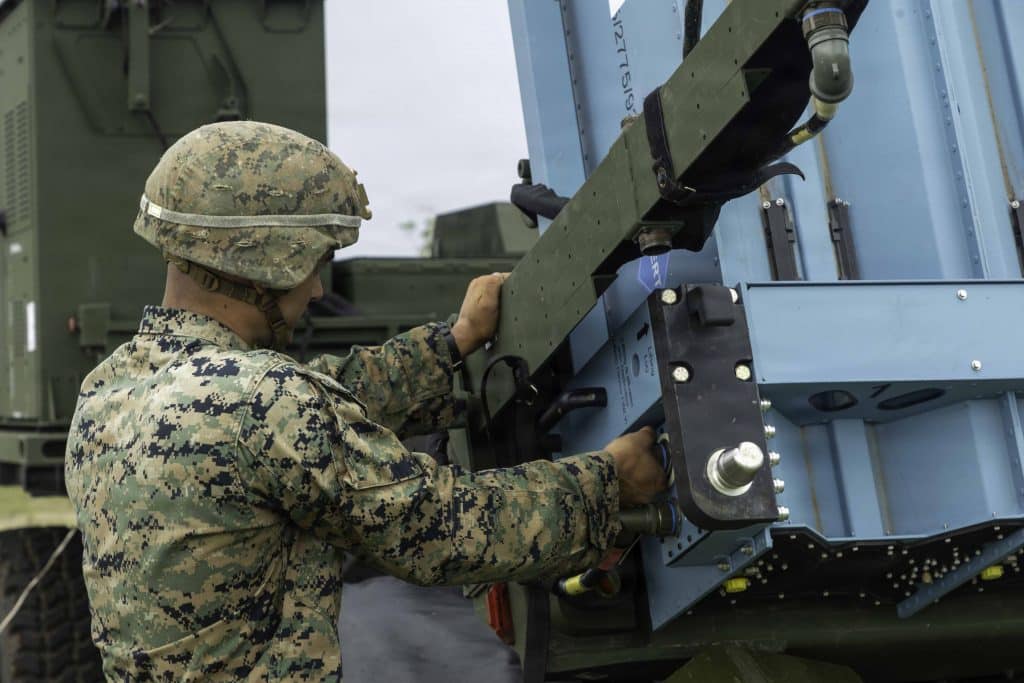
U.S. Marine Corps Corporal Tyler Whitacre, an engagement control operator with III MEF, calibrates MRIC equipment at Mason Range, Guam, on June 24, 2026, in support of Valiant Shield 2026. (U.S. Marine Corps photo by Cpl. Benjamin Catindig)
According to a statement provided by III MEF to Naval News, MRIC will subsequently be integrated into the Marine Corps' forward-deployed force.
III MEF Commanding General Lt. Gen. Roger Turner stated: "Our modernization efforts and forward-deployed posture send a clear message to the region. By enhancing our defensive capabilities with MRIC, we are increasing our ability to fight alongside our allies and partners. We want them to be confident that, with these technological advancements, III MEF is prepared and ready to respond in a time of crisis."
MRIC is specifically designed to support operations within an adversary's weapons engagement zone — precisely the environment in which the Marine Corps is most likely to be deployed. Last week, a III MEF unit based in Okinawa received its first batch of stand-in weapons, which will operate in coordination with MRIC batteries within the First Island Chain to provide force protection in actual combat scenarios.
Patriot and the Palau Exercises
U.S. Army Patriot batteries are also scheduled to participate in live-fire exercises using the PAC-2 Guidance Enhanced Missile (GEM). The Army will further validate test results during Tenacious Archer 2026, a joint exercise held in Palau that will assess Army air and missile defense capabilities. The Marine Corps also plans to field its short-range Marine Air Defense Integrated System (MADIS) Mk 1 and Mk 2 variants for testing during the exercise.
According to briefing slides reviewed by Naval News, U.S. Army drones and unmanned surface vessels will also participate in the exercise, which is scheduled to kick off on July 24.
Koror, Palau — An M903 Patriot Launching Station from D Battery, 1st Battalion, 1st Air Defense Artillery Regiment fires a PAC-2 interceptor during the Tenacious Archer 25 live-fire event on August 21, 2025. (U.S. Army photo by Capt. Frank Spatt)
Chinese Threat Drives Guam Defense Prioritization
China has developed a range of advanced missiles capable of striking the island chain's most critical airfields and ports, making the defense of Guam a top priority for USPACOM. China's rapidly modernizing inventory of long-range missiles is placing enormous pressure on the Pentagon's existing intercept capabilities.
USAPACOM has significantly strengthened its air defense capabilities over the past decade, primarily targeting long-range threats to regionally deployed and stationed personnel. One air defense system, secretly developed by Lockheed Martin's Skunk Works for the U.S. Air Force, has been deployed in the Pacific region and is capable of fusing imagery from dozens of radar systems into a single integrated picture, providing battlefield situational awareness and automated engagement capability to defend against the long-range missile attacks expected in a Pacific conflict.
The C2 equipment developed by Skunk Works enables seamless interoperability between MRIC, Patriot, and MADIS, building a unified operational network for the Guam Defense System.
Strategic Importance of Guam and the CNMI
Defending Guam and the Commonwealth of the Northern Mariana Islands (CNMI) has become critical to U.S. operational success across the Pacific. International airports throughout the CNMI and expanded basing access at reclaimed military installations have significantly increased available logistical throughput, making the island group a more important — and more attractive — target. The GDS aims to neutralize any incoming threat with a 360-degree protective shield.
原文來源: 查看原文
FAQ
Newsletter
Subscribe to our Low-Altitude Industry Newsletter
Daily curated news on low-altitude economy and drone industry, delivered to your inbox.